


Key Points
Nebius and CoreWeave operate in a fast-growing market that should ensure solid long-term growth.
Both companies are sitting on massive backlogs.
However, there is a significant difference between the valuations of the two companies, and investors may prefer one over the other depending on their risk profile.
The demand for artificial intelligence (AI) data centers is exceeding supply, which isn't surprising, as major hyperscalers and AI companies are sitting on massive contractual backlogs that they need to fulfill.
Bank of America estimates that the combined backlog of Microsoft, Oracle, Amazon, and Google was worth a whopping $2.3 trillion at the end of the second quarter. That doesn't include the backlogs of other companies offering AI services in the cloud, suggesting that the actual number could be much higher.
Missed Nvidia in 2009? This Rare Signal Is Flashing Again. In 2009, a "Double Down" signal flashed for a little-known chipmaker called Nvidia. For the first time in years, that same "Total Conviction" signal is flashing for a company 1/100th the size of Nvidia. Continue »
Not surprisingly, dedicated AI data centers are in high demand, which explains the phenomenal growth that Nebius Group (NASDAQ:NBIS) and CoreWeave (NASDAQ:CRWV) have witnessed over the past year. Both companies delivered solid Q2 results and are on track to sustain healthy long-term growth.
However, if you have to choose one of these two AI stocks for your portfolio, which one should it be? Let's find out.

Image source: The Motley Fool.
CoreWeave and Nebius are built for solid long-term growth
CoreWeave and Nebius are neocloud infrastructure companies that build dedicated AI data centers equipped with high-end hardware, including graphics processing units (GPUs) and custom processors. They rent out their infrastructure to major hyperscalers and other customers looking to run AI services in the cloud.
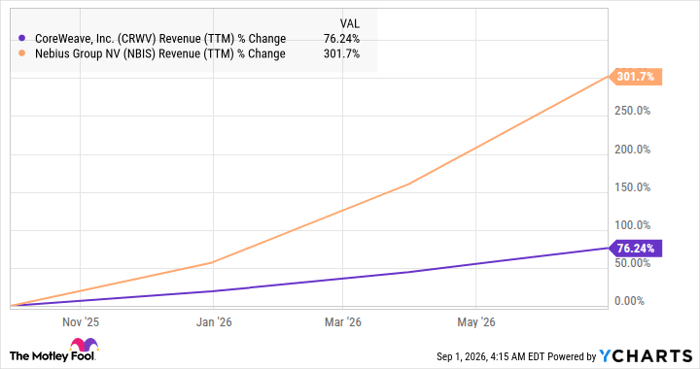
The business model has been quite successful, as evident from the rapid revenue growth both companies have been clocking.
CRWV Revenue (TTM) data by YCharts
CoreWeave's revenue, for instance, shot up by 112% year over year in the second quarter of 2026 to $2.6 billion. Nebius' growth was even more fantastic, with its top line jumping by a whopping 454% year over year to $582 million. Don't be surprised to see both companies sustaining such fantastic growth rates over the long run.
That's because the neocloud infrastructure market is growing at an incredible pace. Synergy Research Group estimates that the neocloud infrastructure market generated $25 billion in revenue in 2025. It is expected to grow 16x by 2031, generating $400 billion in revenue at the end of the forecast period. That translates into a compound annual growth rate (CAGR) of 58%.
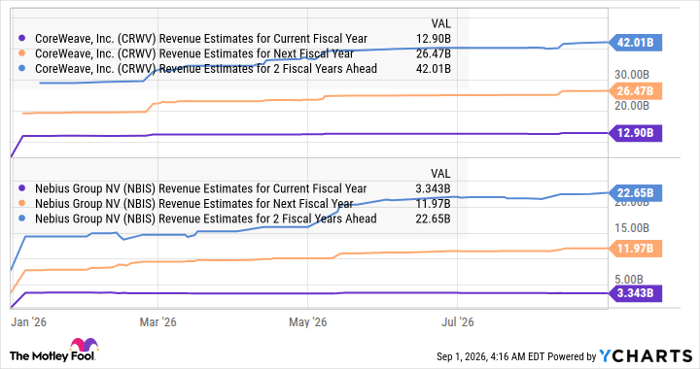
So, Nebius and CoreWeave are at the beginning of a terrific growth curve. Also, both companies have a solid backlog that should ensure outstanding growth in the long run. CoreWeave, for example, had a revenue backlog of $104 billion at the end of Q2, up 246% year over year. Though Nebius doesn't disclose its backlog, its figure could be close to $50 billion or more.
The backlogs indicate why analysts expect both companies to grow at a terrific pace in the future.
CRWV Revenue Estimates for Current Fiscal Year data by YCharts
In all, the secular growth of the neocloud infrastructure market will be a tailwind for Nebius and CoreWeave in the long run. However, there is a stark difference in their stock market performance so far this year.
While Nebius stock has surged 146% in 2026, CoreWeave stock has gained a paltry 18%, as of this writing. CoreWeave's poor returns can be attributed to the company's ballooning expenses. The company's loss per share increased by 90% year over year in the second quarter, driven by its aggressive AI infrastructure build-out.
Nebius, however, reduced its adjusted net loss by 64% to $33.2 million in Q2. Nebius' stronger bottom-line performance can be attributed to its software stack, as customers have been increasing the usage of its Token Factory to build AI models, run inference applications, and deploy AI models at scale, among other things.
So, does this make Nebius a better AI cloud stock than CoreWeave?
The verdict
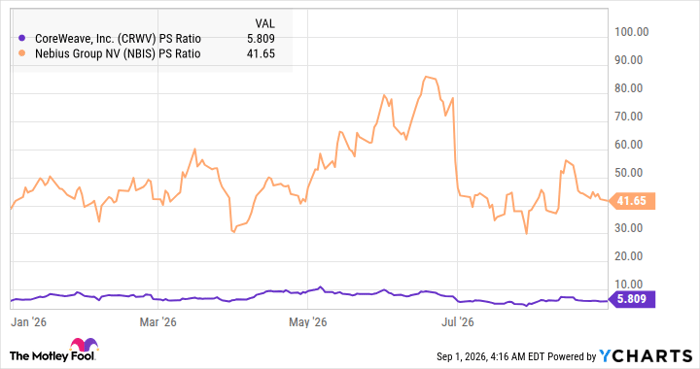
Nebius' improving bottom-line performance makes it look like an attractive bet compared to CoreWeave. Also, Nebius is clocking a significantly faster growth rate. However, Nebius stock trades at a significantly expensive sales multiple.
CRWV PS Ratio data by YCharts
Meanwhile, CoreWeave has a stronger revenue backlog, providing greater visibility into its future. As such, investors seeking a mix of value and growth may consider buying CoreWeave despite its underperformance in 2026. But at the same time, even Nebius could deliver solid gains to investors over the long run, driven by its ability to deliver phenomenal growth.
So, investors can consider buying any of these two AI stocks for their portfolios depending on their risk profile, as both of them can soar impressively over the long run on the back of booming AI cloud infrastructure demand.
Bank of America is an advertising partner of Motley Fool Money. Harsh Chauhan has no position in any of the stocks mentioned. The Motley Fool has positions in and recommends Microsoft and Oracle. The Motley Fool has a disclosure policy.