


CorVel stock has delivered a 23.5% gain over the past five years, yet current valuation checks suggest the shares are not an obvious bargain. The intrinsic value estimate points to a price that is slightly below where the stock trades today, while market multiples appear richer.
- Over the past five years, CorVel has returned 23.5%, which points to moderate long-term value creation but not a runaway winner.
- Future cash flow growth and margin resilience in CorVel's workers compensation and medical cost management services can support the valuation, while any pressure on claim volumes or pricing may weigh on how much investors are willing to pay for those cash flows.
- The broader valuation checks, including a fairly valued Discounted Cash Flow (DCF) estimate and richer trading multiples, indicate CorVel looks on the expensive side overall rather than a clear bargain, with only 1 of 6 checks screening as attractive.
For investors, the debate is whether CorVel's current share price already reflects a full view of its cash flow potential, or if there is still room for value to build from here.
Stress test your expectations for CorVel by comparing it with 45 high quality undervalued stocks, which combine stronger value checks with solid fundamentals.
Where Does CorVel Sit on Cash Flow?
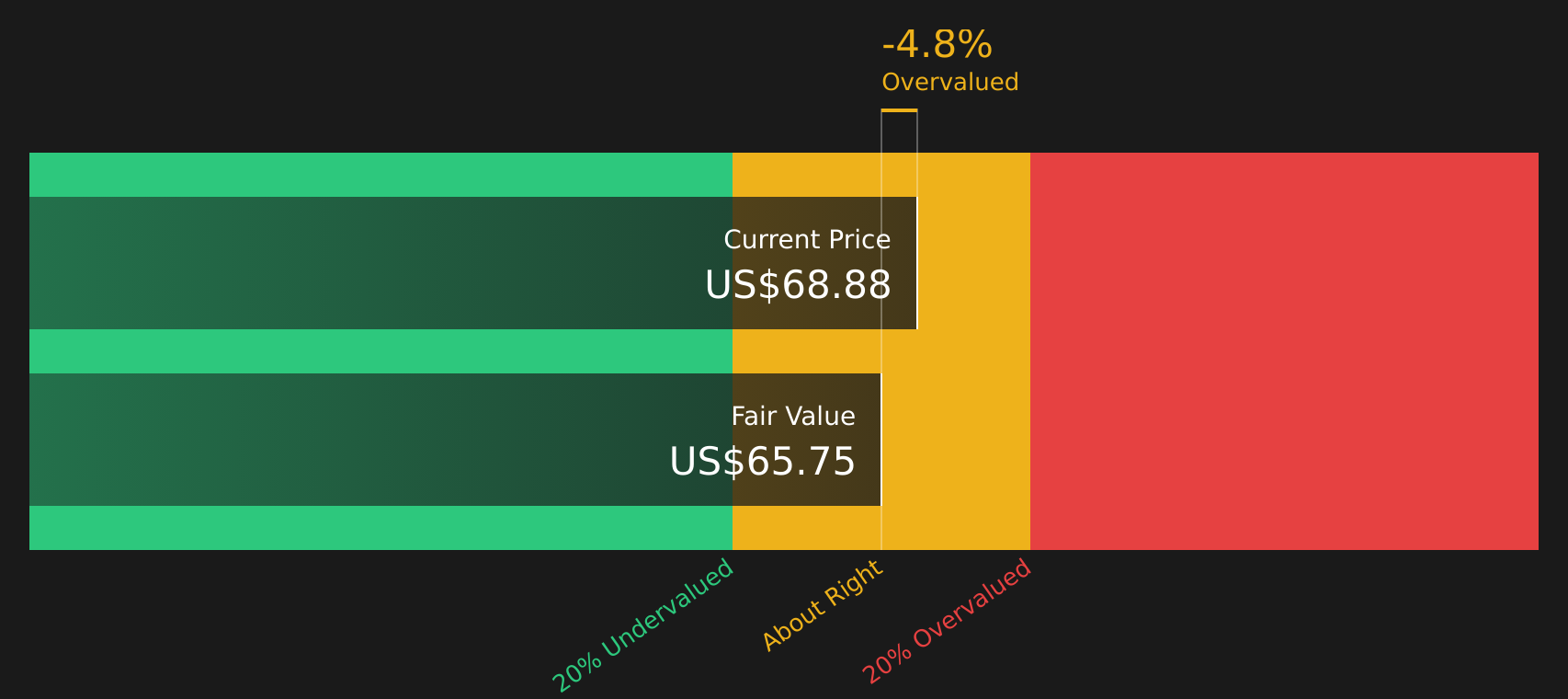
The Discounted Cash Flow (DCF) model estimates what CorVel’s future cash flows could be worth in today’s dollars. For CorVel, the model uses latest twelve month free cash flow of about $110 million and assumes those cash flows continue to grow at a measured pace rather than swinging sharply higher or lower.
On these assumptions, the DCF points to an intrinsic value of about $65.75 per share. That sits slightly below the current share price, which implies the stock trades at roughly a 4.8% premium to this cash flow based estimate. The gap is not huge, but it suggests the market is already pricing CorVel for steady execution rather than leaving a wide margin of safety.
On this DCF view, CorVel appears roughly fairly valued with only a small tilt toward being somewhat expensive at today’s price.
CorVel is fairly valued according to our Discounted Cash Flow (DCF), but this can change at a moment's notice. Track the value in your watchlist or portfolio and be alerted on when to act.
Does CorVel Look Pricey on Earnings?
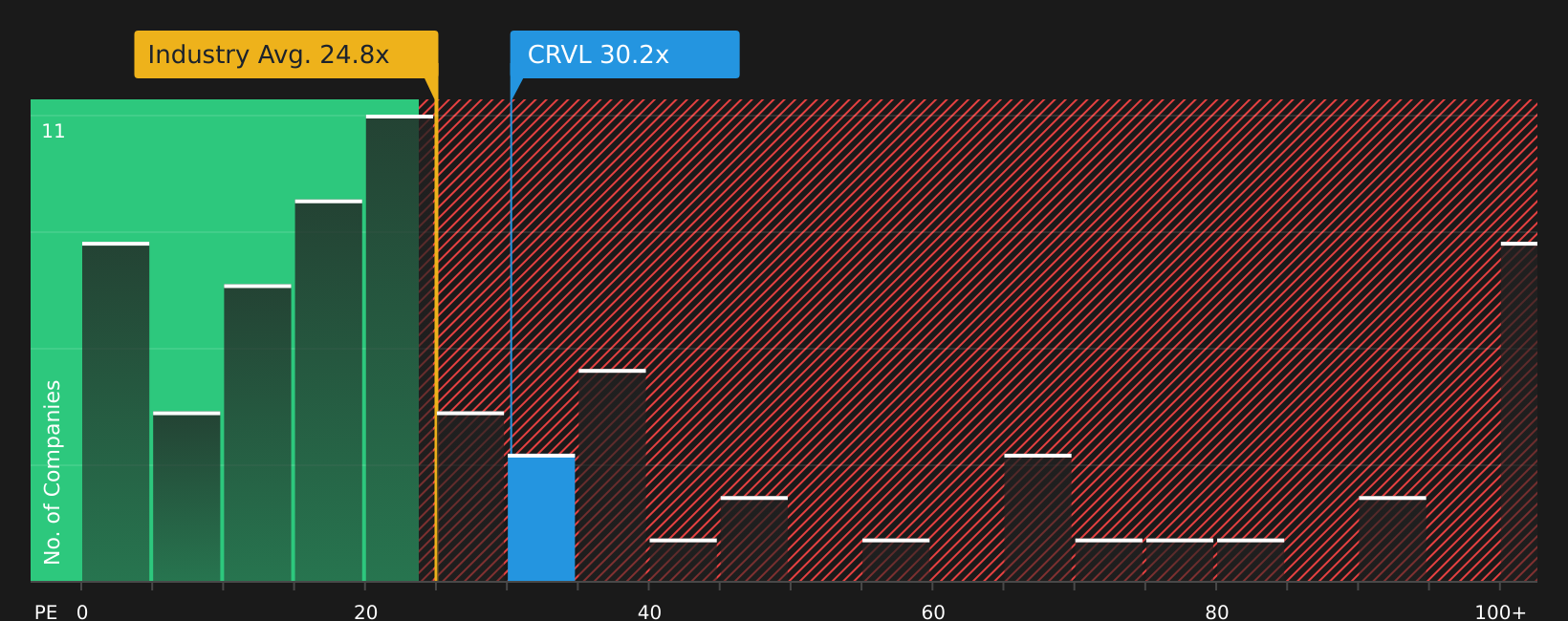
The P/E ratio suits CorVel because earnings are a key yardstick for a mature, profitable services business. CorVel trades on a P/E of about 30.2x, which is higher than the Healthcare industry average of roughly 24.8x. That means you are paying a larger price tag for each dollar of CorVel earnings than for the typical healthcare stock.
The stock also screens as expensive versus its peer group, where the average P/E sits around 53.5x but likely includes some very high multiple outliers. Taken at face value, CorVel looks overvalued relative to the industry benchmark, even if the peer average suggests investors sometimes accept richer earnings multiples in this space.
On the P/E multiple alone, CorVel stock currently screens as overvalued compared with the broader Healthcare industry.
See what the numbers say about this price — find out in our valuation breakdown.
The CorVel Narrative: What Would Justify Today's Price?
Simply Wall St Narratives for CorVel pick up where the valuation checks leave off. They spell out which future paths for CorVel's growth, margins and earnings would need to play out for the stock to look meaningfully cheaper or more expensive than today’s price on the Community page. Each narrative links its number to a specific view on how CorVel's growth, profitability and risks might evolve, so you can revisit those assumptions as new information emerges.
Add your view on where CorVel's growth, margins and execution go from here, and put a clear number-driven case on the stock that others can test against future results. This is a chance to be one of the first voices in the Simply Wall St community to set out a narrative and see how it holds up over time.
Do you think there's more to the story for CorVel? Head over to our Community to see what others are saying!
The Bottom Line
CorVel looks roughly fully priced on the current numbers. The Discounted Cash Flow (DCF) estimate sits a little below the market price, while the P/E multiple screens as overvalued compared with the wider Healthcare industry. With a low overall value score, the burden of proof now rests on CorVel sustaining cash flow strength and margins that justify paying up for the stock. The key question is whether earnings quality and pricing power hold well enough to support today’s premium, or whether investors eventually demand a cheaper entry point.
This article by Simply Wall St is general in nature. We provide commentary based on historical data and analyst forecasts only using an unbiased methodology and our articles are not intended to be financial advice. It does not constitute a recommendation to buy or sell any stock, and does not take account of your objectives, or your financial situation. We aim to bring you long-term focused analysis driven by fundamental data. Note that our analysis may not factor in the latest price-sensitive company announcements or qualitative material. Simply Wall St has no position in any stocks mentioned.
Have feedback on this article? Concerned about the content? Get in touch with us directly. Alternatively, email editorial-team@simplywallst.com