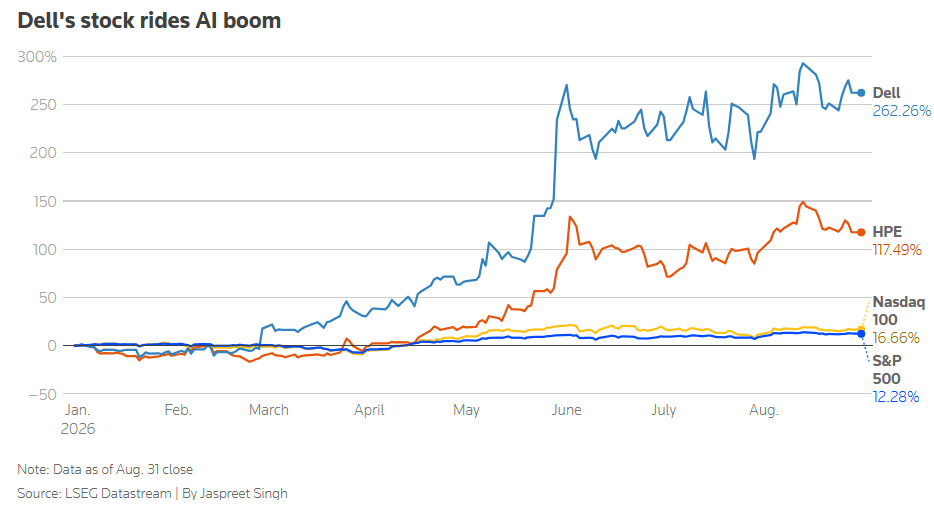
The Zhitong Finance App learned that Dell Technology (DELL.US) released a financial report that far exceeded market expectations after the market on Tuesday, and once again drastically raised its annual revenue and profit forecast, showing its strong momentum in the AI server field. Driven by this news, the company's stock price rose by about 11% after the market.
Financial reports show that in the second quarter of the 2027 fiscal year ending July 31, Dell achieved revenue of 46.97 billion US dollars, an increase of 58% over the previous year, higher than analysts' average forecast of 44.92 billion US dollars. Net profit for the quarter was US$4.13 billion, or US$6.34 per share, a sharp increase of more than three times that of US$1.16 billion and US$1.70 per share in the same period last year. Adjusted earnings per share (excluding expenses related to equity incentives) were $7.04, far higher than analysts' expectations of $4.92.
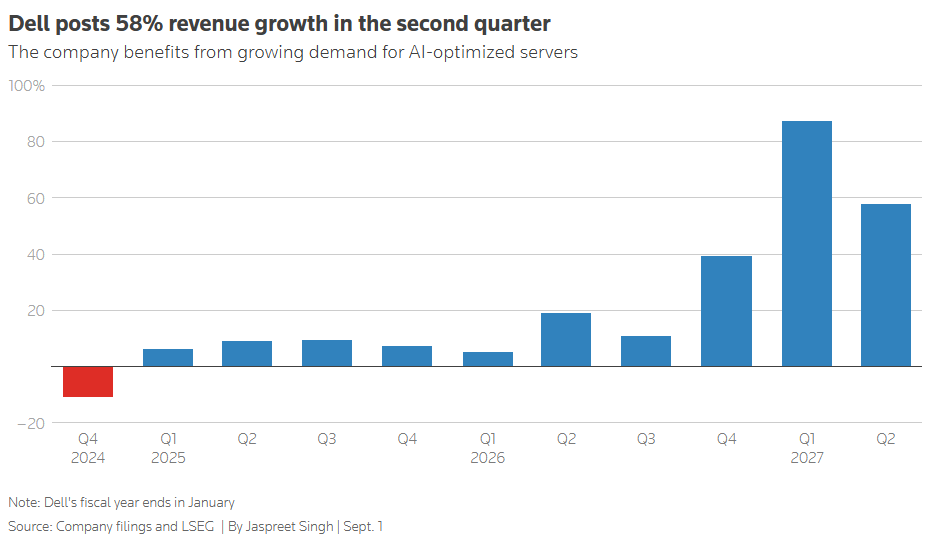
Looking ahead, Dell gave strong guidance for the third fiscal quarter: adjusted earnings per share are expected to be $6.50, and revenue is $49 billion, which means revenue will increase by about 81% year over year. Analysts had previously averaged an adjusted earnings per share of $4.49 and revenue of $41.42 billion for the fiscal third quarter.
The company also raised its full-year results forecast for the 2027 fiscal year significantly. Dell currently expects full-year adjusted earnings of $25.50 per share, with revenue of $1920 billion; analysts had anticipated full-year adjusted earnings of approximately $18.92 billion per share, with revenue of $172.67 billion. In contrast, the full-year guidance given by the company in May of this year was adjusted earnings per share of $17.90 billion, with revenue ranging from $165 billion to $169 billion.
Among them, the annual revenue forecast for AI-optimized servers was raised to 74 billion US dollars, compared with the company's previous forecast of 60 billion US dollars. This level is equivalent to a year-on-year increase of approximately 200%. Six months ago, Dell's annual growth forecast for the AI server business was only 103%.
Dell Chief Operating Officer Jeff Clark said in an analyst conference call that product price increases due to rising investment costs have boosted revenue guidance to a certain extent.
“Over the past 12 months, we have received over $130 billion in AI server orders,” Clark said. He also revealed that the number of AI server customers has exceeded 6,500, and demand is expanding from new cloud vendors and sovereign entities to enterprise customers. By the end of the second fiscal quarter, Dell's backlog of AI server orders reached US$95 billion, which is seen as an important leading indicator of future revenue.
Strong infrastructure business, recovery in demand for traditional servers
By business, Dell Infrastructure Solutions Group (ISG) achieved revenue of US$31.78 billion in the second fiscal quarter, an increase of 89% year over year, higher than analysts' average expectations of US$29.61 billion.
Among them, AI-optimized servers contributed US$16.4 billion in revenue, which was higher than market expectations of US$16.07 billion. Storage business revenue was $4.85 billion, up nearly 26% year over year. Revenue from traditional servers and network equipment surged 122% year over year to reach US$10.53 billion.
“We are seeing more and more customers require significant CPU computing power to support AI and intelligent workflows, and these workloads are creating incremental demand for traditional servers,” Clark said. He added that in the past two quarters alone, the revenue generated by Dell's traditional server and networking business has been almost equivalent to the level of any full fiscal year in the company's history.
Dell's Customer Solutions Group (CSG) for consumer and business customers achieved revenue of $15.03 billion in the second fiscal quarter, up 20% year over year, but slightly below analysts' expectations of $15.08 billion. The division's operating profit was $1.1 billion, up 42% year over year.
Clark said that earlier this year, the company noticed signs of weakness in the PC market in the second half of the year, so it “optimally allocates resources to the infrastructure business.” Despite a decline in overall shipments in the PC industry, Dell's PC business sales continued to grow due to rising costs such as memory chips driving up sales prices. The company protected profitability by passing on higher memory costs to customers.
In terms of cost control, Dell's operating expenses for the second fiscal quarter represented only 8% of sales, the lowest level in the company's history.
Large orders and market confidence
In fact, before the earnings report was announced, Dell had obtained several important contracts: the company received a software contract worth 9.7 billion US dollars from the US military, while AI cloud infrastructure provider IREN (IREN.US) agreed to purchase $1.6 billion worth of Dell hardware, including servers equipped with NVDA.US (NVDA.US) chips. Additionally, Dell has won clients such as CoreWeave Inc. (CRWV.US) and Nscale Global Holdings Ltd.
Last month, Nvidia and Ultra Micro Computer (SMCI.US) both released strong performance forecasts, further strengthening investors' confidence in the continuation of the AI boom. Currently, the market's outlook for AI infrastructure spending is still optimistic. S&P Global Ratings predicts that AI infrastructure spending will exceed 1.3 trillion US dollars by 2027. Dell's rival HPE.US (HPE.US) and ultra-microcomputer shares also rose after Dell rose after the market.
Michael Dell, founder, chairman, and CEO of Dell, posted on social networking platform X after the earnings report was released: “There's an old Texas saying — probably I just made up — if you keep earnings per share above 200% year over year, good things will happen.” According to statistics, Michael Dell is currently the fifth richest person in the world.
Furthermore, US President Trump bought Dell shares since coming back to power last year, and recommended buying Dell computers again in July. Dell stock has attracted the attention of some investors as a result. As demand for AI servers continues to expand, Dell has become one of the popular targets betting on AI infrastructure growth.
As of Tuesday's close, Dell's stock price was 425 US dollars. The cumulative increase this year had reached 236%. The S&P 500 index rose only 11% during the same period. However, the stock has fallen by about 14% since reaching a stage high on August 13.