


The Zhitong Finance App learned that Broadcom (AVGO.US), one of the biggest winners of the global AI craze, announced the results data for the third quarter of the 2026 fiscal year up to the end of the 2026 fiscal year after the US stock market closed on September 2 (Thursday morning Beijing time), as well as the management's latest future outlook. According to performance data, Broadcom's revenue for the third fiscal quarter was US$29.591 billion, up 86% year on year, higher than Wall Street analysts' recent strong average estimate of about US$29.5 billion. Among them, the overall revenue of AI semiconductors around AI ASIC (Google TPU is an ASIC technology route) and Ethernet switch chips was US$16.7 billion, up 221% year over year and 54% month-on-month, exceeding the average forecast of US$15.9 billion.
In terms of the much-focused future outlook, management further anticipates that AI semiconductor revenue will expand massively to about $58 billion in fiscal 2026 (management unexpectedly raised the 2026 AI semiconductor revenue guidance outlook from $56 billion to $58 billion at the performance meeting) to $115 billion in fiscal 2027, which is expected to reach an astonishing $230 billion in fiscal 2028, and is expected to earn more than $30 per share in fiscal 2028 — significantly higher than Wall Street analysts' consistent upward expectations of about $26.5 billion.
Broadcom is one of the core chip suppliers for Apple and other major technology companies. It is also the core supplier of high-performance Ethernet switch chips for large-scale AI data centers around the world, and AI ASIC, a customized self-developed AI chip for cloud computing giants that are critical to AI training/inference.
Broadcom's strong performance and future prospects can be described as highlighting that with the advent of the AI inference era, AI ASIC computing power systems with higher cost performance and energy efficiency ratios under the surge in demand for cloud AI inference computing power and the “micro-training” trend focusing on embedding large AI models into business operations have had a strong impact on Nvidia's AI chip monopoly position with nearly 90% market share. Broadcom's performance and strong outlook, as well as Nvidia's previously announced explosive results and the forecast that overall revenue will grow by about 70% in the 2028 fiscal year can be described as showing that global demand for artificial intelligence computing power is still far from peaking.
The AI computing power infrastructure construction process led by global AI application leaders such as OpenAI/Anthropic and hyperscale cloud computing vendors such as Google, Amazon, and SpaceX is being completely upgraded from “group procurement of Nvidia GPUs” to a heterogeneous computing system with large-scale collaborative operation of Nvidia GPU+AMD GPU+self-developed AI ASIC (AI ASIC) /XPU+CPU/DPU. As the AI large model architecture gradually stabilized and the number of token calls in various industries around the world showed exponential growth, highly concurrent AI inference workloads became more and more suitable for reducing the cost per token through customized ASIC chips.
In other words, AI training operator processes and cutting-edge AI workloads with the most complex architectures and the fastest changing rate still require AI GPU clusters — cutting-edge model pre-training, reinforcement learning, and rapidly changing new operators still rely more on GPU programmability, CUDA ecosystem, and NVLink/NVSwitch cluster capabilities, while large-scale AI inference workloads around mature and open source AI models, Copilot proxy AI workflows, and AI agents (AI agents) are increasingly suitable for dedicated self-developed AI ASIC chip.
According to institutions such as Morgan Stanley and Wedbush Securities that continue to be optimistic about the investment prospects of the AI computing power industry chain, the almost limitless cutting-edge computing power in the AI reasoning era and the computing power requirements surrounding AI agents have enabled AI ASICs to grow into an important component of the second trillion-level computing power ecosystem without destroying GPU demand — instead further strengthening the AI computing power industry chain investment logic that “the AI semiconductor supercycle is not a single GPU cycle, but an entire data center silicon content increase cycle”.
Short-term guidance put the brakes on, and the long-term computing power blueprint is amazing: Broadcom rushed to generate $230 billion in AI semiconductor revenue in two years, challenging Nvidia's GPU hegemony
Broadcom's revenue for the third fiscal quarter of fiscal year 2026 was US$29.591 billion, up 86% year on year, higher than Wall Street analysts' average forecast of US$29.5 billion; adjusted earnings per share were US$3.32, up 96% year over year, higher than Wall Street's average forecast of US$3.23; the overall revenue of the AI semiconductor business was US$16.7 billion, up 221% year on year and 54% month on month, exceeding the average forecast of US$15.9 billion.
Broadcom's total revenue guide for the fourth fiscal quarter was US$34.8 billion, up 93% year on year, slightly lower than Wall Street's average forecast of US$35.1 billion. This was the most direct trigger for Broadcom's stock price to be pressured after the release of financial reports and performance forecasts. Broadcom's stock price fell more than 6% after the US market, then rose nearly 3% and then continued to fluctuate; however, Broadcom's AI semiconductor revenue guide for the fourth fiscal quarter reached US$21.7 billion, up 236% year on year, slightly higher than Wall Street's forecast of about US$21.3 billion. At the conference call, management further predicted that AI chip revenue would increase from about US$58 billion in FY2026 to US$115 billion in FY2027, US$230 billion in FY2028, and expected earnings per share to exceed US$30 billion in FY2028.
The market's demand for Broadcom's performance growth and outlook is not only “growing fast,” but “whether it can continue to exceed expectations.” Before the financial report was announced, Broadcom's stock price had already fallen by more than 20% from the record high set in early June. At one point, the market value evaporated by more than 520 billion US dollars, but before June 2, Broadcom's stock price rose by as much as 50% during the year. Under the AI chip leader valuation system, investors want management to provide long-term AI computing power-related revenue visibility similar to Nvidia's last week, and replicate Nvidia-style strong growth guidelines.
However, Broadcom's current results only gave regular guidance on revenue for the fourth fiscal quarter, and the overall revenue guidance was slightly lower than expected, and did not fully meet the market's expectations for a longer-term, more quantitative overall revenue path. As a result, in an environment of low liquidity after the market, the market increased selling pressure.
The core logic behind Broadcom's strong growth in performance is not that ASIC will immediately replace Nvidia's AI GPUs, but rather that hyperscale cloud vendors are building a heterogeneous computing power system of “general-purpose GPU+ self-developed and customized XPU”: GPUs undertake general training and rapid iteration, while ASICs such as TPU optimize performance per watt, energy efficiency ratio per token, and supply autonomy for stable scale training, inference, and internal workloads. Broadcom also masters the interconnection of customized AI accelerators with high-speed interconnections within data centers, SerDes, switching chips, and Ethernet network infrastructure, so it can benefit not only from the “number of computing power chips”, but also from the increase in the value of high-speed interconnection due to increasing network complexity and demand due to the expansion of clusters.
Broadcom's GAAP operating profit for the third fiscal quarter was US$15.955 billion, up 171% year on year; GAAP net profit was US$13.088 billion, up 216% year over year; GAAP diluted earnings per share were US$2.68, up 215% year over year. Non-GAAP operating profit was US$20.95 billion, up 92% year on year; non-GAAP net profit was US$16.372 billion, up 95% year over year. Operating cash flow was US$14.197 million, up 98% year on year; after deducting capital expenditure of US$532 million, free cash flow was US$13.665 million, up 95% year on year, and free cash flow rate remained at 46%.
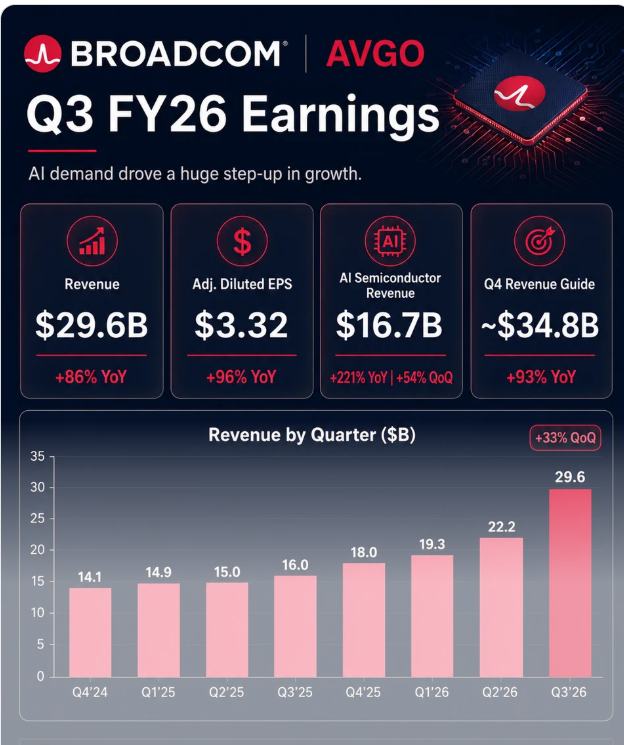
Semiconductor solutions revenue for the third fiscal quarter was US$20.839 billion, up 127% year on year, accounting for 70% of total revenue; infrastructure software revenue was US$8.752 billion, up 29% year on year, accounting for 30%. Cash and cash equivalents at the end of the quarter were $24 billion, up from $19.6 billion at the end of the previous quarter. The non-GAAP gross margin is about 75%, and the operating profit margin is about 67.9%; although the increase in the cost content of AI accelerators and HBM memory reduces the gross margin percentage, it continues to expand absolute profit due to revenue scale and operating leverage.
According to the results of the conference call, XPU shipments in the third fiscal quarter increased more than 3.5 times year on year and contributed about 73% of AI semiconductor revenue; non-AI semiconductor revenue was about 4.2 billion US dollars, up 5% year on year, and remained flat from month to month. Semiconductor revenue for the fourth fiscal quarter is expected to be about US$26.1 billion, up 136% year on year; the company's management expects infrastructure software revenue for the fourth quarter to be about US$8.7 billion, up about 24% to 25% year on year; non-GAAP gross margin is expected to drop to about 73%, and capital expenditure is expected to rise to US$1.4 billion.
Broadcom's custom AI semiconductor business is booming as companies such as Google, OpenAI, and Meta Platforms under Alphabet seek to supplement their adoption of Nvidia AI chips by increasing supply and product diversity.
Chatbot developers Anthropic and OpenAI, which are competing to expand AI infrastructure, have become particularly important customers for Broadcom. Anthropic is expected to replace Google as Broadcom's largest customer in the custom AI ASIC chip business by 2027. Broadcom CEO Chen Fuyang predicted at the performance conference that OpenAI will soon become the second-largest customer in this business.
The rapid expansion of AI data center infrastructure has also boosted sales of Broadcom's network products. Research analysts Quincan Sobhani and Oscar Hernandez Tejada from Bloomberg Intelligence said in a report that the capital budgets of the top five hyperscale cloud computing service providers, including the largest data center operators, have increased by about 40% to more than 700 billion US dollars. “These very large customers have greatly enhanced the visibility of the needs of Broadcom's customized AI chips and network services.”
Investors are excited about this long-term outlook; in contrast, Broadcom's forecast for the fourth fiscal quarter did not leave them equally impressed. The company said revenue for the quarter ending October will reach US$34.8 billion. According to data compiled by the agency, the average estimate of Wall Street analysts is about 35.1 billion US dollars, and some analysts even forecast more than 36 billion US dollars. Broadcom said that AI chips alone will generate 21.7 billion US dollars in revenue in the fourth fiscal quarter. This figure is slightly above average expectations, but some analysts forecast far more than $22 billion.
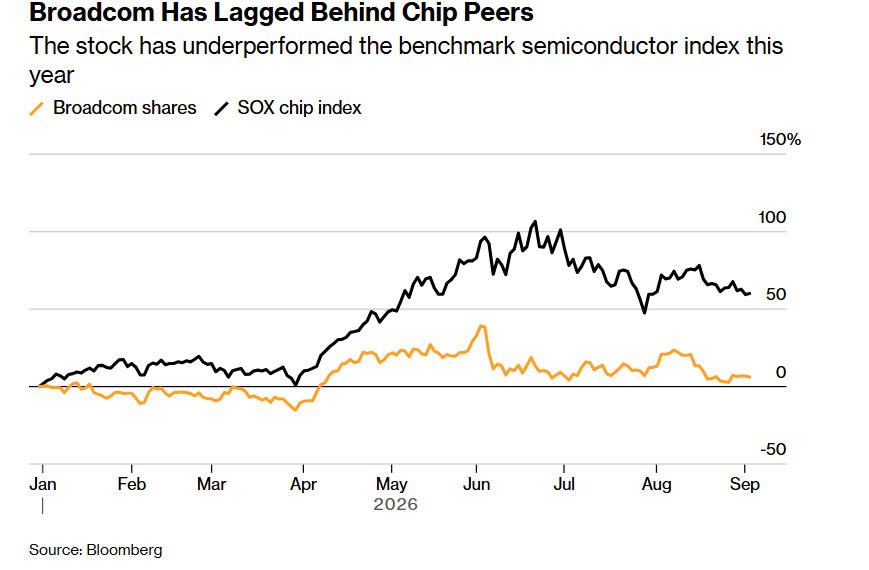
By the close of regular trading, Broadcom's stock price had risen 6.1% since this year. This performance lags behind the gains of many chip peers in 2026.
Chen Fuyang said in a conference call that the company is speeding up cooperation with Google, Anthropic, and OpenAI. Chen Fuyang said that in the next few years, Broadcom will deliver customized processors worth “tens of billions of dollars” to Google every year. If energy consumption is used as a benchmark for measuring data center capacity, Broadcom will deliver chips that can support 5 gigawatts of computing power to Anthropic next year, and another 10 gigawatts of chips next year.
Chen Fuyang said that Broadcom also “can anticipate” supplying more than 5 gigawatts of customized chips to OpenAI in 2028. From now until the end of 2027, Broadcom will deliver three generations of chips to its fourth-largest customer, Meta.
Chen Fuyang has always positioned Broadcom as an important alternative to Nvidia's main chip; Nvidia chips currently dominate the AI field. On the conference call, he said in a slightly provocative manner to his rivals that the performance of the new chip jointly developed by Broadcom and Google is at least comparable to Nvidia's next-generation Vera Rubin product line when running AI models.
Broadcom has always benefited from the demand for customized AI chips, not only continuously signing deals, but is even pioneering ways to help companies like Anthropic raise capital for expensive semiconductor purchases. Chen Fuyang has set up financing instruments with Apollo Global Management and Blackstone Group to help Anthropic be able to purchase Google chips developed with Broadcom's participation. This latest funding partnership is aimed at supporting more than 20 gigawatts of computing power and will require hundreds of billions of dollars. The computing power capacity of this scale is roughly equivalent to the power generation of 20 nuclear power plants.
Nvidia's 70% growth outlook and Broadcom's strong performance outlook break through the “AI peaking theory”, perfectly explaining that global AI computing power infrastructure is still in full swing
The strong rebound trajectory of the Philadelphia Semiconductor Index, Nvidia's latest performance and 70% outlook, combined with the strong performance and future outlook just announced by Broadcom, and the latest tens of billion dollars of cloud computing power resource agreement signed by AI application leader Anthropic and South Korea's strong semiconductor export data, these positive signals at the AI computing power industry chain level highlight that global AI computing power demand is still far from peaking.
Global investors remain strong in their risk appetite for the AI computing power industry chain after experiencing a sharp decline after experiencing AI deleveraging and de-crowding in July. As of September 2, the Philadelphia Semiconductor Index has risen sharply by 60.09% this year, and Korea's KOSPI Index has risen 55.73%. Both entered a technical bear market in July according to the traditional 20% decline standard, and then rebounded; among them, Korea's KOSPI Benchmark Index, which has the title of “Global AI Computing Power Industry Chain Investment Trend Vane”, once rebounded more than 30% from its low at the end of July, clearly entering a new round of technical bull market. As of September 1, the Philadelphia Semiconductor Index reported 11,339.25 points, up about 60% during the year; the index once retreated nearly 29% from its June high to its July 29 low, then crossed the technical bull market threshold of 20% in mid-August.
Demand for AI computing power infrastructure is changing from the budget intentions of major cloud computing and AI application developers to multi-year computing power capacity locking. Anthropic reportedly signed an artificial intelligence cloud computing agreement with Nvidia-supported Lambda worth 35 billion US dollars, corresponding to an artificial intelligence cloud computing agreement with a capacity of about 350 megawatts; not long ago, about 45 billion US dollars was used to lock Nscale's 460 megawatts of computing power over the next six years. The latter will deploy Nvidia's next-generation AI computing power cluster, the Vera Rubin platform, on a large scale. South Korea's exports in August increased 68.7% year-on-year to US$98.26 billion. Among them, exports of semiconductor products surged 209% to a record 46.65 billion US dollars, accounting for 47.5% of total exports.
AI GPU clusters, AI ASIC (TPU) clusters, and memory chips are still the most prominent bottlenecks in AI computing power systems in the world under the token inference torrent. Counterpoint expects AI server AI ASIC shipments to triple from 2024 to 2027, and Broadcom expects to account for about 60% of the ASIC design partner market in 2027. Another market research agency, TrendForce, expects DRAM and NAND Flash contract prices to rise 13% — 18% and 10% — 15%, respectively in the third quarter; the cumulative increase in server DRAM and enterprise solid-state drive prices in 2026 may reach about 270% and 235%, respectively. The HBM contract price is still likely to rise another 70% — 140%. DRAM and NAND are expected to account for 47% of the capital expenditure of cloud computing service providers, rising further to 68% in 2027.
Of the 33 Wall Street analysts compiled by MarketBeat, 29 suggested “buying” Broadcom, and 4 suggested “holding”, and no one recommended selling; Wall Street analysts were more optimistic about Broadcom's average target price of $491.97, which corresponds to a potential increase of 33.96%, and the average target price of $509 shown by TIPRANKS is more optimistic. There are many opinions overall, but weak overall revenue guidance for the fourth fiscal quarter, the AI product portfolio depresses gross profit margins, Google's introduction of a second supplier, and customer and financing risks will still determine short-term valuation fluctuations.
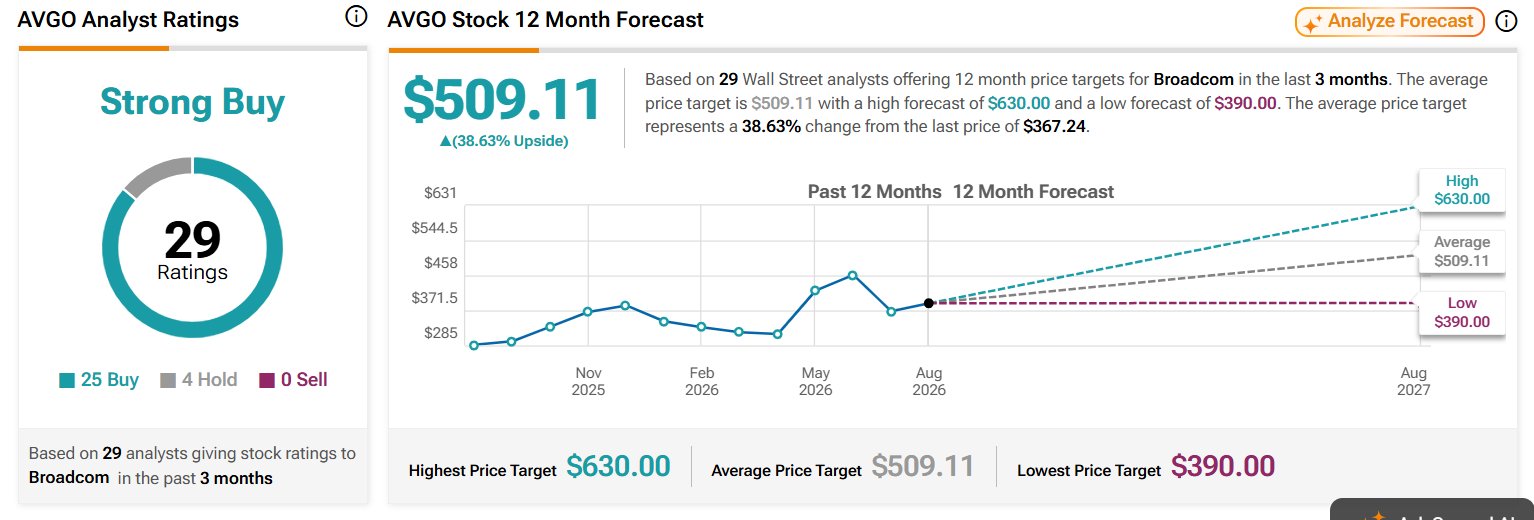
Citibank listed Broadcom as the first choice for semiconductors; Morgan Stanley believes that Broadcom is expected to maintain about 80% of the serviceable ASIC design market share; the common logic of Deutsche Bank, Goldman Sachs, and Bank of America is that customized AI ASIC/XPU clusters, AI Ethernet network infrastructure, and customer diversification are jointly extending Broadcom's growth cycle. Among them, Bank of America also gave a target share price of $530.
Nvidia's revenue for the second fiscal quarter was US$96.2 billion, particularly the data center business unit's revenue of US$89 billion, up 106% and 117% respectively; Nvidia's latest growth framework for FY2028 was significantly higher than Wall Street's previous expectations of about 44%. The latest research report released by J.P. Morgan Chase shows that if the supply of advanced wafers, HBM, etc. is fully sufficient, Nvidia's expected increase is expected to exceed 100%. All of these signs indicate that Nvidia's GPU and Broadcom's customized AI accelerator (AI ASIC/TPU/custom accelerator/xPU) are accelerating at the same time. It is not simply that market share is losing ground, but rather that the overall AI computing power demand pool is rapidly expanding.
PwC's latest estimates further reveal that this is not a real estate capital expenditure that ends once it is built, but rather an “AI computing power subscription cycle” where hardware is continuously updated: under the benchmark scenario, PwC expects the cumulative investment in global data centers to reach an astonishing 31.6 trillion US dollars from 2026 to 2050, and the most optimistic forecast by PwC is likely to approach 50 trillion US dollars when AI becomes more popular; annual expenditure is expected to increase from about 800 billion US dollars in 2026 to 1.1 trillion US dollars in 2030 and 1.8 trillion US dollars in 2050. Among them, the US market absorbed a total of 15.1 trillion US dollars, accounting for about 48%, and the Asia-Pacific region reached 8.2 trillion US dollars.
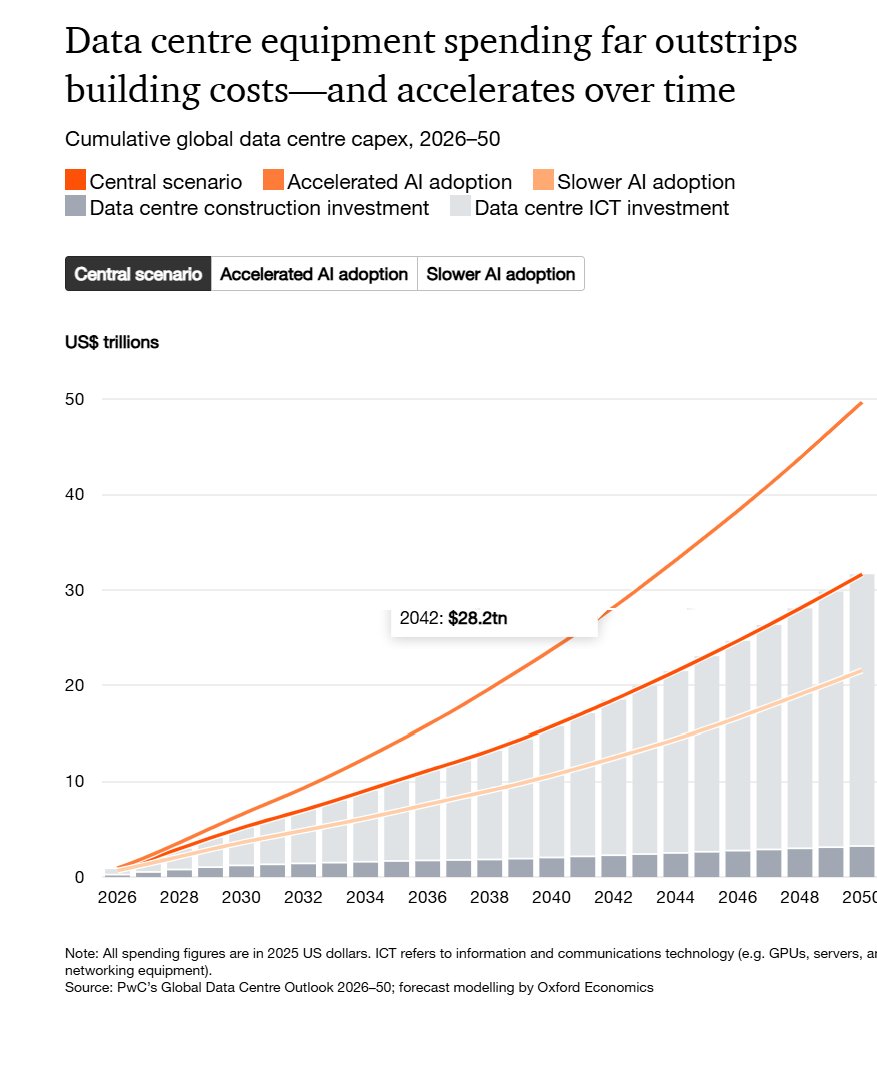
According to PricewaterhouseCoopers estimates, data center internal infrastructure such as AI GPUs, AI ASIC/TPU, storage, and high-speed network equipment is usually updated every four to six years, increasing the share of ICT equipment (ICT equipment) in data center capital expenditure from about 70% now to 93% in 2050; PwC estimates also show that every dollar invested in data center construction capital will actually lock in about 12 US dollars of subsequent ICT equipment investment, that is, every 1 dollar invested in data center construction capital in the future. It is expected to drive approximately $12 in ICT capital expenses for internal data center infrastructure such as AI GPUs, AI ASIC/TPUs, and memory chips.