


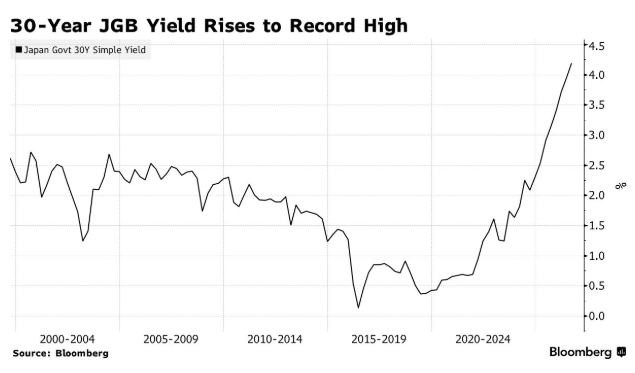
The Zhitong Finance App learned that on Thursday, Japan will auction 30-year treasury bonds. This move will test the resilience of market investors' demand. Currently, global bond sell-offs have pushed long-term treasury bond yields to their highest level in nearly two decades.
If the results of this auction are poor, the impact may affect global financial markets, further driving up borrowing costs. Meanwhile, within Japan, concerns raised by Prime Minister Sanae Takaichi's expansionary fiscal policy are further increasing these pressures.
Prior to Thursday's auction, the yield on Japan's 30-year treasury bonds fell 7 basis points to 4.095%, further breaking away from the highest level since the introduction of this maturity type in 1999. This pullback is due to the overnight strengthening of US Treasury bonds due to falling oil prices.
Despite the smooth progress of the 10-year treasury bond auction earlier this week, the 30-year variety faces an even more severe test — global long-term yields are still high, and ultra-long-term bonds are more sensitive to changes in financial conditions and supply and demand.
Barclays Bank strategists (including Ayao Ehara) stated in a report: “We expect the overall results to be weak or moderate. Affected by the rise in yield last month, the current interest rate level is already high, and in terms of long-term drivers, it is close to a reasonable value range, but financial concerns are still suppressing.”
Meanwhile, various departments in Japan have submitted record budget applications for the next fiscal year, and market attention on how to finance additional expenses and the amount of debt the government may issue has soared. This concern coincides with Japan's benchmark 10-year Treasury yield hitting 3% for the first time in 30 years.
Furthermore, Bank of Japan Governor Kazuo Ueda hinted that this month's policy meeting may raise interest rates, saying that decisions will be made on the basis of considering upward price risks. Earlier, US Treasury Secretary Scott Bessent also made several statements, pointing out the need to take corresponding action.
Strategist Mark Cranfield said, “The 30-year Japanese treasury bond auction on Thursday may become another pain point in the US bond market. There is a risk that interest spreads on Japanese and US long-term treasury bonds will fall below 100 basis points.”
“Weak market conditions are gradually taking shape: the USD/JPY exchange rate has reached the 160 mark, the G-10 national bond market is under pressure as a whole, and the yield on Japanese 30-year treasury bonds is only a few basis points away from the peak in May. Once it breaks through into a higher trading range, the Japan-US dollar spread will narrow to less than 1%, which will make Japanese bonds more attractive in terms of relative value, which in turn may increase the selling pressure on US bonds,” the strategist added.
Market observers pointed out that if the auction results are weak, the shock wave may surpass mainland Japan, amplify the global sell-off wave, and may make it more difficult for the US authorities to contain the rise in long-term treasury bond yields.
Prashant Newnaha, Asia Pacific senior interest rate strategist at TD Securities, said, “Japanese treasury bonds have long been the anchor of the global fixed income market, but now this role has been reversed. The continuation of the sell-off in Japanese bonds may trigger a repricing of global fixed income assets.”
Newnaha also pointed out that the rise in 30-year yields may “return the market focus to fiscal policy, not just monetary policy,” and emphasized that the current ratio of Japan's debt to GDP is far higher than the previous period when 10-year Japanese bond yields were around 3%.
However, there are also reasons to look forward to buying into the market. According to Den Miki, senior interest rate strategist at Sumitomo Mitsui Nikko Securities, the previous two 30-year treasury bond auctions (both held when the yield was about 4%) recorded relatively high subscription multiples, and purchases of ultra-long-term bonds by life insurance and non-life insurance institutions have recently accelerated.
However, at the same time, she said that at a time when the end point of the rise in yield is still unclear, investors are still unwilling to extend it on a large scale for a long time. Den expects the results of this auction to be between average and slightly weak.