


The Zhitong Finance App learned that ANZ said that copper prices are expected to rise to record levels early next year, driven by the combination of US tariff concerns, mine supply challenges, and global demand resilience. The bank said the copper price is expected to rise to $14,500 per ton by the end of the year and has the potential to reach $15,000 in early 2027.
As of press release, three-month copper futures on the London Metals Exchange (LME) reported around US$14,228 per ton. Copper prices have risen 15% since this year and hit a record high of 14527.50 US dollars/ton in January of this year.
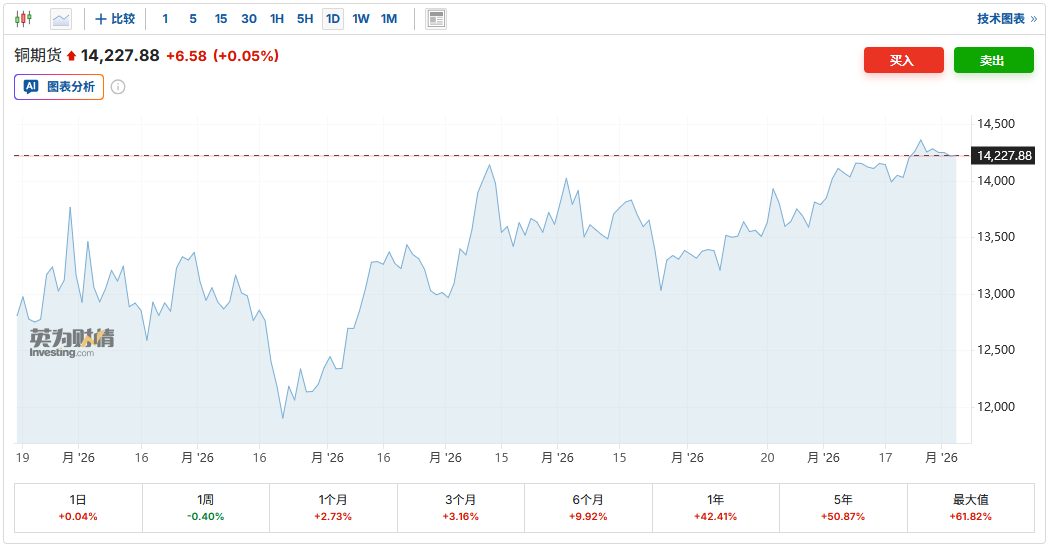
Previously, due to traders planning for the possibility that the US Trump administration may announce import tariffs on refined copper, large amounts of copper resources have flowed to the US, and copper stocks from other regions of the world have been continuously withdrawn. ANZ analysts Soni Kumari and Daniel Hynes said in a report: “The tariff-driven flow of metals into the US continues and continues to distort the balance between supply and demand in the global copper market.” They pointed out that the price of copper in New York is higher than the price of LME copper, thus opening up room for arbitrage transactions. “Most of the inventory is concentrated in the US, making supply in markets other than the US tighter.”
Notably, although the June 30 deadline for US Secretary of Commerce Lutnick to submit tariff proposals has passed, the White House has yet to announce the final policy. Producers, consumers, and traders are closely watching whether Trump will further extend current trade protection measures for semi-finished copper products to refined raw materials such as copper.
While copper consumption remains resilient, copper supply is under pressure. According to data from consulting agency Project Blue, in the first half of this year, due to the blockage of mining production in Indonesia, the Democratic Republic of the Congo, and Chile, global copper market supply declined by about 338,000 tons. As long-term demand from artificial intelligence (AI), renewable energy, and power grid construction continues to grow, any disruption in mine operations will further increase supply pressure.
In the medium to long term, copper prices are expected to be supported. On the demand side, copper is widely used in various fields such as electric vehicle batteries and data centers. Under the wave of rapid advances in global artificial intelligence (AI) computing power infrastructure, data centers are becoming veritable “new copper mines.” Copper, a traditional industrial metal, has become a core material supporting the development of the artificial intelligence industry due to its irreplaceable electrical and thermal conductivity. The Morgan Stanley report predicts that global data center copper consumption will increase to 740,000 tons in 2026, contributing 0.6 percentage points to the increase in global copper demand; by 2027, data center copper consumption is expected to reach 1 million tons (2.8% of total demand), and further increase to 1.3 million tons (accounting for 3.3%) in 2028, with a compound annual growth rate of 40%.
In an earlier report, Jefferies estimated that by 2030, total global copper demand will reach 30.93 million tons, with a compound annual growth rate of 2.1% from 2025 to 2030. Among them, electric vehicles led the way with a growth rate of 9.6%, and data centers and renewable energy (wind power+photovoltaics, excluding power grids) also reached 6.1% and 6.7%, respectively. On the supply side, it is difficult to keep up with the pace. The global copper supply in 2030 is expected to be only 3.09 million tons, which would mean a gap of about 840,000 tons.
Jefferies put it bluntly: “Even in a world where the global GDP growth rate is only 2%, the copper market will still experience significant supply and demand shortages over the next 12 months and more.” This means that the core driving force behind this round of rising copper prices is not short-term excitement fueled by macro-sentiment, but rather a real “physical shortage” on the supply side. The copper market may be leaving the cyclical cycle of “rising for three years and falling for two years” in the past, and it is likely that it is facing a mismatch between supply and demand that will continue for several years.