


The Zhitong Finance App learned that Bank of Japan data showed that Tokyo did not significantly intervene in the foreign exchange market on Wednesday. This indicates that sharp fluctuations in the exchange rate may be due to traders' nervousness due to readjusted interest rate hike expectations. The gap between the Bank of Japan's current account forecast released on Thursday and the money brokers' estimates is too small to indicate an intervention by buying yen on a large scale like a month ago.
The Bank of Japan predicts that due to fiscal factors, its current account will be reduced by 410 billion yen, while according to the average forecast of Central Tanshi, Ueda Yagi Tanshi, and Tokyo Tanshi Research, the current account will decrease by about 700 billion yen. This difference is far less than 729 billion yen — the smallest level of Japan's intervention since 2022.
Exchange rate fluctuations are partly due to traders adjusting their positions in anticipation of the Bank of Japan's interest rate hike. A series of remarks from Japanese and US policymakers strengthened the market's expectations that the Bank of Japan would raise interest rates in September, and also triggered speculation that the pace of interest rate hikes would accelerate or even raise interest rates sharply thereafter.
According to people familiar with the matter, the Bank of Japan is inclined to raise interest rates by 25 basis points at the September meeting. The news came out on Thursday, but it also threw cold water on the idea of a bigger rate hike.
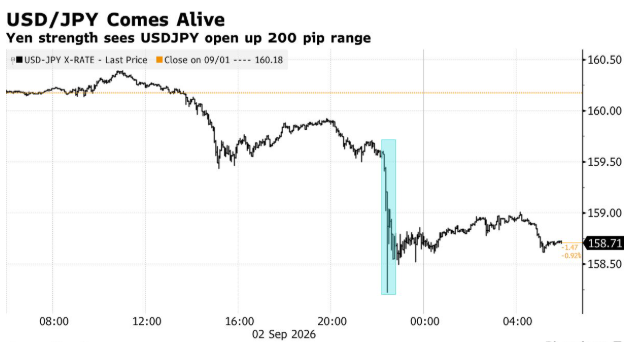
On Wednesday, the exchange rate of the dollar fell by more than 1 yen against the yen. This trend initially sparked speculation that Japan might reenter the market after a record intervention a month ago. In the past, sharp fluctuations in the yen exchange rate of more than 2 yen were usually related to market concerns about the risk of Japanese intervention, rather than Japan's actual intervention.
Every time the Japanese monetary authorities intervene in the foreign exchange market, they usually try to reverse the 5% fluctuation of the yen in the first round of intervention, and then carry out minor operations. About a month ago, Japan spent 15.4 trillion yen (about 98.5 billion US dollars) to interfere in the foreign exchange market, and the US also supported the yen for the first time in 28 years.