


Atlanta, Georgia-based The Southern Company (SO) generates, transmits, and distributes electricity. Valued at $101.6 billion by market cap, the company also offers wireless telecommunications services, provides businesses with two-way radio, telephone, paging, and internet access services, and wholesales fiber optic solutions.
Companies worth $10 billion or more are generally described as “large-cap stocks,” and SO definitely fits that description, with its market cap exceeding this threshold, reflecting its substantial size, influence, and dominance in the utilities - regulated electric industry. SO has a robust foundation, with strong finances, a skilled workforce, and extensive infrastructure, including power plants and transmission lines. The company's expertise in navigating complex regulatory environments and influencing energy policy is a key asset.
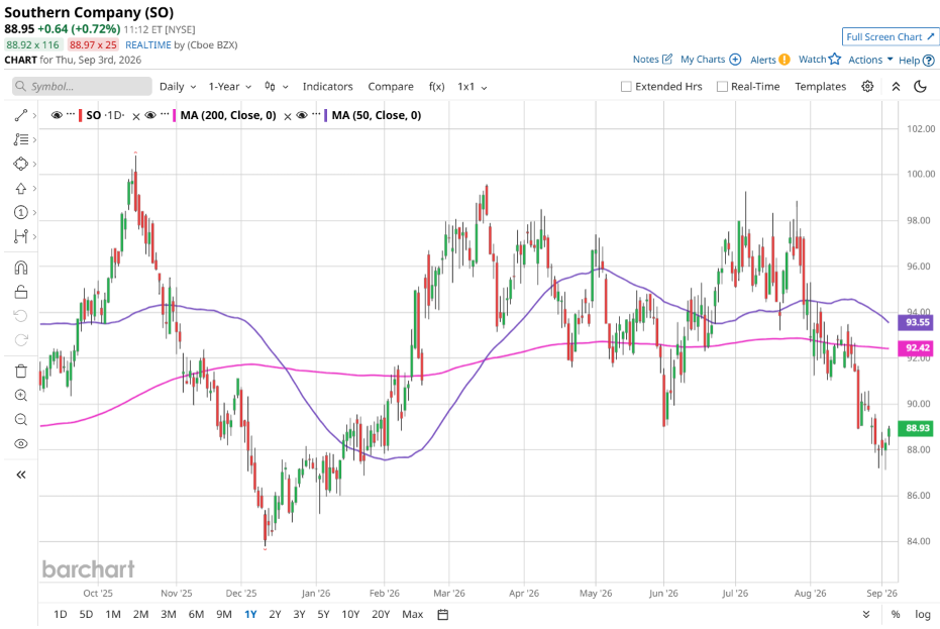
Despite its notable strength, SO slipped 11.7% from its 52-week high of $100.84, achieved on Oct. 16, 2025. Over the past three months, SO stock has declined 2%, underperforming the Dow Jones Industrials Average’s ($DOWI) 5.3% gains during the same time frame.
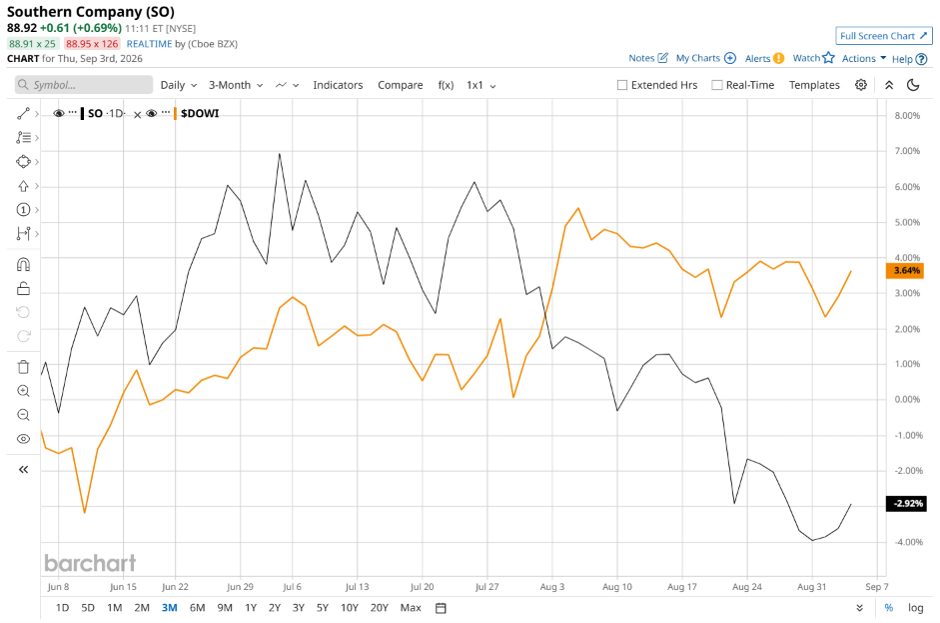
Shares of SO rose 1.7% on a YTD basis but dipped 3.3% over the past 52 weeks, underperforming DOWI’s YTD 11% gains and 17.9% returns over the last year.
To confirm the recent bearish trend, SO has been trading below its 50-day moving average since late July, with slight fluctuations. The stock is trading below its 200-day moving average since early August, with slight fluctuations.
SO’s relative underperformance was driven by persistent high interest rates, which raised debt-servicing costs for its capital-intensive projects and squeezed dividend yields relative to risk-free bonds. Worries over equity dilution from large-scale debt financing like its multi-billion dollar convertible notes offering weighed on sentiment, while potential regulatory friction in core markets like Georgia and a broader market rotation into high-growth tech stocks capped its valuation upside.
On Jul. 30, SO shares closed down by 1.8% after reporting its Q2 results. Its adjusted EPS of $1.13 topped Wall Street expectations of $1.01. The company’s revenue was $7 billion, falling short of Wall Street forecasts of $7.4 billion.
In the competitive arena of utilities - regulated electric, Duke Energy Corporation (DUK) has taken the lead over SO, with a 3.4% uptick on a YTD basis and a marginal loss over the past 52 weeks.
Wall Street analysts are cautious on SO’s prospects. The stock has a consensus “Hold” rating from the 24 analysts covering it, and the mean price target of $100.83 suggests a potential upside of 13.2% from current price levels.
On the date of publication, Neha Panjwani did not have (either directly or indirectly) positions in any of the securities mentioned in this article. All information and data in this article is solely for informational purposes. For more information please view the Barchart Disclosure Policy here.