


Intuit stock has dropped sharply over the past year, yet the current checks on its pricing suggest the shares lean cheap rather than expensive. With the company pushing deeper into AI-driven finance tools while the share price lags, investors are weighing whether the recent weakness has gone too far.
- The share price is down 47.9% over the past year, which puts recent sentiment under pressure and raises the question of whether expectations have reset too aggressively.
- The expansion of Intuit Intelligence Chat and AI skills may support longer term revenue and profit potential, while slower or patchy adoption of these tools remains a key risk for how the stock is valued.
- On a broad set of valuation checks, Intuit screens as relatively cheap, with a high value score of 5. This indicates the broader measures lean toward undervalued rather than expensive.
For investors, the debate is whether Intuit's recent share price decline now offers a margin of safety that matches the risks around execution on its AI and software growth plans.
Spot opportunities other investors may be missing by scanning 53 high quality undervalued stocks, which share Intuit’s mix of pressure on recent returns and stronger value checks.Is Intuit Still Cheap on Earnings?
The P/E multiple is a useful check for Intuit because earnings remain a key focus for how investors look at mature software platforms with strong cash generation.
Intuit currently trades on a P/E of 20.6x. That sits below the broader software industry average of 31.4x and under the 45.2x peer group average. The fair P/E ratio from the model is 37.5x, which is higher than both the current multiple and the sector benchmark. This indicates a notable difference between what the stock is priced at today and what investors might expect based on Intuit's earnings profile, margins, size and risk level.
Recent news around Intuit expanding its AI driven finance tools, even as the share price has fallen over the past year, has not pushed the P/E back toward either peers or the modelled fair ratio.
On this earnings multiple, Intuit stock currently appears undervalued relative to both sector averages and the model's fair P/E level.
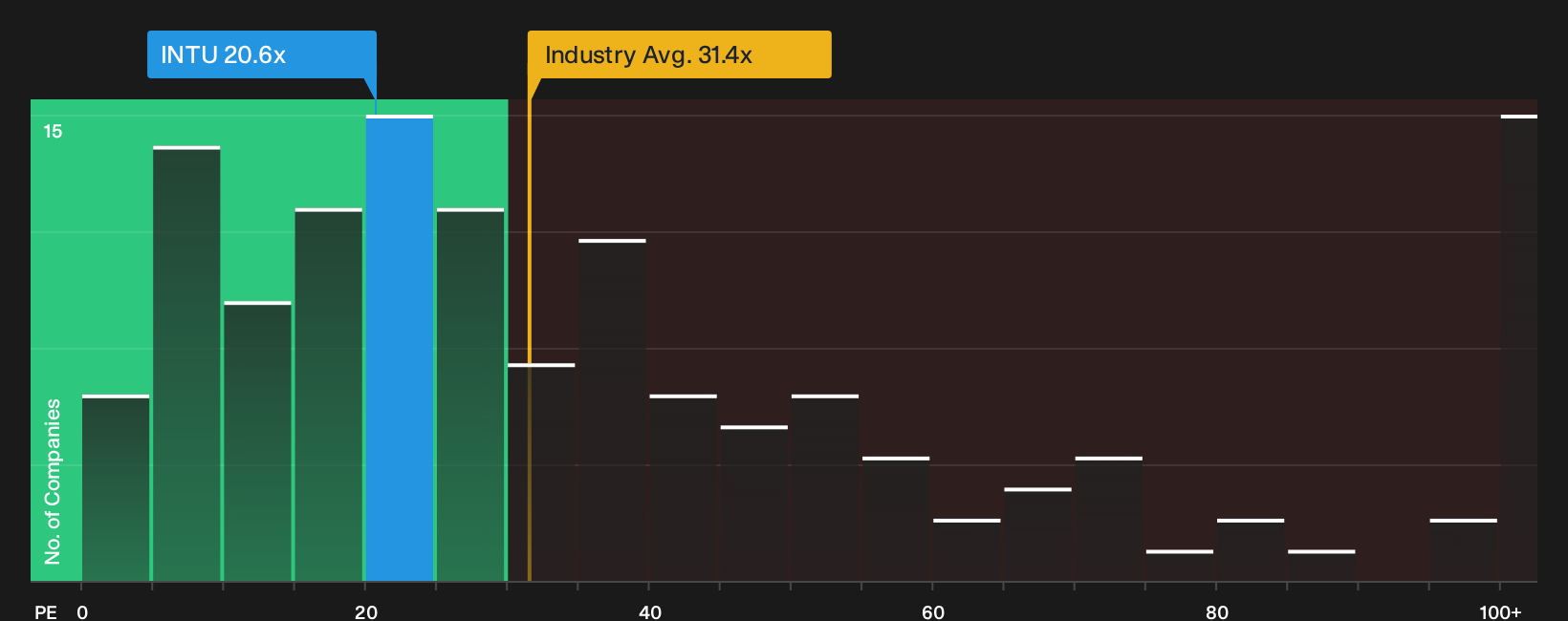
See what the numbers say about this price — find out in our valuation breakdown.
The Intuit Narrative: What Would Justify Today's Price?
Simply Wall St Narratives for Intuit pick up from this valuation puzzle and lay out what growth, margin and earnings paths would need to hold for the stock to be worth materially more or less than today's price, and they sit on the company’s Community page. Rather than rely on a single multiple or model output, each narrative spells out the assumptions behind its view of fair value so you can compare them with Intuit's actual results over time.
The community views on Intuit are far apart, with some seeing a quality business on sale and others focused on AI and credit risks that could cap upside.
Bull case: 39% undervalued
"Here's what makes Intuit unusual: once a small business puts its financial life into QuickBooks (years of invoices, payroll records, tax history), switching to a competitor isn't just inconvenient."…
Read the full Bull Case to see why Intuit could be undervalued
Bear case: 19% overvalued
"Although Intuit is seeing early traction with its AI driven expert platform and virtual AI agents across QuickBooks and consumer products, the heavy reliance on continued AI adoption raises the risk that execution missteps or slower customer uptake could limit the uplift to revenue growth and pressure earnings."…
Read the full Bear Case to see why Intuit could be overvalued
Do you think there's more to the story for Intuit? Head over to our Community to see what others are saying!
The Bottom Line
Intuit screens as undervalued on earnings-based checks, which puts the focus on whether the current discount reflects genuine mispricing or simply bakes in the execution risk around its AI push. If you think Intuit can translate its AI-driven tools into durable adoption and steady profits, the current multiple could leave room for upside over time. If those products stumble or customers take longer to embrace them, the lower valuation could prove justified. The crux is whether Intuit's AI strategy earns the confidence needed for the market to re-rate the stock closer to peers.
This article by Simply Wall St is general in nature. We provide commentary based on historical data and analyst forecasts only using an unbiased methodology and our articles are not intended to be financial advice. It does not constitute a recommendation to buy or sell any stock, and does not take account of your objectives, or your financial situation. We aim to bring you long-term focused analysis driven by fundamental data. Note that our analysis may not factor in the latest price-sensitive company announcements or qualitative material. Simply Wall St has no position in any stocks mentioned.
Have feedback on this article? Concerned about the content? Get in touch with us directly. Alternatively, email editorial-team@simplywallst.com