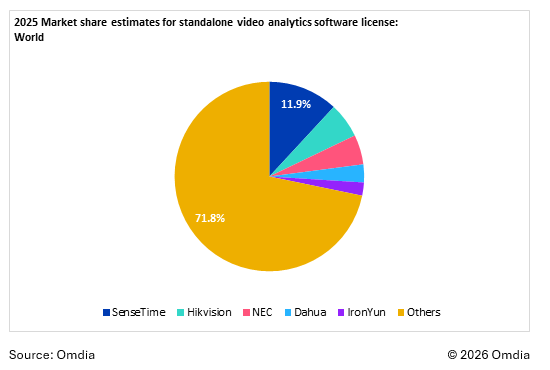
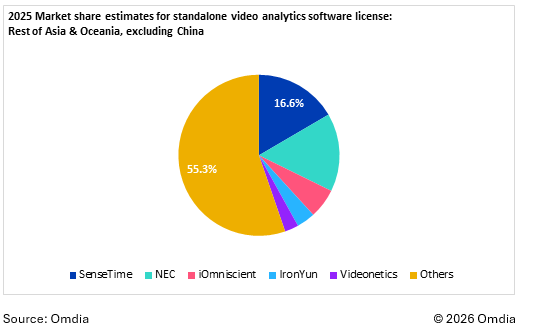
The Zhitong Finance App learned that in 2025, the global video analysis software market sales reached US$990 million, an increase of 14.3% over the previous year. Omdia expects global sales in this sector to reach $1.7 billion by 2030, with a CAGR of 11.4% from 2025 to 2030. This growth rate has made it one of the strongest growing segments in the security industry chain. It also indicates that analytical software is shifting from an ancillary function of hardware to the value core of security systems.
Omdia believes this round of growth is driven by three factors. First, technology upgrades and big model empowerment drive a leap forward in software value. Second, most enterprises are no longer satisfied with simple hardware deployment, but are pursuing operational efficiency and safety insights brought about by AI analysis. The proportion of software procurement in the overall security system continues to increase. Third, global data security and AI regulations continue to be tightened, and the cost of iterating software to meet compliance is far lower than replacing hardware as a whole, driving the rapid upgrading of massive existing systems.
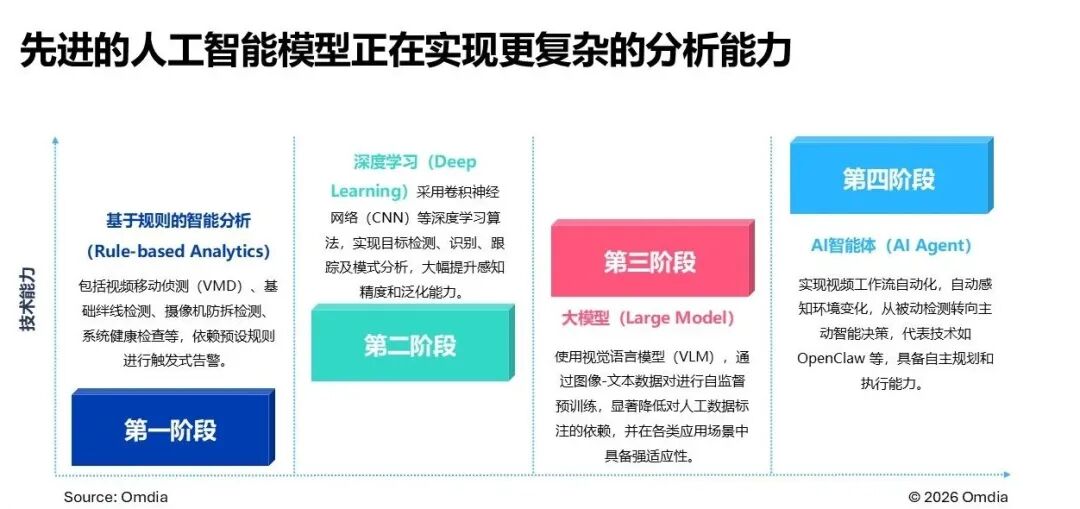
Technological evolution: Advanced AI models drive continuous upgrading of video analysis capabilities
The core driving force behind the growth of the video analysis software market stems from the continuous iteration of video analysis technology.
Regional differentiation: parallel and convergence of independent software and embedded architectures
If mature Western markets define the mainstream form of video analysis software, the Asia-Pacific market shows another development path for the industry. According to Omdia data, in 2025, the Asia-Pacific market revenue grew by more than 20% year on year, accounting for 53% of global video analysis software revenue, and is the fastest growing core region in the world.
Europe and the US mostly use a cloud-side collaborative deployment model: the software runs on a server or cloud, connects to multi-brand front-end devices through standard agreements, emphasizes openness and scalability, and adapts to mature local IT systems and compliance requirements. The characteristics of stratification in the Asia-Pacific region are obvious: developed economies are speeding up the upgrade to platform-based solutions; the vast majority of emerging markets prefer lightweight models with embedded architectures, thereby lowering the deployment threshold and reducing the pressure on operation and maintenance.
Omdia believes that there is no absolute advantage or disadvantage between the two architectures; they are all rational choices based on local cost levels, infrastructure conditions, and operation and maintenance capabilities. The hybrid architecture of “real-time edge inference + in-depth analysis in the cloud” will gradually become a bridge connecting the two models.
Evolution of the competitive landscape: Chinese manufacturers' breakthrough in globalization
The video analysis industry is not a short-term explosive racetrack. Its competitiveness depends not only on algorithm accuracy, but is also closely related to product maturity, engineering delivery capability, and industry experience.
The market performance of Chinese manufacturers just confirms this — with years of experience in large-scale deployment in the local market, they have transformed their localization advantage into global competitiveness. According to Omdia's latest “Global Smart Video Security Market Report” released in 2026, Shangtang Technology (00020) also topped the Asia-Pacific and global independent video analysis market share rankings. Behind this achievement is a comprehensive victory in technology, product, ecology, and large-scale delivery. In this mature circuit, which has been in development for many years, the global landscape is still being reshaped, and the weight of Chinese manufacturers continues to rise.
It is worth noting that technological iteration is not only reshaping the market pattern, but also driving the deep evolution of the industry's business model. Omdia senior analyst Runa Zhang (Runa Zhang) said intelligence (proxy AI) could disrupt the traditional business model of video security software vendors: the industry will shift from one-time and subscription pricing to pay-per-result or pay-per-call. This shift will lower the barriers to software usage and provide end users with more flexible payment options. This model innovation will not only change the revenue structure of manufacturers, but is also likely to accelerate the spread of intelligent analysis technology in small and medium-sized enterprises and emerging markets.
From a global perspective, the global market is undergoing a triple transformation: from hardware dominance to software definition, from passive recording to active understanding, and from regional competition to global gaming.
Omdia believes that future enterprises with AI technology capabilities, platform openness, and localization ecosystem capabilities will dominate the industry pattern for the next five to ten years.