


The Zhitong Finance App learned that economists expect the ECB to raise interest rates for the second and last time in the current austerity cycle on September 10, after which it will stop acting. According to the survey, the vast majority of economists expect the ECB to raise the deposit mechanism interest rate by 25 basis points to 2.5% next Thursday and maintain this interest rate level until 2027. Compared to current interest rate futures betting that the ECB will raise interest rates about three times before the middle of next year, economists' expectations are much more dovish.
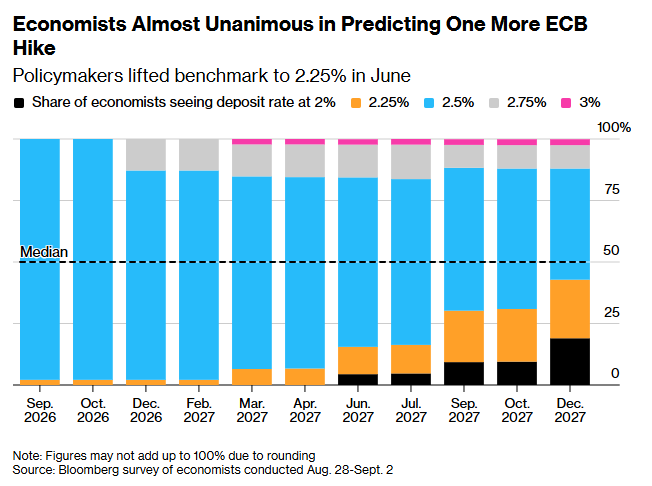
Economists expect the ECB to raise interest rates once more
If the ECB stops acting after raising interest rates in September, as economists expect, the current ECB austerity cycle will include only two rate hikes, making it the shortest round since 2011. This scenario is quite similar to the experience of 2011. At that time, the ECB also raised interest rates twice in a row against the backdrop of soaring oil prices. Since then, this round of austerity has been viewed by many policymakers as a policy mistake.
Now, with inflation once again being driven by energy prices, if the contraction stops after the September rate hike, it means that the ECB will clearly be more restrained in its response to supply-side shocks, avoid excessive policy tightening, and reduce the risk of a hard landing in the economy, which may become a more important policy consideration.
Currently, it has basically become a market consensus that the ECB will raise interest rates by 25 basis points next week. Overall inflation continues to rise, and the market generally expects it to remain above 3% during the year, making it difficult for most policymakers to publicly oppose another rate hike. Meanwhile, the war in the Middle East has once again escalated and hit the energy market once again — international oil prices are once again approaching $100 per barrel, and natural gas prices have soared to levels since 2023. Although high inflation has yet to show signs of being entrenched, risks are everywhere.
Meanwhile, the Eurozone economy has recently shown more resilience than expected. On the one hand, some rivals in Asia have been further impacted by the blockade of the Strait of Hormuz, and orders and part of the supply chain have been transferred to Europe. On the other hand, fiscal stimulus policies in many countries continued to gain strength, which together supported growth momentum.
As a result, the ECB's interest rate hike next week is generally regarded as an “insurance rate hike” — its core purpose is to further strengthen the central bank's anti-inflation reputation and effectively prevent energy price shocks from being transformed into indirect or second-round effects through wage negotiations and pricing behavior.
Ken Egan, director of Kroll Bond Rating Agency Europe, said, “The ECB is likely to describe a 25 basis point rate hike as a necessary step. However, it is likely that it will not further guide the market to raise interest rates again, but will continue to emphasize reliance on data, inflation expectations remain fixed, wage growth is still under control, and the need to evaluate how strongly previous austerity policies have been transmitted to the economy.”
The data showed that the Eurozone inflation rate rose to 3.3% in August, further exceeding the ECB's 2% target, providing a reason for the September rate hike. However, the survey shows that most economists believe that the rise in energy prices will not turn into broader inflationary pressure for the time being, which is also an important basis for the market to bet that interest rate hikes will stop after September. Few of the economists interviewed were able to point to evidence that businesses and consumers are preparing for stronger price pressures in the future, while most have only mild concerns about the ripple effects in sectors, including wages.
Although ECB policymakers generally agree that the three-year high level of inflation has not changed medium- to long-term inflation expectations or affected workers' pay levels, this situation is still likely to change.
ECB Executive Committee member Isabelle Schnabel said that it is “essential” to stop the second-round effect as soon as possible before it requires stronger countermeasures. ECB Governing Council member Martin Koch said that the next few months will “make it more clear” whether any such two-round effects have occurred.
Some ECB governing boards have already begun to consider this issue in advance. Gediminas Simkus said that raising interest rates “once is not enough” next week. Dimitar Radev called both September and December meetings “where action is still possible”, and borrowing costs are likely to rise further at that time.
Ulrike Kastens, senior economist at DWS International, said: “The ECB is unlikely to suggest further rate hikes in the next few months. However, we believe that the risk of the next policy action is still on the upward side, and interest rate hikes seem more likely than interest rate cuts.”
Another rate hike will bring deposit interest rates to a level where it is more likely to limit economic activity. More than three-quarters of survey respondents believed that even if the interest rate was 2.5%, it would be slightly higher than the neutral interest rate level. So far, the European economy has proven itself strong enough to withstand an even tighter monetary environment. Economic output increased more than expected in the second quarter, and business surveys show that future economic momentum will remain steady.
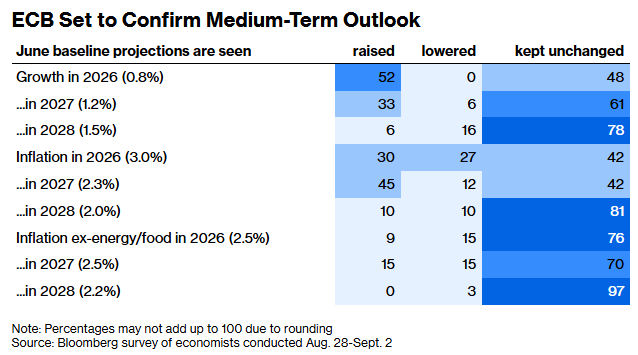
The ECB is expected to confirm its medium-term economic outlook
Furthermore, economists expect the ECB to raise its economic growth forecast for 2026, confirm the medium-term economic outlook, and confirm the inflation outlook. Whether this vision can be realized depends on how the situation in the Middle East develops. The US and Iran are once again fighting over control of the Strait of Hormuz, which may further prolong a war that has been going on for half a year.
Dennis Shen, a lecturer at the School of International Management at the Technical University of Berlin, said that this waterway “has become a key variable affecting the ECB's future decisions, because if the interruption lasts too long, the energy price shock will evolve into a broader inflation problem.” He added: “The ECB can ignore a temporary energy shock, but it cannot afford to turn a blind eye to a continuing energy shock.”