


Washington's Beef Politics Take Center Stage
Feeder cattle sentiment has turned sharply defensive over the past two weeks as government intervention, not weather or demand, has become the dominant driver. On August 21, 2026, President Trump announced on Truth Social that the United States would allow up to 300,000 metric tons of lean beef trimmings, roughly 661 million pounds, to enter the country tariff free over 90 days, with a stated commitment that the beef would be sold 25% below current market prices. The policy was formalized on August 26 through Proclamation 11059, taking effect September 1, and largely benefits Brazil and Paraguay since Argentina, Australia, New Zealand, and Uruguay already operate under separate country specific quotas. The announcement triggered an immediate and sharp selloff in feeder cattle futures.
Sentiment worsened further after the Wall Street Journal reported that Joesley Batista, a controlling shareholder of Brazilian meatpacker JBS, met privately with Trump at the White House on August 20, one day before the import announcement, to discuss lowering the 26.4% tariff on Brazilian beef. The report drew sharp criticism from ranchers, R CALF USA, the National Cattlemen's Beef Association, and lawmakers including Nebraska Senator Pete Ricketts, who argued the move undercuts efforts to rebuild the domestic herd, which USDA data puts at roughly 94.1 million head, its lowest level in 75 years.
Not all recent news has been bearish. On August 24, USDA reopened the Douglas, Arizona port to Mexican cattle imports under a phased, science-based protocol following more than a year of screwworm related closures, a modest supportive development for feeder supply normalization. On August 31, Agriculture Secretary Brooke Rollins unveiled the Ranchers First Initiative, which includes a new Beef Retention and National Development endorsement for Livestock Risk Protection, disaster recovery flexibility, and support for expanding independent processing capacity, an attempt to offset producer anger over the import decision. The market remains highly sensitive to any further headlines on tariff policy, screwworm developments along the southern border, and USDA's Cattle on Feed data.
What the Market Has Done
- Feeder cattle futures rallied aggressively into October 2025, reaching an all-time high near 381 (approximately 380).
- The market then capitulated, selling off sharply into November and December 2025 down to the 310/300 area (Daily Level 3/4).
- A strong recovery rally followed from January into February 2026, attempting to revisit the 380 highs.
- The rally fell short, and the market settled into a sideways consolidation range between roughly 380 and 338 (Daily Level 2) from March through July 2026.
- At the start of August 2026, sellers stepped down offers to the 350 area, and buyers ultimately lost control of the 338 support.
- This failure triggered an expansion move down out of the consolidation range, driving the market to the 313 area (Daily Level 3).
What to Expect in the Coming Weeks
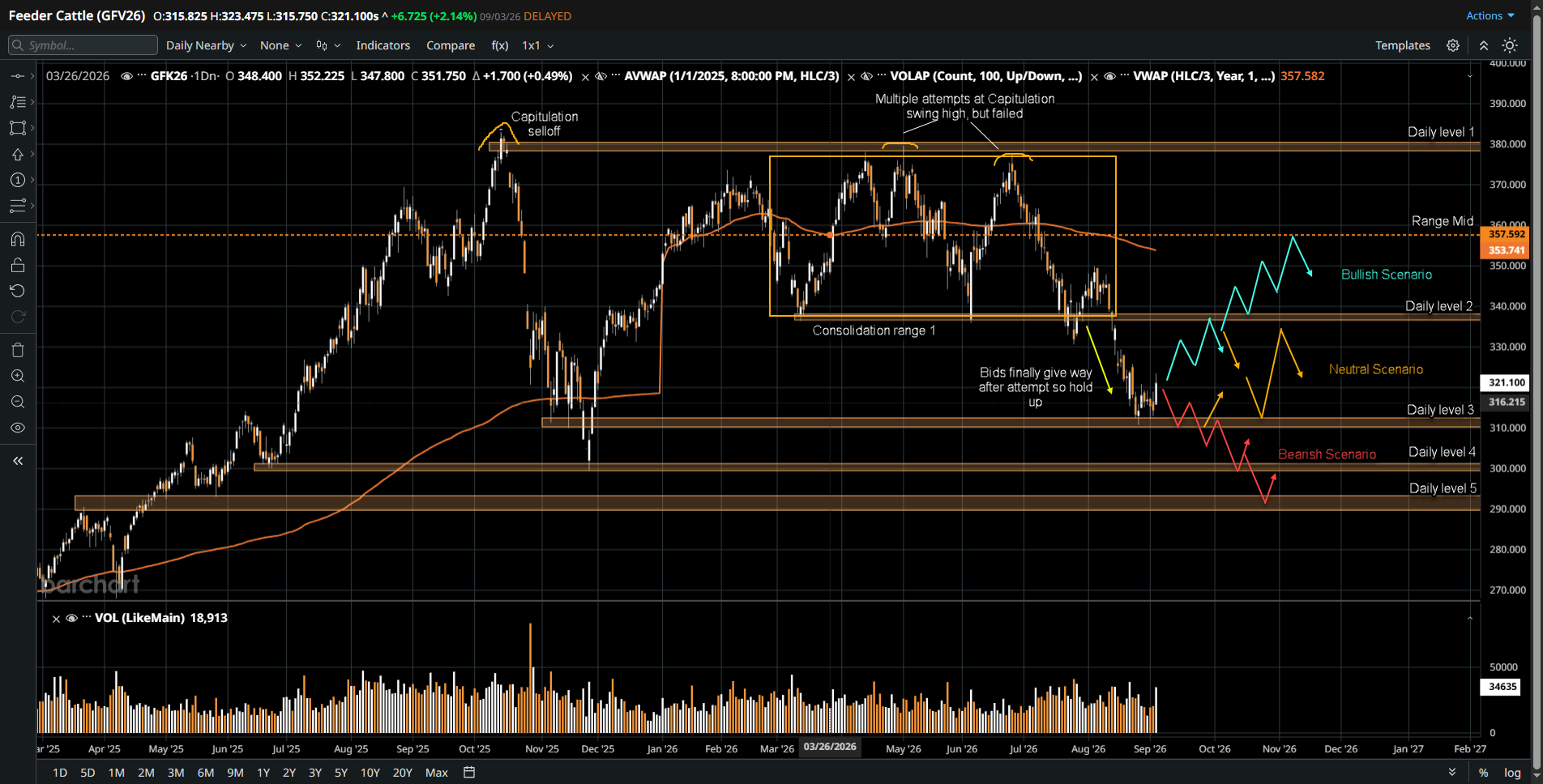
The key level to watch is the 313/310 area (Daily Level 3).
Bullish Scenario
- If buyers defend the 313/310 area, expect a move back up toward 338 (Daily Level 2), where sellers are expected to defend.
- If sellers fail to defend 338, expect a return into the prior Consolidation Range 1, with an initial move to 350, the level where sellers stepped down offers before the breakdown, followed by a subsequent move toward 357 (Consolidation range mid).
- A possible trigger for this scenario is a policy reversal or delay on the beef import tariff waiver, or a bullish surprise in USDA's Cattle on Feed report showing tighter than expected supply.
Neutral Scenario
- If sellers defend 338 following a bounce, or buyers hold bids at 313/310 following a rotation down, expect the market to settle into a new consolidation range between 338 and 313/310 to establish value lower.
- A possible supporting condition for this scenario is a period of policy digestion, where the 90-day tariff waiver runs its course without fresh escalation and USDA's Ranchers First Initiative measures are viewed as a partial offset to import pressure.
Bearish Scenario
- If buyers fail to hold bids at 313/310, expect a move down to 300 (Daily Level 4), with a possible further decline toward 290 (Daily Level 5).
- A possible trigger for this scenario is an expansion of the tariff free import program beyond its current 90-day window, further screwworm related disruption prompting another Mexican border closure, or a larger than expected increase in feedlot placements in the next Cattle on Feed report.
Conclusion
Technically, feeder cattle futures sit at a pivotal juncture, having broken decisively out of a five-month consolidation range and now testing the 313/310 support zone that separates a recovery attempt toward 338 and 357 from a deeper decline toward 300 and 290. Fundamentally, the market remains caught between two opposing forces, a historically tight domestic cattle herd at a 75-year low that argues for structurally higher prices, and an increasingly activist Washington trade policy aimed at importing more foreign beef to cool retail costs ahead of the midterm political cycle. With USDA's Cattle on Feed data, further tariff developments, and screwworm containment progress all still in play, how the market behaves around the 313/310 level over the coming weeks may say as much about Washington's next move as it does about the cattle themselves.
EdgeClear is designed for traders who refuse to guess. We deliver unfiltered tick data via Rithmic, competitive pricing starting at $0.22 per side, and performance analytics that transform your trade log into a roadmap. The serious trader’s next move is clear. Open an Account today.
Disclaimer:
This article is provided for informational and educational purposes only and does not constitute financial, investment, or trading advice. The analysis presented reflects the author’s market observations and opinions at the time of writing and is not a recommendation to buy or sell any futures contract, security, or financial instrument. Futures trading involves significant risk and is not suitable for all market participants. Losses may exceed initial margin deposits, and market conditions can change rapidly.
Any scenarios, levels, or market expectations discussed are hypothetical in nature and are intended solely to illustrate potential market behavior. They do not represent actual trading results and should not be interpreted as guarantees of future performance. Past performance, market behavior, or historical price action are not indicative of future outcomes.
Readers are solely responsible for their own trading decisions and risk management. Always conduct independent research, consider your financial situation and risk tolerance, and consult with a qualified financial professional, if necessary, before engaging in futures or derivatives trading.