


Northrop Grumman Corporation (NOC), headquartered in Falls Church, Virginia, specializes in aerospace, defense, and security solutions for various industry applications. Valued at $75 billion by market cap, the company provides systems, products, and solutions in aerospace, electronics, information systems, and technical services to government and commercial customers worldwide.
Companies worth $10 billion or more are generally described as “large-cap stocks,” and NOC definitely fits that description, with its market cap exceeding this threshold, reflecting its substantial size, influence, and dominance in the aerospace & defense industry. NOC’s competitive edge relies on sole-source, high-barrier defense programs which secure multi-decade revenue streams. Its massive technological scale creates high switching costs for the U.S. military, ensuring exceptional backlog visibility, pricing power, and insulation from macroeconomic downturns.
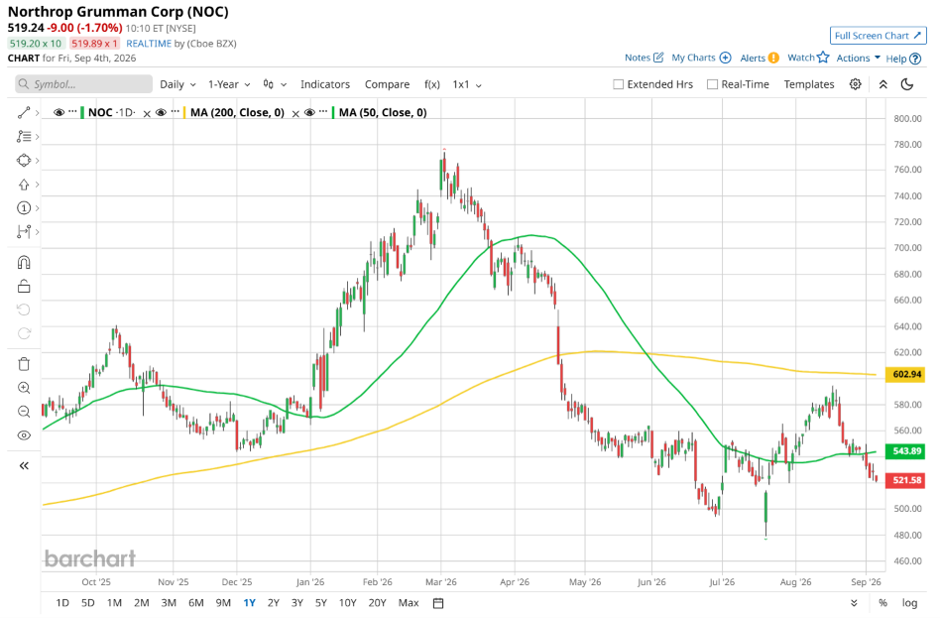
Despite its notable strength, NOC slipped 32.6% from its 52-week high of $774, achieved on Mar. 3. Over the past three months, NOC stock declined 4.2%, underperforming S&P 500 Index’s ($SPX) 2.1% gains during the same time frame.
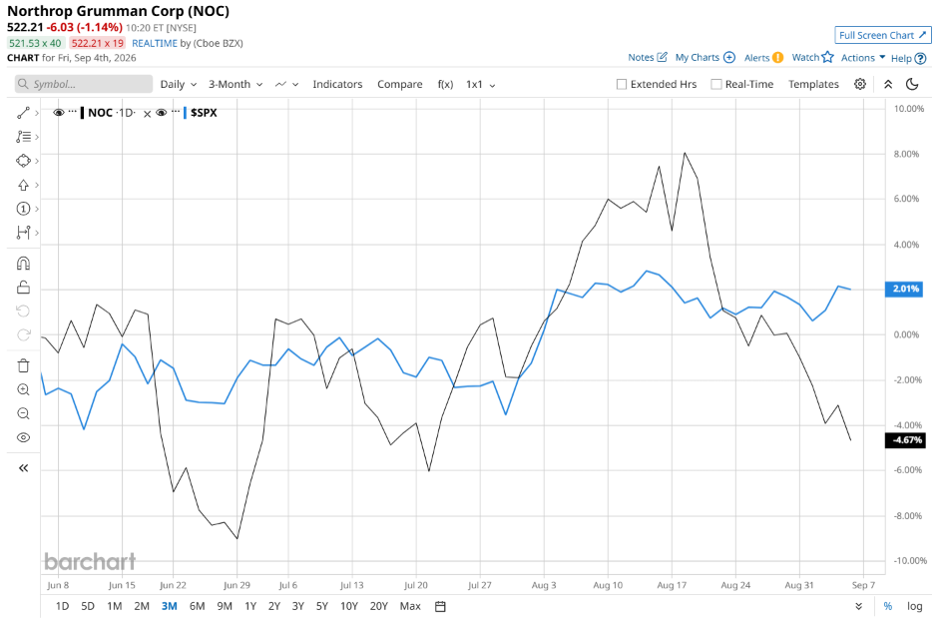
Shares of NOC fell 8.4% on a YTD basis and dipped 9.9% over the past 52 weeks, underperforming SPX’s YTD gains of 13.1% and 19.1% returns over the last year.
To confirm the bearish trend, NOC has been trading below its 200-day moving average since late April. The stock has been trading below its 50-day moving average recently.
NOC underperformed due to fixed-price contract charges notably B-21 Raider loss provisions and GEM 63XL rocket motor execution issues that squeezed operating margins. Heavy capital expenditures for scaling production, seasonal free cash flow burn, and elevated corporate debt further pressured the stock, leading investors to discount its valuation despite record backlog growth.
On Jul. 21, NOC shares closed down more than 2% after reporting its Q2 results. Its EPS of $7.68 beat Wall Street expectations of $6.84. The company’s revenue was $10.9 billion, beating Wall Street forecasts of $10.8 billion. NOC expects full-year adjusted EPS in the range of $28.60 to $29.10, and revenue in the range of $43.8 billion to $44.3 billion.
NOC’s rival, RTX Corporation (RTX) shares have taken the lead over the stock, with a 26.6% gain over the past 52 weeks and a 9.5% uptick on a YTD basis.
Wall Street analysts are reasonably bullish on NOC’s prospects. The stock has a consensus “Moderate Buy” rating from the 22 analysts covering it, and the mean price target of $658.24 suggests a potential upside of 26.2% from current price levels.
On the date of publication, Neha Panjwani did not have (either directly or indirectly) positions in any of the securities mentioned in this article. All information and data in this article is solely for informational purposes. For more information please view the Barchart Disclosure Policy here.