


Duolingo (DUOL) stock moved up following an upgrade from Evercore ISI from “In Line” to “Outperform” as well as a price target increase to $210 from $105. Evercore noted that Duolingo appears to be doing fine amid the emergence of generative AI, which has been considered potentially disruptive to demand for stand-alone language learning apps.
The report revealed that, out of 1,300 U.S. language learners surveyed by Evercore, 53% used Duolingo compared to only 13% using the closest pure-play competitor, Babbel. At the same time, 66% of respondents reported that they felt very satisfied using the platform. Notably, Duolingo has also been growing its number of daily active users while adding AI to its app.
About Duolingo Stock
Based in Pittsburgh, Pennsylvania, Duolingo is engaged in operating one of the world's largest mobile learning platforms, with the main product of the company being its language-learning app. Duolingo uses a freemium business model, in which it generates revenue by monetizing free users and converting them to paid subscriptions. Currently, the market capitalization of the company is $7.4 billion.
Shares of DUOL stock have experienced a dramatic reset in value. Despite the fact that DUOL stock currently trades near $154, shares are still 56% off the 52-week high of $353, although they are up 75% from the 52-week low of $87.8. Duolingo has also performed poorly relative to the broader market over the last 12 months; the S&P 500 Index ($SPX) has gained 19% during this time frame versus Duolingo stock's drop of 43%.
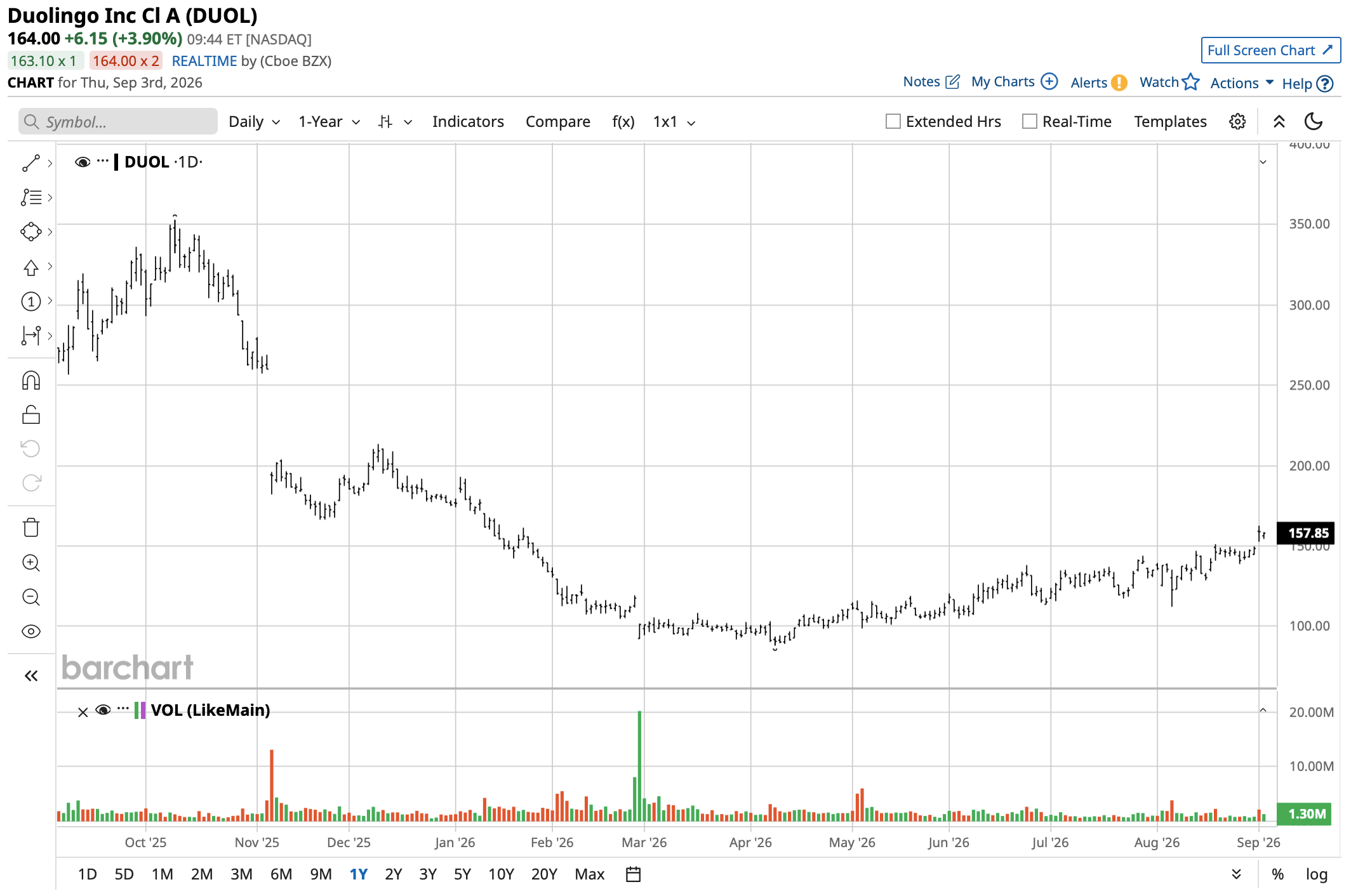
That drop in value has not automatically made Duolingo a good value stock, however. The forward price-to-earnings (P/E) ratio is 60.1 times, while the price-to-sales (P/S) ratio is 7.1 times. This is quite a steep valuation, and in order to justify such a stock price, Duolingo needs to demonstrate consistent growth in users as well as future earnings. Of course, DUOL stock is not as expensive as it used to be, but it is still far from being a cheap stock with a margin of safety.
Duolingo Reports Earnings Beat
The most recent results reported by Duolingo confirmed this growth story. Revenue reached $298.5 million in Q2 2026, increasing 18% year-over-year (YOY) and beating expectations of $295.9 million. Total bookings grew 8% YOY to $289.1 million, while diluted EPS reached $0.66 and beat estimates of $0.61. Net income fell approximately 26% YOY to $33.2 million as the company invested in its growth.
But perhaps the most important numbers from the report were related to user activity. Daily active users (DAU) grew by 23% YOY to 58.7 million, while monthly active users (MAU) reached 140.6 million. The number of paid subscribers increased 17% YOY to 12.7 million in Q2. This DAU growth is crucial for understanding Evercore's upgrade, as it indicates that the arrival of more advanced AI products did not hinder consumers using Duolingo.
Management also increased its adjusted EBITDA guidance for the year, forecasting 2026 revenue of around $1.21 billion with adjusted EBITDA of $320 million. In Q3, Duolingo expects to generate $302 million in revenue and $76 million in adjusted EBITDA. Barchart's current consensus points to EPS of $0.55 in Q3, down from $0.95 in the same period a year ago.
More important is what can happen beyond 2026. Duolingo's focus on user activity growth and product development will continue. As a result, Evercore expects the company to reach 99 million DAUs by 2028. The firm also expects EPS for 2027 and 2028 to be 10% and 25% above Wall Street's consensus estimates, respectively.
What Do Analysts Think About Duolingo Stock?
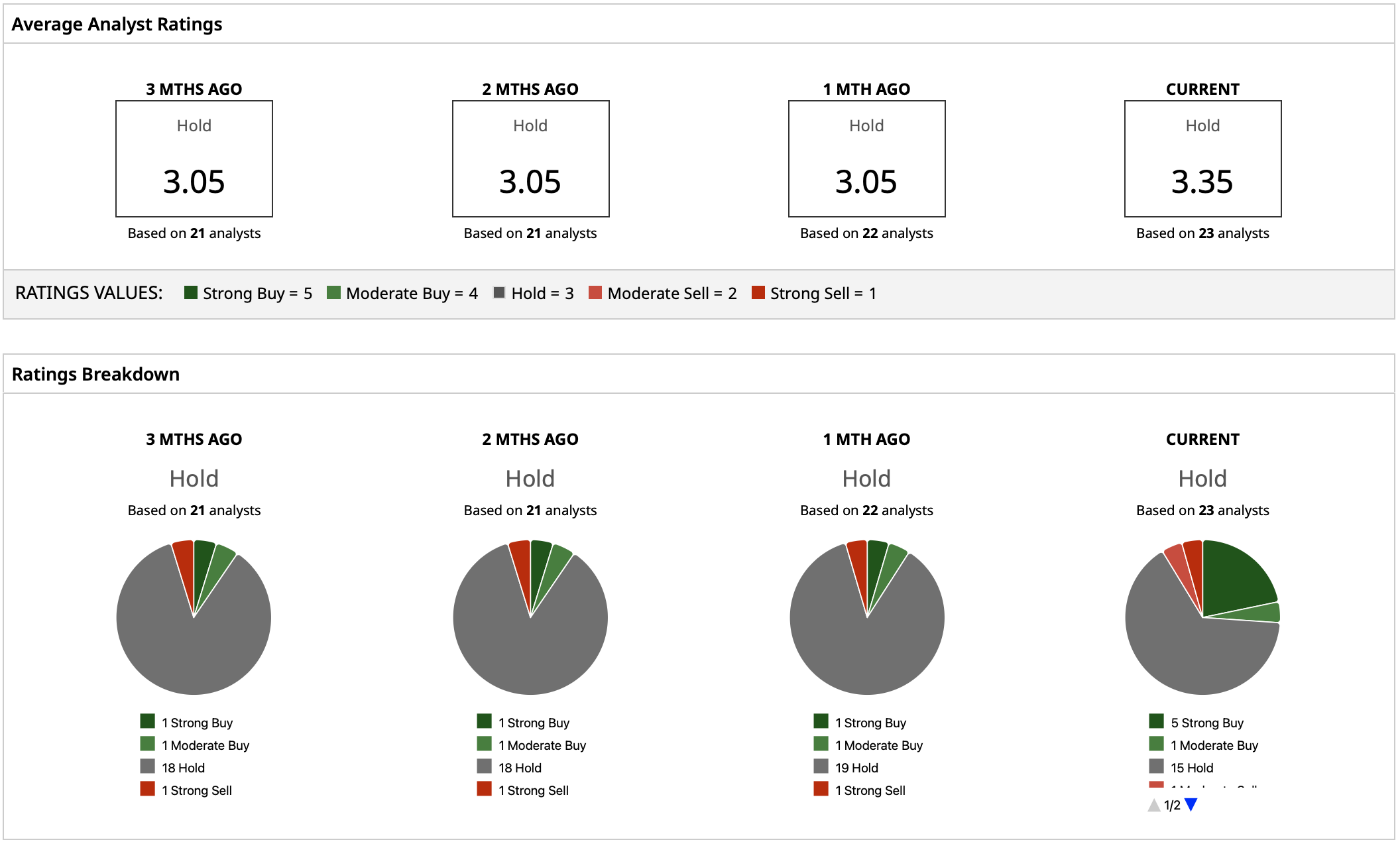
Evercore upgraded DUOL stock to an “Outperform” rating and doubled its price target to $210, while DA Davidson upgraded the stock to a "Buy" and raised its price target to $175. However, Wall Street is much more conservative about Duolingo's prospects with a consensus “Hold” rating.
The mean price target for DUOL stock is $132.56, which points to approximately 14% potential downside from current levels. At the same time, the highest price target of $210 points to potential upside of 36% from here.
On the date of publication, Yiannis Zourmpanos did not have (either directly or indirectly) positions in any of the securities mentioned in this article. All information and data in this article is solely for informational purposes. For more information please view the Barchart Disclosure Policy here.