


The Zhitong Finance App learned that sugar is becoming more and more expensive. According to the data, sugar prices soared 21.5% in August, the strongest monthly increase since October 2010 (rising 24% at the time). The Food and Agriculture Organization of the United Nations (FAO) Food Price Index also rose at the same time in August. Among the various commodities that have generally risen, sugar prices rose the most.
The FAO stated in a recent report: “This surge reflects multiple factors such as expectations of a decline in EU sugar beet production due to unfavorable weather, the impact of El Niño on the production prospects of major Asian sugar producers, the decline in sugar production in Brazil, and India's announcement of duty-free imports of raw sugar.”
Strong gains in August have driven sugar futures prices to rise by about 20% year to date, surpassing the S&P 500 index's increase of about 13%.
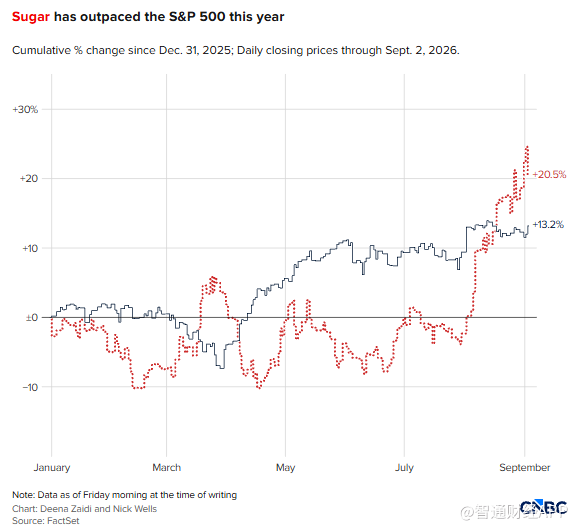
Multiple supply shocks resonate, and sugar prices hit the biggest monthly increase in nearly 16 years
According to the Food and Agriculture Organization of the United Nations, the rise in sugar prices is linked to multiple factors, which together drive up market prices.
William Osnato, director of commodity data research at Barchart, said that this round of sugar price increases reflects a shift in market expectations for global supply. According to Osnato, the damage caused by the summer heat wave to European sugar beet crops is one of the most important direct factors.
Beets are grown in the same region and season as corn and wheat, so the heatwave may have a major impact on sugar production.” Over the past month, the market has absorbed this factor. Many agencies have lowered their production estimates one after another.” Osnato said.
Major agencies have recently either lowered their production estimates or raised their supply-demand gap estimates. The European Commission's latest sugar market balance sheet estimates that in 2026/27, EU sugar production will drop 19% to 13.4 million tons from 16.6 million tons in 2025/26. Citi estimated the global sugar supply gap of 1.3 million tons in its research report last Tuesday, while Green Pool commodity experts estimated the gap to reach 3.2 million tons.
Osnato said, “They are all in the same direction; they are all estimating widening the gap.”
Citigroup analysts said in the report that among agricultural products traded on the Intercontinental Exchange, sugar is “the most confident bullish target.” The bank raised its three-month price target to 19 cents per pound for reasons including tight inventories, India's unexpected import plans, and worsening weather conditions in India, Thailand, and the European Union.
The biggest supply concern in the global sugar market: El Niño is approaching
Osnato said that El Niño is a global climate phenomenon that may lead to rising ocean temperatures and extreme weather, which is probably the “biggest forward-looking concern.”
The potential extreme El Niño will further increase the pressure on sugar prices.
Together, Brazil, India, and Thailand account for about 70% of global sugar exports. Goldman Sachs pointed out in a research report that droughts during the growing season may reduce sugar cane production, while excessive rainfall during the harvest season may interrupt field work and reduce sugar content in sugar cane. According to Climate Brink's multi-model median forecast, the temperature anomaly in the 3.4 Pacific Nino zone peaked at about 3.9 degrees Celsius (about 39 degrees Fahrenheit) in November, far exceeding the “super strong El Niño” threshold of 2 degrees Celsius.
El Niño is increasing, putting sugar production in Brazil, India and Thailand at risk
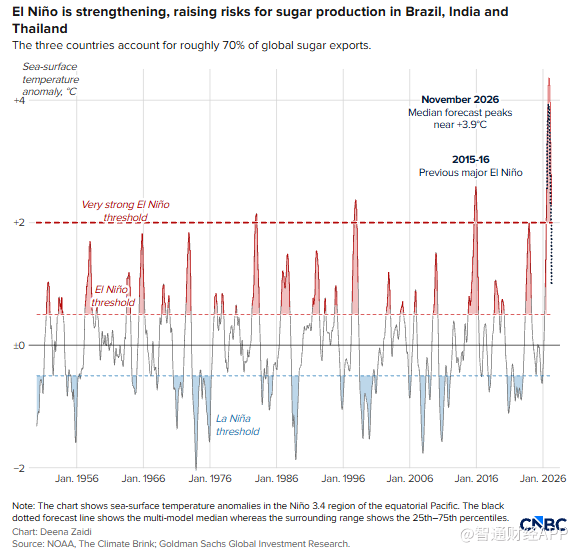
Rainfall continues to be below normal in India's major sugar producing regions. Weak monsoon winds may dry up reservoirs, undermining farmers' willingness to grow sugarcane, which consumes a lot of water during the next planting season. Furthermore, unusually warm water temperatures in the Pacific Ocean are expected to cause unstable rainfall and water scarcity problems in Thailand.
Global sugar market supply added another variable: Brazil switches to ethanol, India rarely imports
Rising energy prices have also made Brazilian ethanol more attractive than sugar, and Brazilian sugar mills can flexibly adjust the distribution ratio of sugar cane between the two.
Rob Johnson, director of economic and policy analysis at the American Sugar Federation, said: “When oil prices rise, countries that use sugar cane to produce ethanol are more motivated to produce more ethanol and export less sugar to the global market. When oil prices exceed $90 per barrel, countries like Brazil that heavily subsidize the ethanol industry will produce more biofuels, thereby reducing the supply of sugar in the market and driving up prices.”
Brazil accounts for about half of global sugar exports. Brazilian sugar mills can usually adjust production ratios between table sugar and ethanol based on profitability.
According to Goldman Sachs's analysis, since corn and sugar cane are important raw materials for ethanol production, due to the El Niño phenomenon, poor corn harvests may cause more sugar cane to be used for ethanol production, thereby reducing sugar that can be used for export.
Osnato said that the rain also delayed Brazil's harvest progress. Once the fields are dry, part of production can still be recovered, so a rebound in sugar content in Brazilian sugar cane or an acceleration in harvesting is currently one of the clearest risks of falling sugar prices.
India is the world's second-largest sugar producer after Brazil, and recently approved the duty-free import of 1 million tons of raw sugar. The Indian government said the move was aimed at addressing issues such as declining production, seasonal demand and rising prices to increase domestic sugar supply. In a context where India restricts exports on the one hand and enters the market as a buyer, the sources of sugar available to other importing countries will be further reduced.
Osnato said the decision was made after two consecutive seasons of poor harvests and was significant because it was India's first large-scale import of sugar since 2017/18. He pointed out that even if India ended up importing only half of the approved quantity, this move strengthened the judgment that “supply is more tight than previously anticipated.”
Citibank analyst Arkady Gevorkiyan wrote in the research report: “Brazil is still a key balanced supplier in the market, but there is little room for fault tolerance for weather-related execution risks during the rest of the harvest season.”