


Bruker has delivered a strong 1 year share price run, yet both its earnings multiples and an intrinsic value check still point to a stock that screens cheap relative to the current market price. Recent news around superconductors for fusion projects and softer recent returns over shorter windows give you a mix of excitement and hesitation when looking at what that valuation gap might really mean.
- Bruker shares are up 79.4% over the past year, which puts the recent pullback into context as a pause after a strong run rather than a clear reversal on its own.
- The collaboration between Bruker Energy & Supercon Technologies and Luvata on RRP superconductors can support expectations for future demand, while any disappointment in revenue growth or cash generation remains a key risk for today’s price tag.
- Across six separate checks the broader picture leans cheap, with Bruker scoring a high 5 out of 6 on value and both the Discounted Cash Flow (DCF) intrinsic value estimate and market multiples pointing to undervaluation.
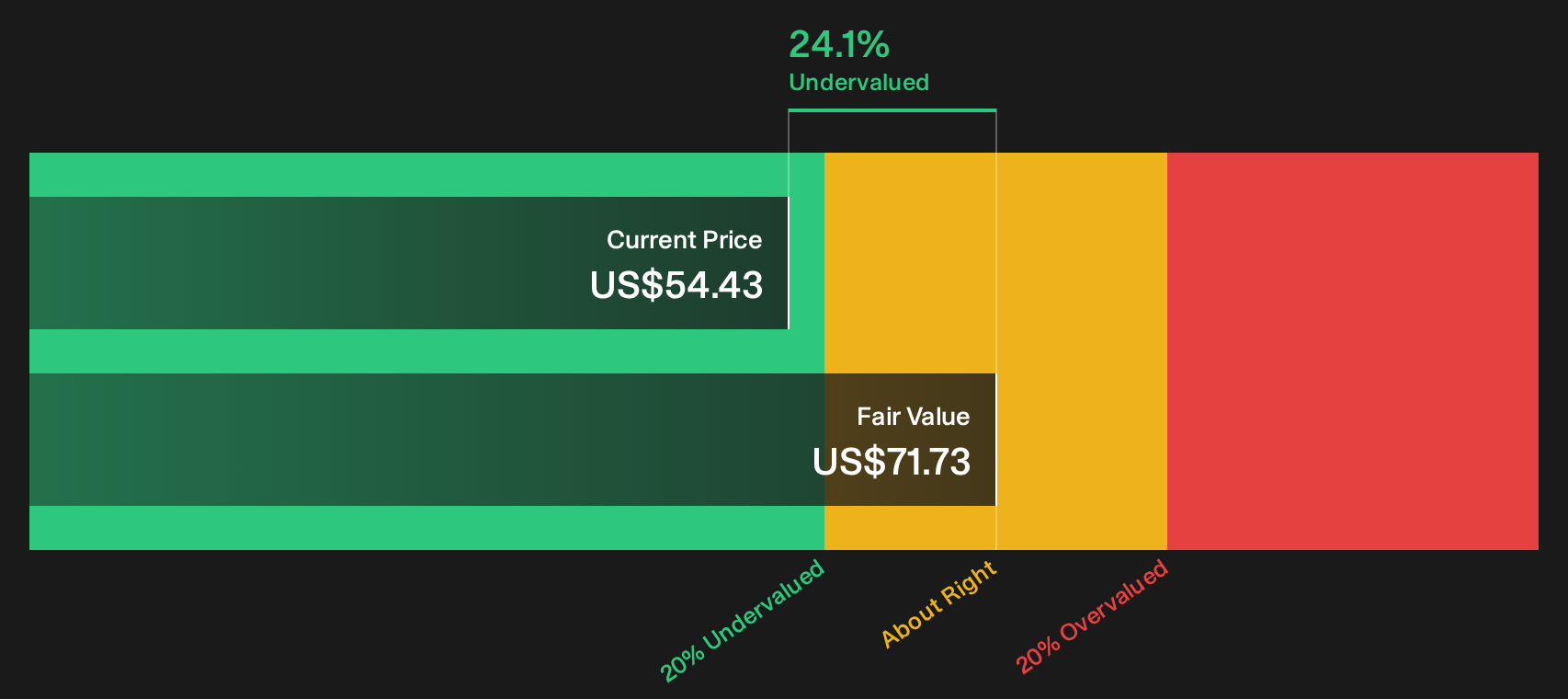
The issue now is whether that apparent discount, including an intrinsic value estimate that sits about 24.1% above the market price, still offers enough upside to compensate you for the business risks around Bruker.
Spot opportunities beyond Bruker by scanning a curated list of undervalued stocks that pair solid fundamentals with potential upside in 31 high quality undervalued stocks.Is Bruker a Bargain on Cash Flow?
The Discounted Cash Flow (DCF) model estimates what Bruker is worth based on the cash it can generate for shareholders over time. On the latest twelve month numbers, Bruker produced roughly $80 million of free cash flow, and the model then assumes that free cash flow grows from this base rather than shrinking.
Feeding those projections into a 2 Stage Free Cash Flow to Equity framework gives an intrinsic value estimate of about $72 per share, which is roughly 24.1% above the current market price. The recent miss on Q2 revenue expectations and softer guidance helps explain why the stock trades below that DCF value, even as the BEST and Luvata fusion collaboration points to potential long term demand for Bruker’s technology.
On this cash flow view, Bruker currently screens as undervalued relative to its DCF based intrinsic value estimate.
Our Discounted Cash Flow (DCF) analysis suggests Bruker is undervalued by 24.1%. Track this in your watchlist or portfolio, or discover 31 more high quality undervalued stocks.
Is Bruker a Bargain on Sales?
P/S fits Bruker well because the company is judged heavily on its ability to turn a large installed base and scientific products into steady revenue rather than near term earnings swings.
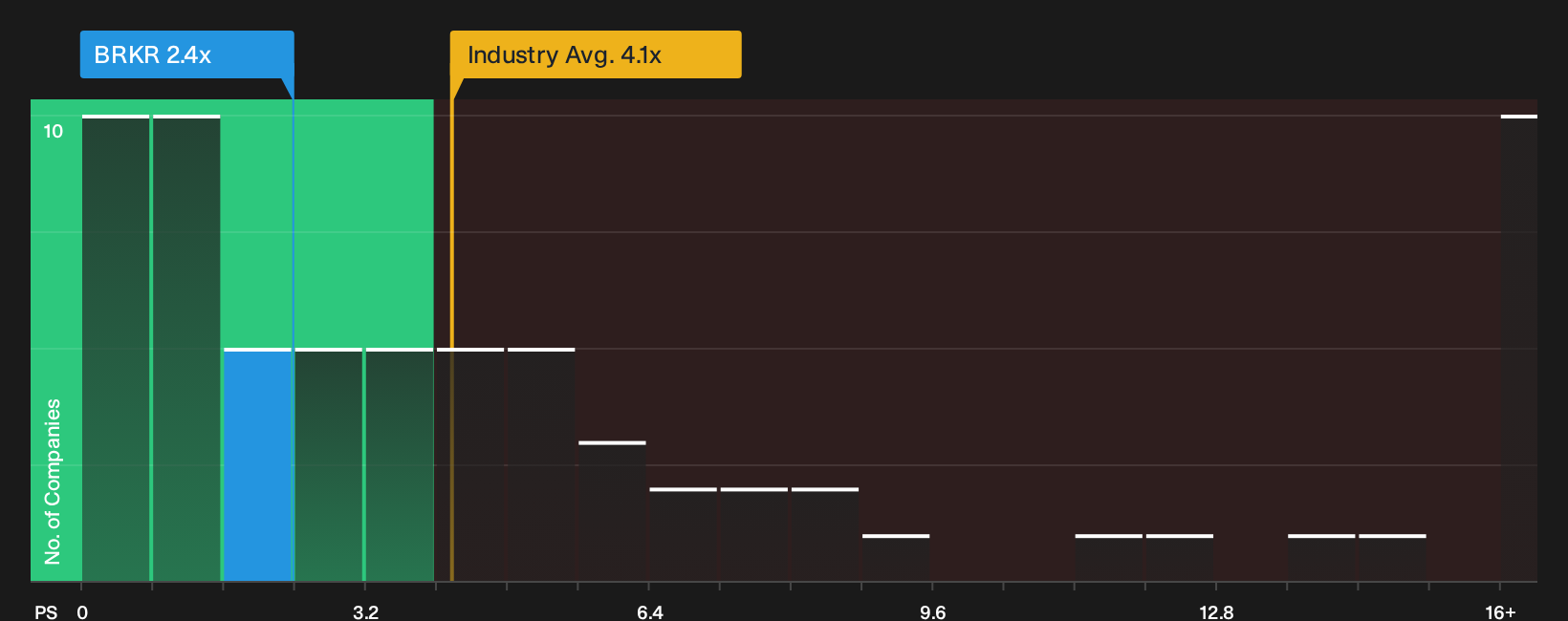
On this measure, Bruker trades on a P/S of about 2.4x. That sits well below the Life Sciences industry average of roughly 4.1x and far under the peer group average of about 9.9x. A tailored fair P/S ratio for Bruker, which factors in its sector, size and risk profile, comes out near 4.2x. Compared with that yardstick, the current multiple indicates the shares trade at a sizeable discount to what this framework suggests for the business.
On the P/S lens, Bruker stock appears undervalued relative to both sector norms and its own fair multiple estimate.
See what the numbers say about this price — find out in our valuation breakdown.
The Bruker Narrative: What Would Justify Today's Price?
Simply Wall St Narratives for Bruker pick up where this valuation puzzle leaves off by spelling out the specific assumptions on growth, profitability and earnings that would need to hold for the stock to be worth materially more or less than today’s price, and they sit on the company’s Community page. Rather than relying on a single multiple or model output, each narrative lays out the underlying expectations for Bruker’s fair value so you can compare them with future results as they are reported.
The Bruker community is split between a recovery story driven by infection detection and tools demand, and a more cautious view focused on funding and pricing pressure.
Bull case: 9% undervalued
"Growing adoption and placements in consumables/software-driven businesses are enhancing recurring revenue streams and earnings stability, which should steadily lift overall net margins..."
Read the full Bull Case to see why Bruker could be undervalued
Bear case: 29% overvalued
"Heavy reliance on academic and government research funding poses structural risks, especially amid major budget cuts in key markets..."
Read the full Bear Case to see why Bruker could be overvalued
Do you think there's more to the story for Bruker? Head over to our Community to see what others are saying!
The Bottom Line
Bruker screens as undervalued on both the Discounted Cash Flow (DCF) intrinsic value estimate, which sits about 24.1% above the market price, and on revenue multiples that price the business below sector norms and its own fair ratio. The consistency between these tools suggests the discount is not just a quirk of one model but reflects a broad market stance on the risks around funding, execution, and demand. For anyone weighing the bull and bear arguments, the key question now is whether Bruker can turn its technology pipeline and installed base into cash flow that aligns with those intrinsic value assumptions without encountering a prolonged growth or margin setback.
This article by Simply Wall St is general in nature. We provide commentary based on historical data and analyst forecasts only using an unbiased methodology and our articles are not intended to be financial advice. It does not constitute a recommendation to buy or sell any stock, and does not take account of your objectives, or your financial situation. We aim to bring you long-term focused analysis driven by fundamental data. Note that our analysis may not factor in the latest price-sensitive company announcements or qualitative material. Simply Wall St has no position in any stocks mentioned.
Have feedback on this article? Concerned about the content? Get in touch with us directly. Alternatively, email editorial-team@simplywallst.com