


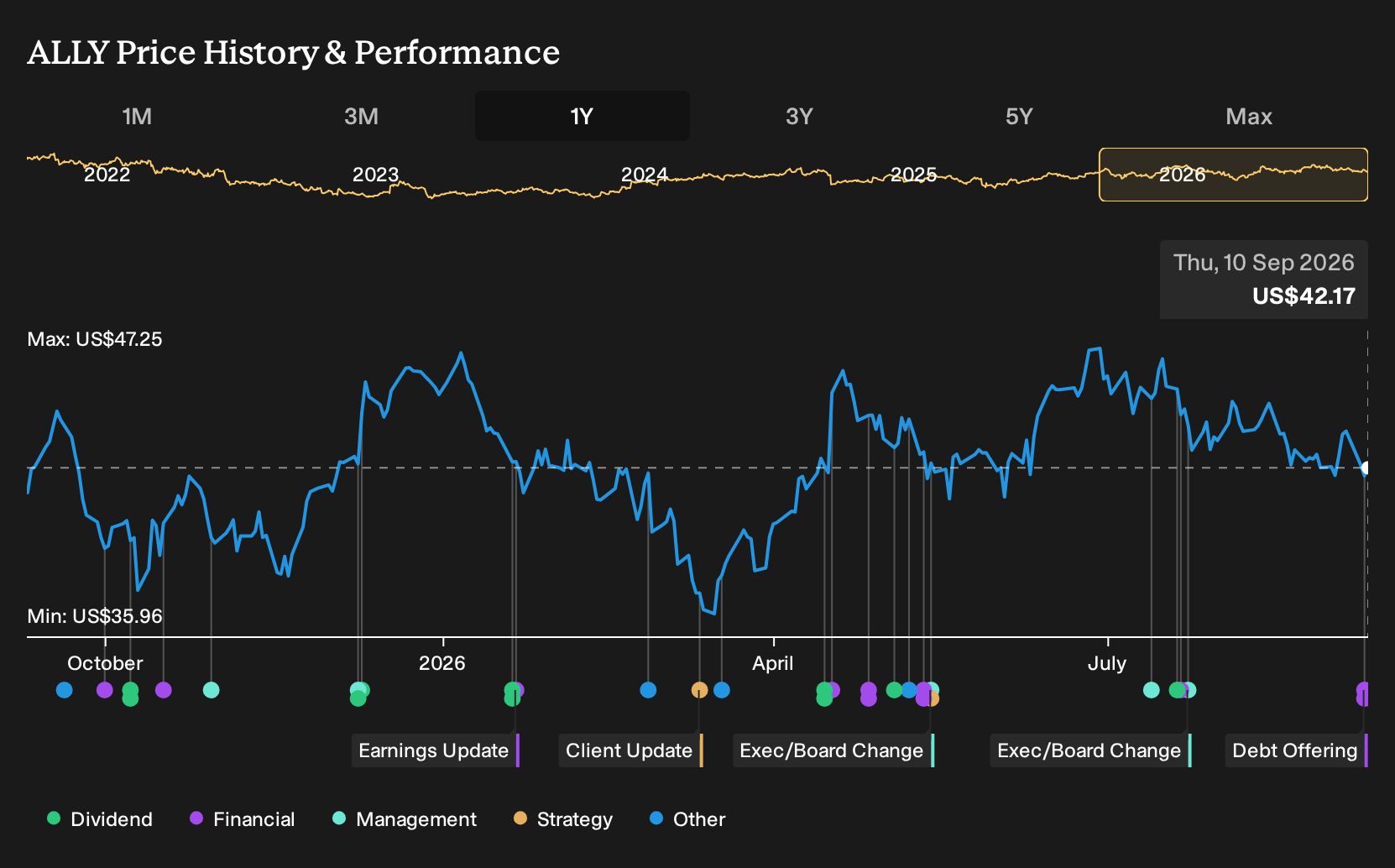
- Ally Financial has completed a US$750 million fixed to floating rate senior unsecured note offering priced at 100%, with a variable coupon and callable structure, due September 16, 2030.
- The fresh senior funding adds another data point on Ally Financial's funding mix and cost of capital, which matter for net interest margins and balance sheet flexibility.
- We will now explore how Ally Financial's investment narrative may shift as investors weigh this US$750 million variable rate senior note issuance.
Scan how Ally Financial funds itself, then widen the lens with a curated set of resilient balance sheet stocks in the list of solid balance sheet and fundamentals (23 results) to compare funding strength and flexibility.
Ally Financial Investment Narrative Recap
To own Ally Financial, you need to be comfortable with a bank that leans heavily on auto and consumer credit but is using a digital model and cost control to push for steadier earnings. The near term story still revolves around credit quality in auto, funding costs, and how well origination yields hold up against competition from banks and fintechs.
The new US$750 million fixed to floating senior note affects that picture mostly at the margin. It adds funding visibility but does not change the main short term swing factor, which is how credit losses and deposit trends evolve. The biggest current risk remains consumer credit stress and any hit to auto financing volumes.
The completed fixed to floating rate notes due September 16, 2030, sit directly within this funding and earnings trade off. A variable coupon and callable structure can influence Ally Financial's interest expense path and flexibility, which ties directly into net interest margins and capacity to support higher yielding auto, corporate, and insurance related assets.
For catalysts, the key question is whether this type of senior unsecured funding allows the bank to continue remixing the balance sheet toward higher yielding loans while managing credit risk. If credit costs rise or deposit growth softens, this new debt could act more like a headwind to returns. If asset mix and underwriting remain disciplined, it supports execution on the existing earnings and dividend outlook.
Ally Financial Long Term Growth Assumptions
Analysts see Ally Financial leaning on steady top line expansion and fatter profit margins over the next few years rather than dramatic reinvention. The forecast points to revenue growing 8.5% each year for the next 3 years, with profit margins moving from 16.7% today to 19.8% by around 2029.
Consensus expectations put current earnings at US$1.3b and point to US$1.9b by the 2029 estimate window, with a wide range of views around that central case. The most optimistic forecasts call for US$2.5b of profit, while the most cautious cluster around US$1.7b.
Ally Financial's narrative projects US$9.8b revenue and US$1.9b earnings by 2029. This rests on 8.5% yearly revenue growth and an earnings increase of about US$0.6b from US$1.3b today.
That step up in profitability also comes with an implied valuation shift. To line up with the analyst scenario, the stock would move from trading on a P/E of 10.4x today to 11.7x on those 2029 earnings, a level above the current 9.8x multiple cited for the broader US consumer finance group.
Forecasts also build in only a very small increase in the share count, with analysts modeling 0.08% annual growth in shares outstanding. For anyone tracking per share metrics like earnings per share or dividends per share, that expected dilution is minimal relative to the earnings bridge described above.
Uncover why Ally Financial's fair value indicates a 28% potential upside to its current price that may not last much longer.
Exploring Other Perspectives
For Ally Financial, the alternate view focuses on auto lending risk. The more cautious analysts were only penciling in about US$9.9b revenue and US$1.8b earnings by 2029 before this US$750m variable rate deal, which represents a smaller increase than consensus. That gap shows how strongly opinions can differ, so consider both perspectives as this new funding influences future updates.
Explore 3 other Ally Financial fair value estimates, including one that suggests it could be worth just $46.64.
The Verdict Is Yours
Disagree with existing narratives? Extraordinary investment returns rarely come from following the herd, so consider your own analysis carefully.
- A great starting point for your Ally Financial research is our analysis highlighting 5 key rewards that could impact your investment decision.
- See our latest analysis for Ally Financial. The report includes a comprehensive fundamental analysis summarized in a single visual, the Snowflake, making it easy to evaluate Ally Financial's overall financial health at a glance.
Looking For More Ally Financial Sized Investment Ideas?
If Ally Financial has you thinking more broadly about credit risk, funding costs, and balance sheet strength, it can help to line it up against a wider peer group. Use the Simply Wall St Screener to surface other stocks that match the kind of return profile and risk balance you want to target next.
- For investors who want income with resilience, focus on businesses that pair strong cash generation with meaningful yields using the 6 dividend fortresses.
- If capital preservation matters most, narrow in on companies with robust finances and steadier risk profiles via the 11 resilient stocks with low risk scores.
- For those hunting for potential mispricings, scan fundamentally solid businesses that screens flag as attractively valued through the 33 high quality undervalued stocks.
This article by Simply Wall St is general in nature. We provide commentary based on historical data and analyst forecasts only using an unbiased methodology and our articles are not intended to be financial advice. It does not constitute a recommendation to buy or sell any stock, and does not take account of your objectives, or your financial situation. We aim to bring you long-term focused analysis driven by fundamental data. Note that our analysis may not factor in the latest price-sensitive company announcements or qualitative material. Simply Wall St has no position in any stocks mentioned.
Have feedback on this article? Concerned about the content? Get in touch with us directly. Alternatively, email editorial-team@simplywallst.com