


Ralph Lauren has delivered a huge 5 year run for shareholders, yet the current valuation signals are pulling in different directions, with an intrinsic value estimate pointing to some upside while the broader checks say the stock is not a clear bargain.
- The share price has returned about 231% over 5 years, which puts extra pressure on today’s price tag to be justified by future cash flows.
- Future cash generation from the core brand portfolio can support the current market value, while any setback in profitability or cash flow conversion may quickly weigh on how much investors are willing to pay.
- The broader valuation framework, where Ralph Lauren screens as undervalued in 2 of 6 checks, points to a stock that leans expensive rather than a straightforward bargain, even though the intrinsic value estimate suggests it is about 11% below that level.
The issue now is whether Ralph Lauren’s current price around US$336.67 leaves enough room between the market value and the intrinsic value estimate to appeal to investors after such a strong multiyear rise.
Stress test your Ralph Lauren thesis against other potential opportunities by scanning 33 high quality undervalued stocks that also pair strong fundamentals with what our models flag as discounted prices.
Is Ralph Lauren a Bargain on Cash Flow?
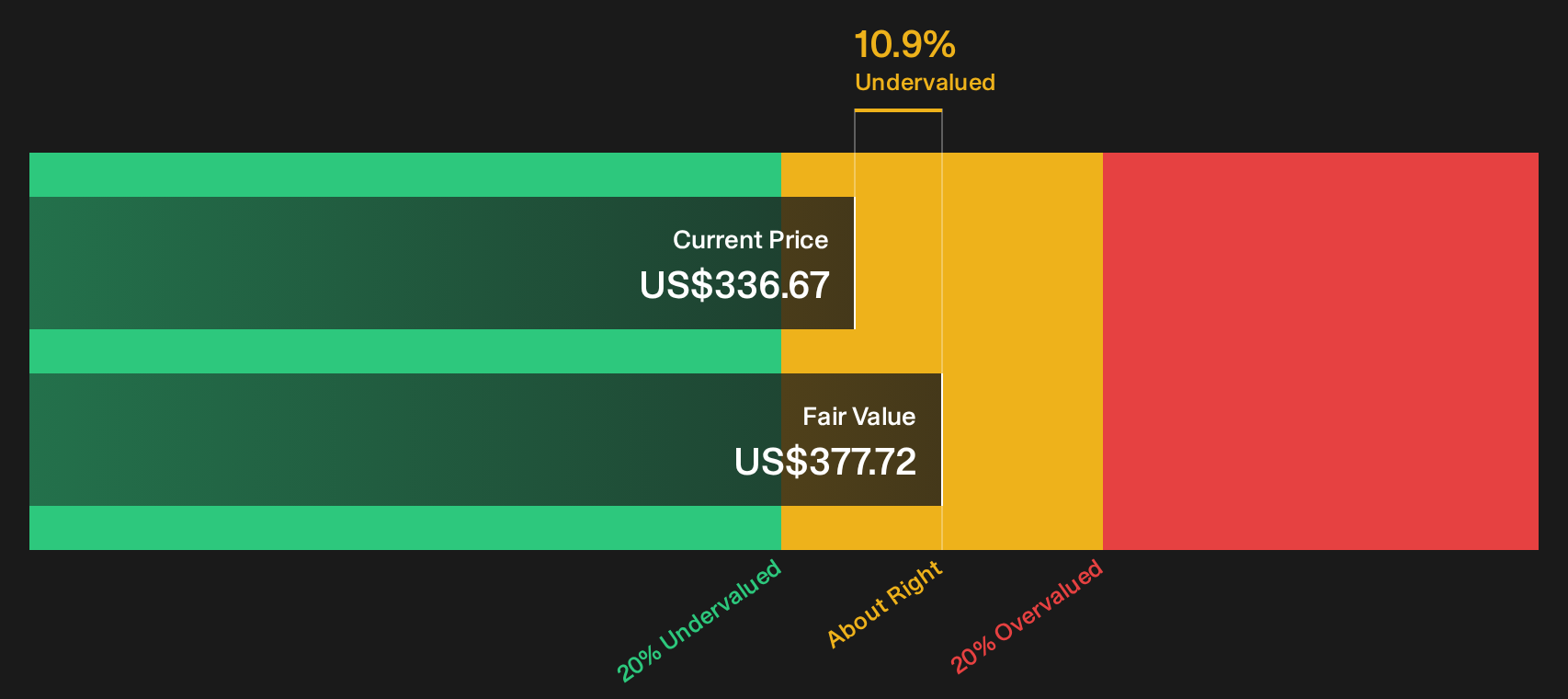
The Discounted Cash Flow model here uses Ralph Lauren’s projected free cash generation to estimate what the shares might reasonably be worth today. On this view, the business produced about $1.02b in free cash flow over the last twelve months, with the forecast path assuming that cash flows grow from this base rather than shrink.
When those future cash streams are discounted back, the model points to an intrinsic value of about $378 per share. Against the recent price around $337, the implied gap is roughly 10.9%. This suggests the market is pricing Ralph Lauren below what its current free cash flow profile supports. The cushion is not large after a strong multiyear run, but it does leave some room for investors who are comfortable with the assumptions embedded in the forecast.
On this DCF view, Ralph Lauren currently screens as undervalued relative to its estimated intrinsic worth.
Our Discounted Cash Flow (DCF) analysis suggests Ralph Lauren is undervalued by 10.9%. Track this in your watchlist or portfolio, or discover 33 more high quality undervalued stocks.
Is Ralph Lauren Fairly Priced on Earnings?
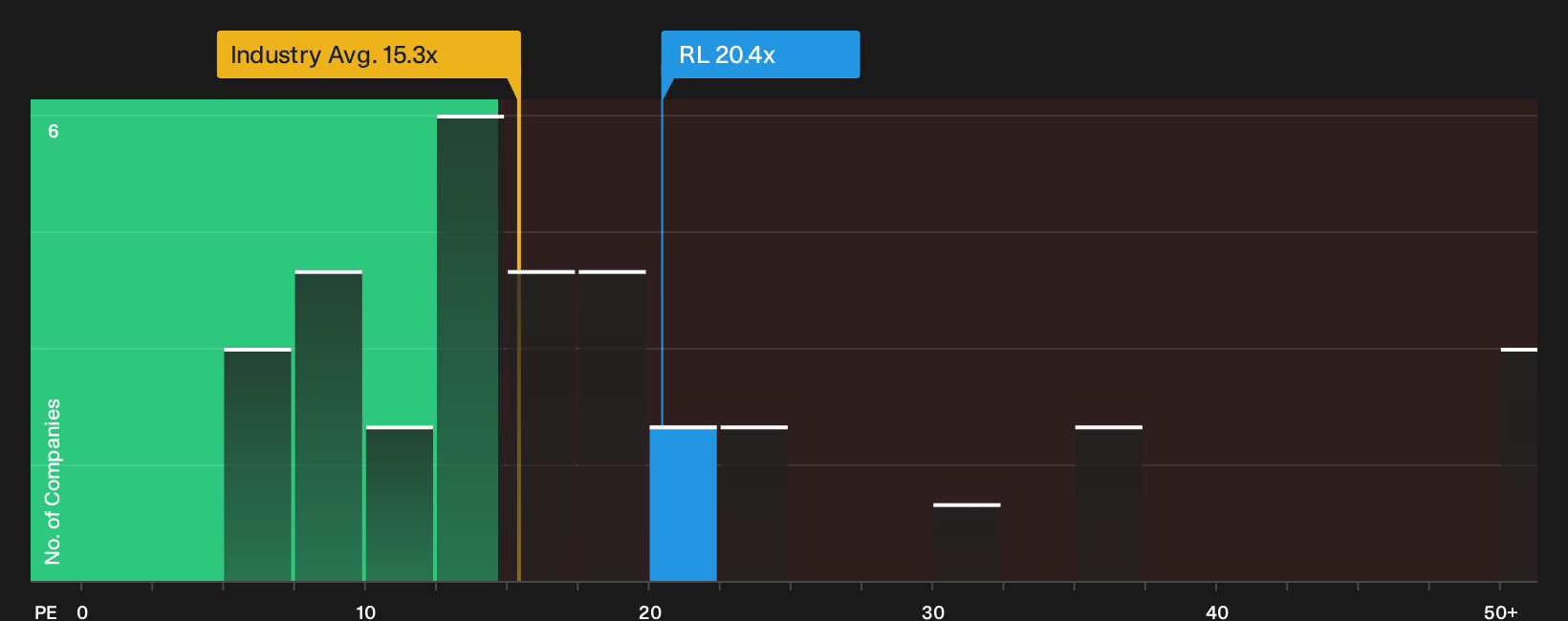
The P/E ratio suits Ralph Lauren because earnings are a clean anchor for a mature, branded apparel business. On this yardstick, the stock trades on about 20.4x earnings, which is higher than both the luxury sector average of roughly 15.3x and a peer group closer to 16.5x. That premium indicates investors are willing to pay more for each dollar of profit than they pay for many other luxury stocks.
A more tailored benchmark, which attempts to adjust for Ralph Lauren’s growth profile, margins, size and risk, points to a fair P/E of about 18.9x. The current 20.4x is only modestly above that level. The gap implies the valuation is neither extremely cheap nor stretched, and instead sits in a range where expectations embedded in the share price broadly align with what the model suggests is reasonable.
On the P/E lens, Ralph Lauren appears to be trading at roughly a fair valuation rather than at a clear discount or premium.
See what the numbers say about this price — find out in our valuation breakdown.
The Ralph Lauren Narrative: What Would Justify Today's Price?
Simply Wall St Narratives pick up where the Ralph Lauren valuation puzzle leaves off and spell out which paths for growth, margins and earnings would need to hold for the stock to justify a meaningfully higher or lower price than today. Rather than relying on a single P/E or DCF output, each narrative lays out its underlying assumptions so you can compare them with Ralph Lauren's reported numbers as they come through.
One of the top community narratives on Ralph Lauren: 25% undervalued
"Premium brand positioning and reduced reliance on discounting continue to increase average unit retail, illustrating strengthened pricing power and value perception among consumers…"
Read one of the top narratives on Ralph Lauren
Do you think there's more to the story for Ralph Lauren? Head over to our Community to see what others are saying!
The Bottom Line
Ralph Lauren screens as modestly undervalued on a Discounted Cash Flow (DCF) view, with the intrinsic value estimate sitting only slightly above the current share price. The market multiple workup points to a stock that looks about right rather than clearly cheap, and the broader valuation checks remain weak despite the DCF signal. That split largely comes down to how much weight you place on future cash generation versus what investors are currently willing to pay for comparable brands. The real swing factor from here is whether Ralph Lauren can keep translating brand strength into steady cash flow without requiring heavier investment that would erode that valuation cushion.
This article by Simply Wall St is general in nature. We provide commentary based on historical data and analyst forecasts only using an unbiased methodology and our articles are not intended to be financial advice. It does not constitute a recommendation to buy or sell any stock, and does not take account of your objectives, or your financial situation. We aim to bring you long-term focused analysis driven by fundamental data. Note that our analysis may not factor in the latest price-sensitive company announcements or qualitative material. Simply Wall St has no position in any stocks mentioned.
Have feedback on this article? Concerned about the content? Get in touch with us directly. Alternatively, email editorial-team@simplywallst.com