


- Hamilton Insurance Group has recently seen analysts project a decline in upcoming EPS compared with the same quarter last year, while revenue is expected to be higher. This points to pressure on profitability even as business volumes hold up.
- The mix of weaker projected earnings per share alongside higher sales suggests rising costs or loss experience could be weighing on near term margins for Hamilton Insurance Group, even as analysts maintain constructive estimates.
- We will now look at how Hamilton Insurance Group's investment narrative is affected by weaker expected EPS alongside anticipated revenue growth.
Scan how Hamilton Insurance Group compares with other insurers facing similar earnings pressure and revenue resilience by reviewing the hand picked 11 resilient stocks with low risk scores in the sector.
Hamilton Insurance Group Investment Narrative Recap
For a shareholder in Hamilton Insurance Group, the core belief is that demand for specialty insurance and reinsurance can support steady premium volumes while underwriting discipline keeps loss ratios under control. The latest guidance that EPS could drop even as revenue is projected higher puts the focus on cost trends and claims experience in the near term.
The key short term catalyst is how the next few quarters of underwriting and reserving outcomes validate or challenge the recent track record of high quality earnings and a 29.5% return on equity. The biggest risk is that large losses or rising expenses squeeze margins further. The recent EPS pressure does not yet look like a thesis breaking event.
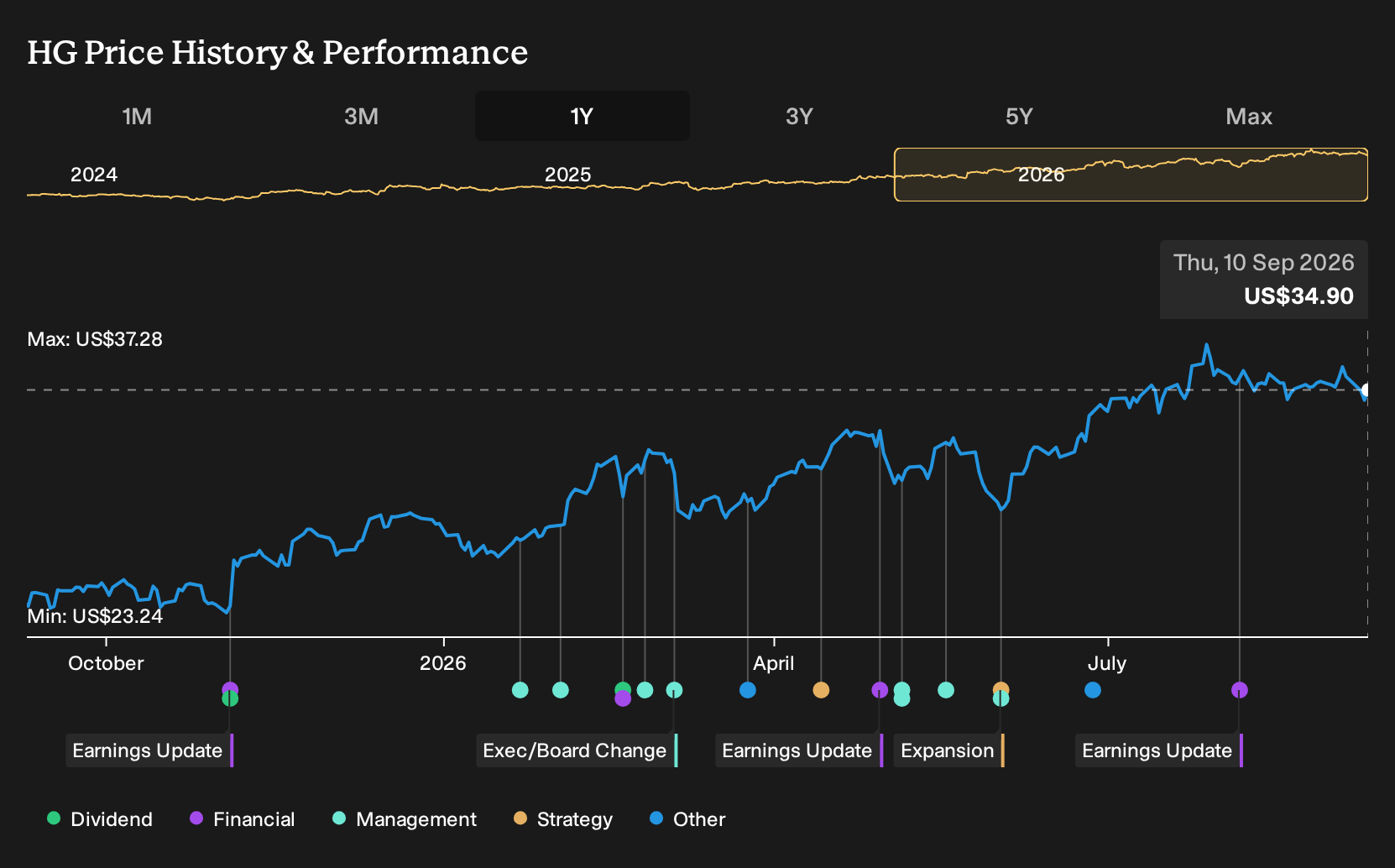
The most relevant development tied to this news is the market reaction. Hamilton Insurance Group shares have fallen more than the broader market recently while analysts still expect revenue to rise and have revised estimates upward. That mix suggests sentiment has become more cautious on near term profitability even as the underlying business volume outlook remains constructive.
This matters for catalysts because it puts more weight on execution in specialty and reinsurance lines that already carry higher volatility. Delivery against current expectations on loss ratios, expense control and reserve stability now sits at the center of the story. The existing Zacks Rank and valuation arguments are secondary to how clean the next set of results looks.
Hamilton Insurance Group is currently modeled to reach about $3.3 billion in revenue and $546.3 million in earnings by 2029, which implies revenue growth of 3.1% per year and an earnings decline of about $39.4 million from current earnings of $585.7 million.
Discover how Hamilton Insurance Group's fair value indicates an 11% potential upside to its current price that may not last much longer.
Exploring Other Perspectives
Some of the most optimistic analysts lean into a different catalyst for Hamilton Insurance Group. They focus on extra capacity from third party capital and sidecars and had been modeling about $3.5b of revenue and $563.8m of earnings by 2029. Their view may shift after this EPS update, so treat it as one viewpoint to compare.
Explore 2 other Hamilton Insurance Group fair value estimates, including one that suggests as much as 245% upside from the current price!
Decide For Yourself
Disagree with existing narratives? Extraordinary investment returns rarely come from following the herd, so go with your instincts.
- A great starting point for your Hamilton Insurance Group research is our analysis highlighting 3 key rewards and 1 important warning sign that could impact your investment decision.
- See our latest analysis for Hamilton Insurance Group. The report includes a comprehensive fundamental analysis summarized in a single visual, the Snowflake, making it easy to evaluate Hamilton Insurance Group's overall financial health at a glance.
Looking for more investment ideas beyond Hamilton Insurance Group?
If the Hamilton Insurance Group story has you thinking about portfolio balance, use the Simply Wall St Screener to quickly scan other companies that fit the kind of risk, income, or valuation profile you want to focus on next.
- For investors who want potential upside without taking on excessive balance sheet stress, start with a curated 18 high quality undiscovered gems that already pass key fundamental checks.
- If consistency and resilience matter most to you, filter for companies with stronger financial footing by reviewing a focused list of solid balance sheet and fundamentals (23 results) that keep leverage and liquidity in check.
- Income focused investors can target cash return opportunities by scanning a hand picked 6 dividend fortresses that aim to combine robust yields with more dependable payout histories.
This article by Simply Wall St is general in nature. We provide commentary based on historical data and analyst forecasts only using an unbiased methodology and our articles are not intended to be financial advice. It does not constitute a recommendation to buy or sell any stock, and does not take account of your objectives, or your financial situation. We aim to bring you long-term focused analysis driven by fundamental data. Note that our analysis may not factor in the latest price-sensitive company announcements or qualitative material. Simply Wall St has no position in any stocks mentioned.
Have feedback on this article? Concerned about the content? Get in touch with us directly. Alternatively, email editorial-team@simplywallst.com