


- Fidelity National Information Services reported record first half core wins in community and regional banking and rolled out new AI driven and embedded banking products, alongside a collaboration with Ericsson to speed digital wallet deployments.
- These moves suggest that more banks and wallet providers are consolidating around Fidelity National Information Services for connected, multi product technology rather than point solutions.
- The next area of attention is how this wave of record core wins shapes Fidelity National Information Services' investment narrative.
Scan other bank technology players riding similar themes by checking the 89 AI infrastructure stocks that screen for companies building the plumbing behind AI driven and embedded financial services.
Fidelity National Information Services Investment Narrative Recap
To own Fidelity National Information Services, you need to believe its connected banking, payments and AI tools can stay relevant as financial institutions modernize and as fintech competitors push hard on price and product breadth. The record first half core wins and millions of accounts added support that belief operationally, but do not remove pressure from rising competitors or changing buying patterns.
In the near term, the key swing factor is whether these wins translate into stable, recurring software and processing revenue while integration work, debt and acquisition complexity stay under control. The biggest risk is execution. If rollouts slip or costs stay high, earnings pressure flagged by analysts can intensify.
The Embedded Banking Platform announcement ties directly into the same theme as the core wins. Both point to Fidelity National Information Services pushing deeper into being the plumbing behind embedded and AI supported banking, across account origination, digital channels and payments, instead of just selling point products.
In terms of catalysts, that embedded finance push gives banks new ways to reach corporate clients inside existing software, while keeping accounts on their own balance sheet. It also brings new operational questions. FIS still has to deliver reliable APIs, handle compliance at scale and manage complex partnerships without adding to the integration and margin risks already on investor radar.
Fidelity National Information Services' current analyst storyline points to revenue of $15.1b and earnings of $2.1b by 2029. That path assumes revenue grows at 7.4% a year, while earnings decline by $1.3b from $3.4b today to reach the 2029 consensus level.
Uncover why Fidelity National Information Services' fair value indicates a 33% potential upside to its current price that could narrow quickly.
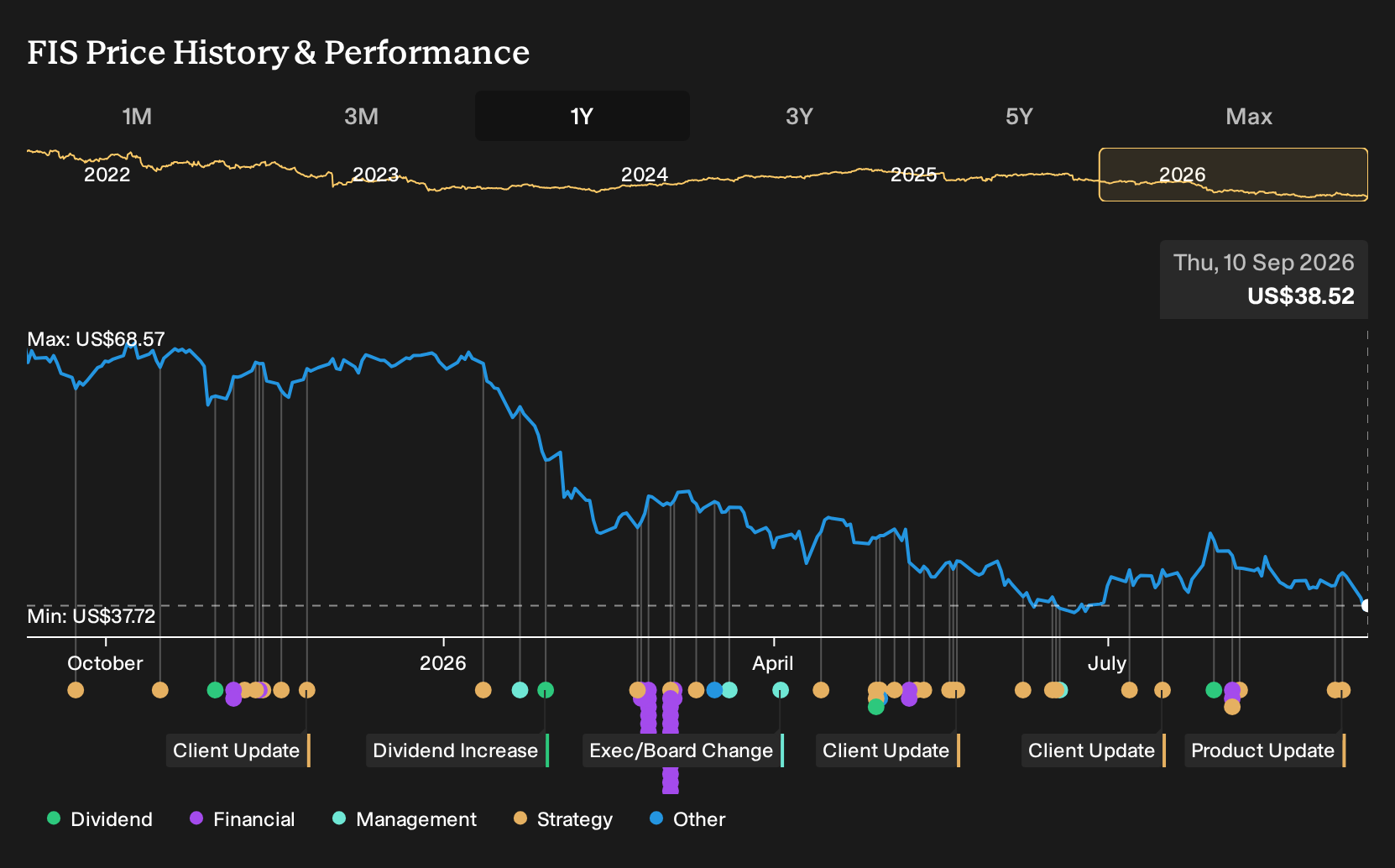
Exploring Other Perspectives
One alternate view focuses on margins rather than growth. The most pessimistic analysts worry that Fidelity National Information Services may need heavy AI and data spending that drags profitability, even with record core wins. Before this news, they were modeling about $14.9b of revenue and $1.6b of earnings by 2029, which is far below consensus. That gap shows how widely opinions differ. Use this event as a prompt to compare those assumptions and decide which narrative you find more convincing.
Explore 2 other Fidelity National Information Services fair value estimates, including one that suggests it could be worth just $51.04!
Decide For Yourself
Disagree with existing narratives? Extraordinary investment returns rarely come from following the herd, so consider developing and trusting your own research.
- A great starting point for your Fidelity National Information Services research is our analysis highlighting 4 key rewards and 3 important warning signs that could impact your investment decision.
- See our latest analysis for Fidelity National Information Services. The report includes a comprehensive fundamental analysis summarized in a single visual called the Snowflake, making it easy to evaluate Fidelity National Information Services' overall financial health at a glance.
Looking For More Ideas Beyond Fidelity National Information Services?
Once you have a view on Fidelity National Information Services, it can help to widen your watchlist with other stocks that fit clear, fundamentals based themes using the Simply Wall St Screener.
- For investors who want potential upside without paying up for quality, consider scanning a curated set of 18 high quality undiscovered gems that pair strong fundamentals with lower market attention.
- If capital preservation and steadier profiles matter more to you than chasing aggressive growth, filter for 11 resilient stocks with low risk scores that pass stricter risk checks.
- Income focused investors can focus on cash return potential by reviewing 6 dividend fortresses that combine higher yields with supporting fundamentals.
This article by Simply Wall St is general in nature. We provide commentary based on historical data and analyst forecasts only using an unbiased methodology and our articles are not intended to be financial advice. It does not constitute a recommendation to buy or sell any stock, and does not take account of your objectives, or your financial situation. We aim to bring you long-term focused analysis driven by fundamental data. Note that our analysis may not factor in the latest price-sensitive company announcements or qualitative material. Simply Wall St has no position in any stocks mentioned.
Have feedback on this article? Concerned about the content? Get in touch with us directly. Alternatively, email editorial-team@simplywallst.com