


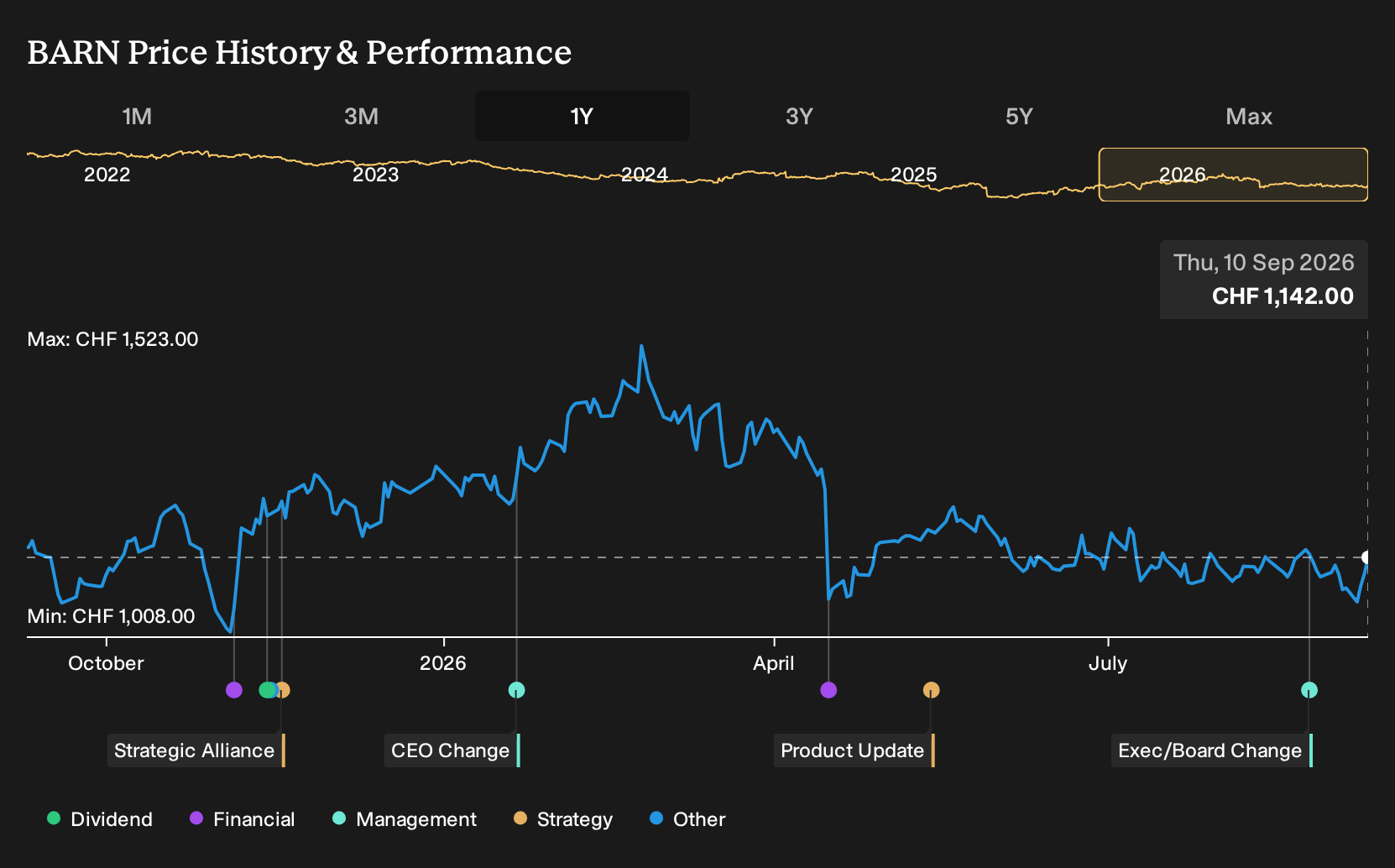
- Barry Callebaut presented at Barclays' Global Consumer Staples Conference in Boston and outlined how a well supplied cocoa market supports its current risk management approach after recent weather and disease concerns in West Africa.
- The proposed 6% pay increase for Ghanaian cocoa farmers, combined with Ivory Coast's larger harvest, highlights how farmer incomes and regional crop quality can directly reshape Barry Callebaut's sourcing costs and supply security.
- This article will examine how Barry Callebaut's investment narrative interacts with cocoa supply risks highlighted by Ghana's proposed 6% farmer pay rise.
Scan beyond Barry Callebaut and see how other cocoa exposed and consumer staples suppliers stack up using our hand picked list of solid balance sheet and fundamentals (192 results).
Barry Callebaut Investment Narrative Recap
To own Barry Callebaut you need to be comfortable with a chocolate and cocoa specialist that sits on top of a very volatile raw material. The big belief is that its sourcing scale, risk management and Next Level cost program can offset cocoa swings enough to keep margins and cash flow on track. The latest conference comments about a well supplied market support that idea, but only as long as weather and disease issues do not escalate.
Right now the most important short term catalyst is execution on cost savings and deleveraging while cocoa prices remain elevated and customer volumes adapt. The biggest risk remains bean price volatility feeding into higher financing, futures carry and inventory costs, especially with interest cover already tight. The Ghana farmer price proposal and Ivory Coast harvest data change sentiment around near term cocoa availability but do not yet look like a decisive break in that underlying risk.
The Barclays Global Consumer Staples Conference appearance is the piece to focus on because it put Barry Callebaut’s operating playbook against live cocoa market headlines. Management stressed that cocoa is currently well supplied and that the group has secured beans into early 2026, which matters directly for near term margin visibility, contract pricing and volume commitments to large food manufacturers.
For catalysts, that supply message ties closely into the Next Level investment program and broader effort to adapt the financing model. A well stocked market, combined with secured sourcing, can make it easier to execute on cost savings and working capital discipline. The flip side is clear: if West African crop quality or yields disappoint relative to these comments, the firm could feel renewed pressure on rolling futures, carry costs and liquidity, which would put more scrutiny on interest cover and cash generation over the next year.
Barry Callebaut’s current analyst storyline points to CHF 11.1b in revenue and CHF 425.9m in earnings by 2029, based on a forecast yearly revenue decline of 8.1% and an earnings increase of about CHF 182.7m from CHF 243.2m today.
Uncover why Barry Callebaut's fair value aligns with its current price.
Exploring Other Perspectives
Some of the most optimistic analysts focus less on cocoa supply risk and more on Barry Callebaut’s potential margin recovery if the Next Level program and digital projects beat expectations. Before this Ghana and Ivory Coast news, the bullish camp was already pencilling in CHF 12.8b of revenue and CHF 588.3m of earnings by 2029. You can treat this conference update as a fresh test of those stronger forecasts and decide which storyline feels more realistic for you.
Explore 3 other Barry Callebaut fair value estimates, including one that suggests it could be valued at CHF1147.
The Verdict Is Yours
Disagree with existing narratives? Extraordinary investment returns rarely come from following the herd, so go with your instincts.
- A great starting point for your Barry Callebaut research is our analysis highlighting 3 key rewards and 2 important warning signs that could impact your investment decision.
- See our latest analysis for Barry Callebaut. The report includes a comprehensive fundamental analysis summarized in a single visual, the Snowflake, making it easy to evaluate Barry Callebaut's overall financial health at a glance.
Looking for more Barry Callebaut investment ideas?
If the Barry Callebaut story has sharpened your thinking about cocoa exposure and balance sheet strength, it can be useful to compare it with other listed businesses that share similar financial traits or offer a different risk profile.
- For investors who want income first and volatility second, take a look at 167 dividend fortresses that may appeal if you prioritise yield and balance sheet support.
- If you are hunting for quality at a sensible entry point, scan through 183 high quality undervalued stocks that combine solid fundamentals with more modest pricing.
- When capital preservation matters as much as upside potential, filter the market using 99 resilient stocks with low risk scores that score well on financial resilience and stability.
This article by Simply Wall St is general in nature. We provide commentary based on historical data and analyst forecasts only using an unbiased methodology and our articles are not intended to be financial advice. It does not constitute a recommendation to buy or sell any stock, and does not take account of your objectives, or your financial situation. We aim to bring you long-term focused analysis driven by fundamental data. Note that our analysis may not factor in the latest price-sensitive company announcements or qualitative material. Simply Wall St has no position in any stocks mentioned.
Have feedback on this article? Concerned about the content? Get in touch with us directly. Alternatively, email editorial-team@simplywallst.com