


UnitedHealth Group has delivered a 15.4% gain year to date, yet the broader valuation checks still flag the stock as looking cheap rather than fully priced.
- Year to date, UnitedHealth Group is up 15.4%. This puts recent weakness into context and suggests investors have already priced in some recovery hopes.
- The sale of an interest in certain Florida WellMed clinics to TPG may support capital efficiency and margin repair, while execution risks around the wider Optum turnaround and cost pressures can weigh on what investors are willing to pay.
- On Simply Wall St's composite scorecard, UnitedHealth Group screens as undervalued, with a high value score of 6 that points to broadly supportive readings across the core checks.
The issue now is whether that high value score and the current price level still leave enough upside potential to justify fresh capital going into UnitedHealth Group today.
Spot opportunities beyond UnitedHealth Group by scanning a curated set of resilient healthcare and insurance peers in the 11 resilient stocks with low risk scores.Is UnitedHealth Group Still Cheap on Earnings?
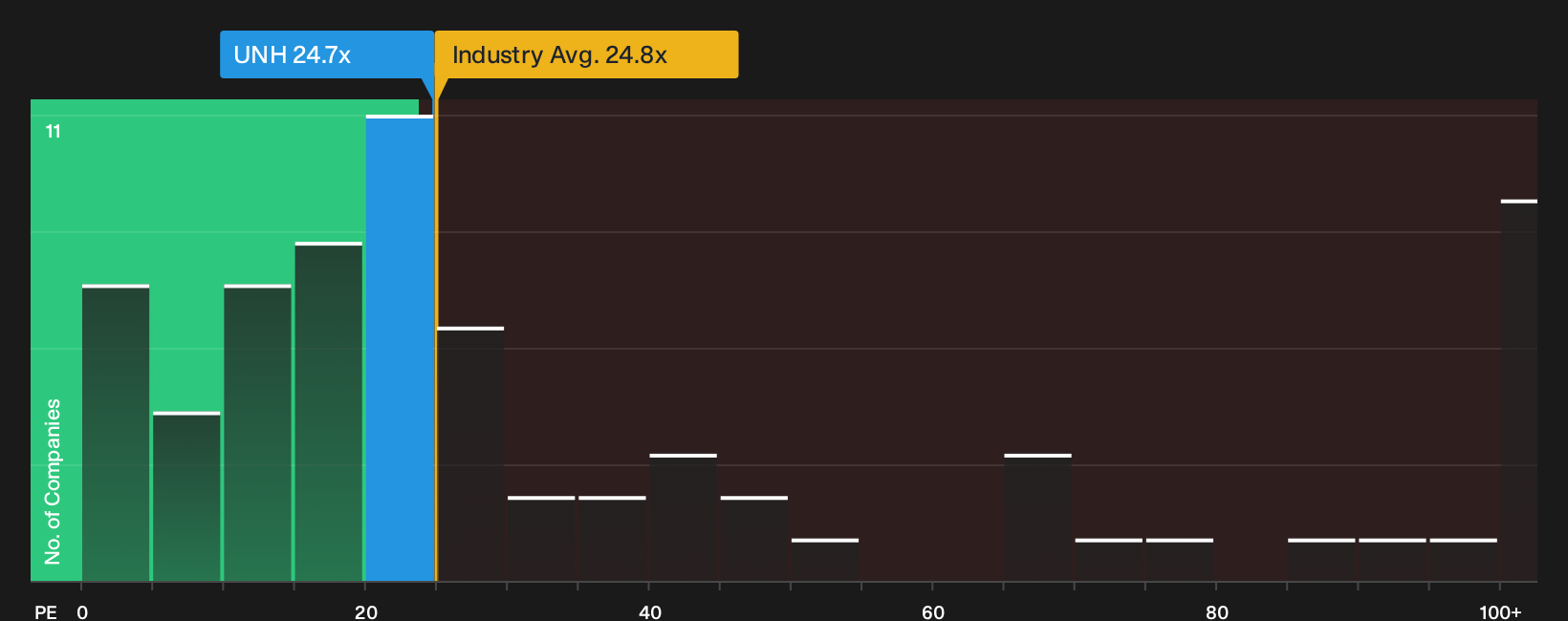
The P/E lens fits UnitedHealth Group because earnings remain the key yardstick investors use to weigh large, mature healthcare insurers. On this measure, the stock trades on about 24.7x earnings, a touch below the broader Healthcare sector on 24.8x and also under the peer group on roughly 28.5x. That already hints at a modest discount for a business still viewed as a core holding in many portfolios.
The fair P/E multiple from Simply Wall St’s model is 40.1x. This reflects what the framework expects investors to pay for UnitedHealth Group once factors like profitability profile, scale, industry positioning and risk are all taken into account. Despite the WellMed stake sale and ongoing Optum reset keeping some investors cautious, the current valuation is below that modelled level, leaving a sizeable gap between price and what this earnings-based approach suggests could be reasonable.
On an earnings multiple basis, UnitedHealth Group currently appears undervalued relative to both its sector and the fair P/E benchmark implied by the model.
See what the numbers say about this price — find out in our valuation breakdown.
The UnitedHealth Group Narrative: What Would Justify Today's Price?
Simply Wall St Narratives pick up where the UnitedHealth Group valuation puzzle leaves off by spelling out which paths for growth, margins and earnings would need to play out for the shares to be worth materially more or less than today’s price. Each scenario on the Community page ties a fair value estimate to a particular set of catalysts and risks for UnitedHealth Group, which helps you see over time which story seems closest to reality.
The community is split on UnitedHealth Group, with one camp focused on margin repair and tech efficiency, and the other worried about concentration and scrutiny.
Bull case: 18% undervalued
"UnitedHealth Group is investing in new technology, including improving physician clinical workflows and enhancing digital engagement tools, which could improve operational efficiency and positively impact net margins..."
Read the full Bull Case to see why UnitedHealth Group could be undervalued
Bear case: 26% overvalued
"The company’s valuation typically reflects this balance and investors pay a premium for predictability, scale, and integration which risks compression if regulatory pressure increases or if Optum’s growth slows..."
Read the full Bear Case to see why UnitedHealth Group could be overvalued
Do you think there's more to the story for UnitedHealth Group? Head over to our Community to see what others are saying!
The Bottom Line
UnitedHealth Group screens as undervalued on earnings, with the current P/E sitting below both sector averages and the modelled fair multiple. That discount only becomes interesting if margin repair at Optum and the clinic reshuffle translate into steadier profitability rather than ongoing noise. The crux is whether investors eventually reward the insurer with a higher multiple for execution on cost control and integration, or keep the valuation restrained as a penalty for regulatory and concentration risk. Your call comes down to whether that gap reflects opportunity or a fair cushion for the operational and policy questions still in play.
This article by Simply Wall St is general in nature. We provide commentary based on historical data and analyst forecasts only using an unbiased methodology and our articles are not intended to be financial advice. It does not constitute a recommendation to buy or sell any stock, and does not take account of your objectives, or your financial situation. We aim to bring you long-term focused analysis driven by fundamental data. Note that our analysis may not factor in the latest price-sensitive company announcements or qualitative material. Simply Wall St has no position in any stocks mentioned.
Have feedback on this article? Concerned about the content? Get in touch with us directly. Alternatively, email editorial-team@simplywallst.com