


The Zhitong Finance App learned that the latest monthly report released by the IEA (the “International Energy Agency”) reveals that the global oil market is undergoing an adjustment process where supply contraction forces a decline in consumption. That is, high oil prices may hit long-term demand prospects hard. The war has caused supply contraction to exceed the decline in demand, and inventories continue to be consumed, and consumers may be forced to further reduce oil use.
Weakening demand is coexisting with tight supply in the oil market. The agency expanded the projected year-on-year decline in global oil demand in 2026 by 940,000 b/d to 2.5 million b/d; at the same time, it lowered the supply forecast by 1.3 million b/d, and the annual supply is expected to decrease 5.7 million b/d year over year. As the decline in supply exceeds the drop in demand, the average annual supply gap widened from about 1.3 million b/d to about 1.7 million to 1.75 million b/d, and the restoration of oversupply was delayed until 2027. Continued inventory consumption means that supply pressure has not been lifted, yet long-term high oil prices may continue to force some consumers to use less oil.
According to IEA statistics, from February to August, global inventories declined at an average rate of 2.8 million barrels per day, indicating that the market is still relying on consumed inventory to make up for the gap. The reduction in demand forecasts alone is biased against oil prices; in the end, the impact on supply and demand also depends on changes in supply at the same time. The IEA lowered the demand forecast by 940,000 b/d this time, but lowered the supply forecast by 1.3 million b/d. The supply reduction was 360,000 b/d more than demand, so the expected supply gap widened. Inventory consumption can temporarily fill the gap, but the gradual reduction of inventory buffers will make it more difficult for the market to withstand subsequent supply disruptions.
The geographical dynamics of September 11 further highlighted the fragility of alternative transportation routes. Some media quoted Yemeni government sources as saying that the Houthis have arrived at Perim Island in the Strait of Mander, making the southern Red Sea, a key shipping channel facing greater threat; Saudi Arabia has increased its use of Red Sea export routes due to the blockage of the Strait of Hormuz, and is under new pressure as a result.
On the same day, the international crude oil price benchmark, the Brent crude oil futures price hit 109.97 US dollars per barrel, then fell back to about 105.90 US dollars after news of the easing of the geopolitical situation in the Middle East related to “Iran is about to meet with the six Gulf countries and the Houthis to cease fire on the west coast of the Red Sea”, indicating that the market began a phased return of some of the geopolitical risk premiums previously included in oil prices while supply risks have not been completely lifted, but the increase for the week was still about 10%. Using the closing price of Brent crude oil at $72.48 on February 27, the last trading day before the war broke out, the price of Brent crude oil has increased by more than 50% since the war.
In other words, the fall in oil prices from around 110 US dollars on the same day does not mean that the fundamentals of supply and demand in the oil market have shifted to easing. Oil prices have declined in the short term due to expectations of an easing in the geographical situation, but the IEA's latest supply and demand data shows that the contraction in supply is still greater than the decline in demand, and inventories continue to decline, so the market is still highly sensitive to subsequent supply disruptions.
Seen from this perspective, current oil prices are actually driven by two main lines at the same time: on the one hand, the risks faced by key transportation routes such as the Strait of Hormuz and the Red Sea and the decline in global oil supply continue to drive up the fundamental risk premium on oil prices; on the other hand, any news about a cease-fire, negotiations, or the resumption of shipping may cause the geographical risk premium accumulated previously to quickly return.
Therefore, the sharp rise and fall in oil prices on September 11 is more appropriate to be understood as a phased contraction of the geographical risk premium rather than the end of the energy supply crisis. As long as shipping in Hormuz and the Red Sea has not returned to normal and inventories continue to fall, oil prices are still likely to be highly sensitive to new news of supply disruptions.
Energy shocks amid geopolitical turmoil are reshaping asset pricing
The world's major economies are facing wider austerity pressure amid the ongoing impact of high energy prices. The ECB raised interest rates again by 25 basis points on September 10, raising the deposit mechanism interest rate to 2.5%. Goldman Sachs, Citi, and Barclays are all expected to raise interest rates in December; the Bank of Japan is also widely expected to raise interest rates by 25 basis points to 1.25% on September 18. On the US side, interest rate futures market pricing after the PPI announcement shows that the probability that the Federal Reserve will raise interest rates by 25 basis points next week is about 71%. These changes all indicate that energy shocks are increasing the risk that inflation will continue to exceed the standard and spread to other prices.
However, interest rate hikes cannot directly increase oil supply; their role is mainly to constrain demand and stabilize inflation expectations; whether subsequent tightening will continue depends on changes in core inflation, wages, employment, and growth in addition to energy inflation.
As far as the stock market is concerned, we need to pay attention to whether high energy costs and tightening financial conditions can create continuous double pressure: the former erodes residents' actual purchasing power and corporate profit margins, while the latter increases financing costs and valuation discount rates. If Japan's interest rate hike is also accompanied by an appreciation of the yen, it may also cause some yen arbitrage transactions to reduce positions and increase cross-market fluctuations.
The key to influencing the sustainability of the current bull market is the cumulative extent and duration of interest rate hikes, and whether corporate profits and employment can be sustained, rather than a single rate hike itself. The further decline in demand, as described by the IEA, is gradually reflected in industrial production cuts, transportation activity contraction, and corporate investment cuts, which means that the energy crisis may begin to shift from an inflationary shock to an economic growth shock.
Opportunities in the energy sector depend on whether companies can turn high oil prices into deliverable production and cash flow. Upstream companies that produce and export are not directly impacted by the war and have lower costs are generally more likely to benefit from tight supply; refiners that can obtain stable raw materials and maintain construction may also benefit from the widening cracking price spread caused by the shortage of refined oil products such as diesel. However, companies suffering from damaged facilities, blocked exports, or shortages of raw materials may be pressured by loss of sales, even if they face higher prices.
IEA warns: if the war with Iran continues, oil demand may have to fall further
The International Energy Agency lowered its oil demand forecast and said that as the war with Iran continues and consumers are forced to adapt to the declining oil and gas supply and sharp rise in energy prices in the context of the blockade of the Strait of Hormuz and the Strait of Mande, oil consumption may have to drop further in the next few months.
The Paris-based agency extended the projected decline in global oil demand this year by 940,000 b/d to 2.5 million b/d — the biggest drop since 2020, when global economic activity came to a standstill due to the COVID-19 pandemic. The agency said the restoration of oversupply has now been delayed until 2027.
“Global oil inventories have been falling at a record rate,” the agency, which advises major economies on energy policies, said in a monthly report. “As supply remains limited, the commercial inventory buffer is rapidly being depleted, and further sustained demand reduction may be needed in the coming months to close the gap.”
The agency said that the impact on oil demand in 2026 appears to be comparable to the scale of the four biggest shocks in the past 60 years. Among them, intermediate distillates such as diesel and raw materials used in petrochemical plants in Asia will be the most affected.
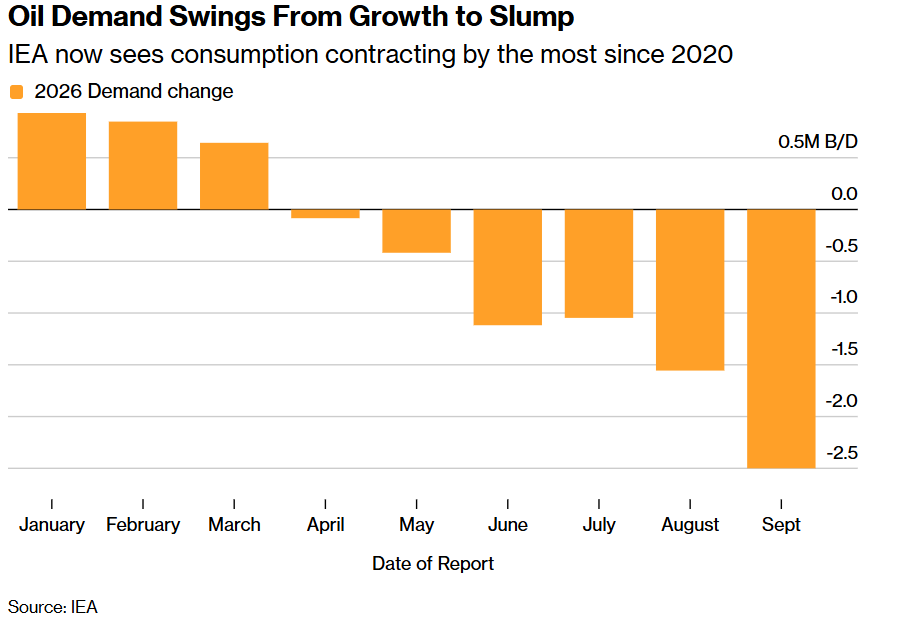
As shown in the chart above, demand for oil is growing and sometimes sluggish — the International Energy Agency currently anticipates the biggest contraction in energy consumption since 2020.
Brent crude oil surpassed $100 per barrel this week for the first time since July, as hostilities between Iran and the US broke out again. On Friday, fighting between the Yemeni-based Houthis and Saudi-backed forces intensified, and market concerns about transporting oil through the southern Red Sea heated up. However, as news related to the slowdown in the Middle East came out, Brent crude oil has since declined but is still trading at a historically high level of around $105 per barrel.
However, the International Energy Agency said that since the impact of the war on oil supply flows was even greater than the impact on consumption, the market is facing a more serious supply shortage than previously estimated.
According to the agency's latest data, the global oil supply gap averaged about 1.7 million b/d this year, compared to 1.3 million b/d in last month's report. The latest data also shows that inventory will continue to decline in the fourth quarter, while previous forecasts suggest a slight increase in inventory over the same period. The agency's August report said that the market will resume oversupply towards the end of this year.
The agency previously characterized the crisis as a record supply disruption. This time, it lowered its global oil supply forecast by 1.3 million b/d, expected to reduce annual supply by 5.7 million b/d, and said it had postponed the expected time for supply recovery until next year.
As a result, the report's data shows that global oil supply is expected to be about 1.75 million b/d less than demand this year. The International Energy Agency said that during the period from February to August, the rate of decline in inventories was even more astonishing, reaching 2.8 million b/d.