


Biofuel Mandates, War Premium, and Chinese Demand Keep the Complex Supported
Sentiment in soybean oil and the broader soy complex has been driven by a combination of energy market volatility, biofuel policy, and trade developments. Crude oil surged to its highest level since May this week, with West Texas Intermediate settling near $102 a barrel and Brent crude trading above $107, after Iran reported strikes on US warships and tankers in the Persian Gulf and Iran backed Houthi forces attacked energy infrastructure in Saudi Arabia. That conflict has now stretched on for more than six months, and the ongoing threat to shipping through the Strait of Hormuz continues to embed a war premium in crude oil, which in turn continues to support demand for soybean oil as a biodiesel feedstock. Indonesia's move toward a B50 palm oil biodiesel blend has reinforced this dynamic across competing vegetable oils. On the trade front, China has purchased roughly 1 million metric tons of US soybeans this week alone, pushing cumulative 2026 season purchases toward half of its 25 million ton annual commitment ahead of President Xi Jinping's planned September 24 visit to Washington, while USDA crop condition ratings have held steady at 58% good to excellent.
What the Market Has Done
- Market staged an aggressive rally from the 50 area to the 65 area (Daily Level 4) between December 2025 and March 2026, coinciding with growing anticipation of the EPA's Renewable Fuel Standard rule, which was finalized on March 27, 2026 and set record biomass based diesel volumes of 5.4 billion gallons for 2026.
- In doing so, the market overcame the 65 area (Daily Level 4), which had served as a daily resistance level dating back to 2023.
- From there, the market found responsive sellers at 70 and consolidated sideways between 65 and 70 until mid April.
- Market then resumed higher, breaking above 70 and rallying from mid April into May, with buyers stepping up bids to hold the 73.5 area (Daily Level 3).
- Building on that strength, the market attempted to continue higher in June and reached the 80 area (Daily Level 2), but was quickly rejected back down.
- That rejection proved decisive, as buyers gave up control at 73.5, resulting in a sweep back down to the 65 area (Daily Level 4).
- At that level, however, buyers responded, showing they still had control at 65.
- Since then, the market has settled into a two-way consolidation, Range 1, between 73.5 and 65.
- Throughout this range, buyers have been stepping up bids and defending the yearly VWAP.
What to Expect in the Coming Weeks
Watch 73.5 (Daily Level 3) and 65 (Daily Level 4), a level dating back to 2023, closely in the weeks ahead.
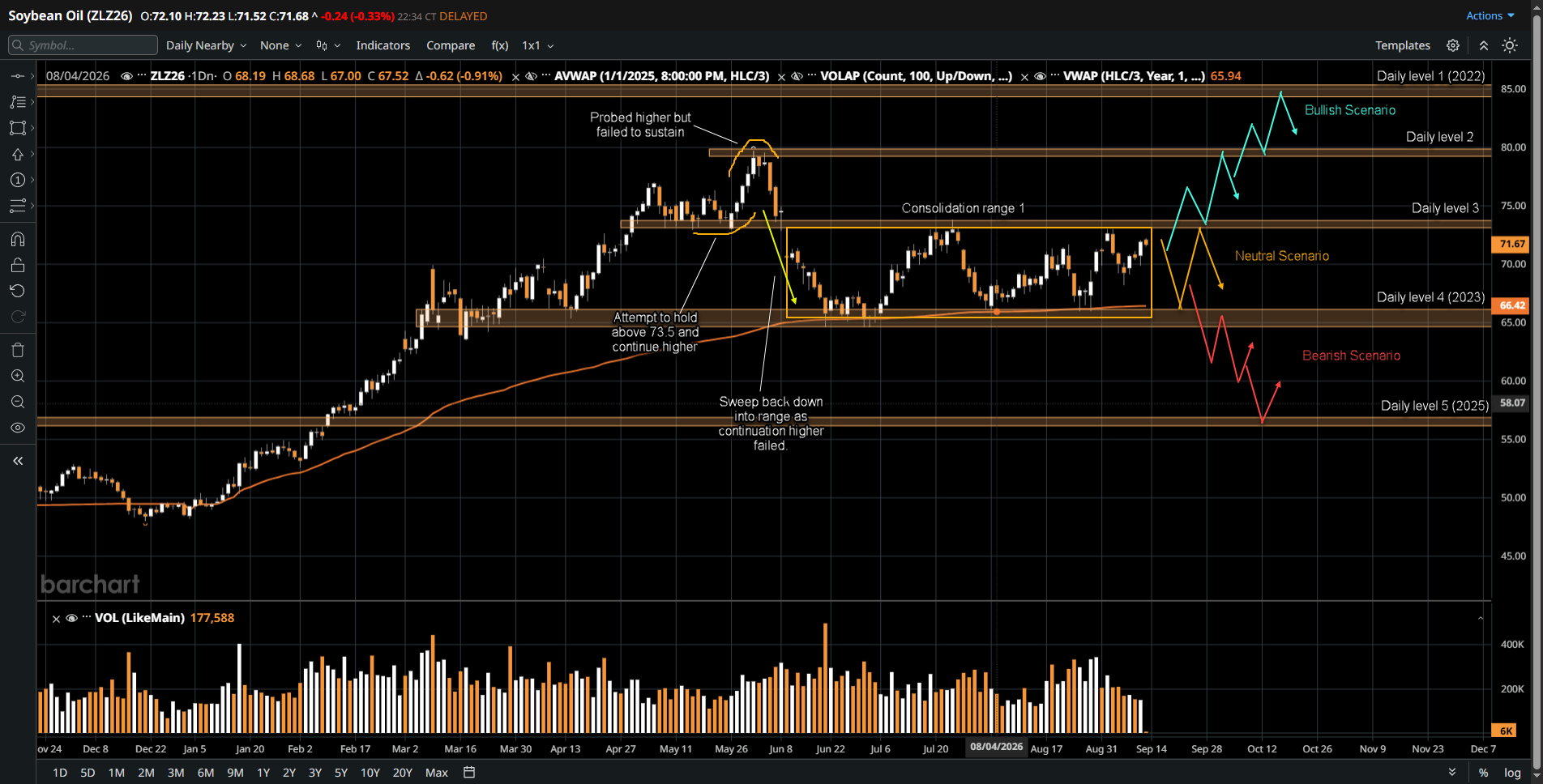
Neutral Scenario:
- If sellers continue to hold offers at the top of the range at 73.5, expect a rotation back down to 65, where buyers are expected to defend, resulting in a continued two-way consolidation within the current Range 1.
- A possible supporting condition for this scenario is a muted outcome from the Trump Xi summit combined with crude oil holding its current elevated range rather than extending higher, keeping the soy complex contained.
Bullish Scenario:
- If market is able to break and accept above 73.5, expect a move back up to revisit the 80 level (Daily Level 2), where responsive sellers are expected. However, if market is able to break and accept above 80, expect a move up to 85 (Daily Level 1), a level from 2022.
- A possible trigger for this scenario is a larger than expected Chinese purchase announcement following the September 24 Washington summit, or a further escalation of the Iran conflict that pushes crude oil and biodiesel feedstock demand even higher.
Bearish Scenario:
- If buyers fail to defend the 65 area, and market is able to break and accept below that level, expect a move down to 60, and subsequently down to 56.5 (Daily Level 5), a level from 2025.
- A possible trigger for this scenario is a sudden ceasefire or de escalation in the Middle East that sends crude oil sharply lower, or a disappointing follow through on Chinese purchases after the summit that undercuts demand for the soy complex.
Conclusion
Soybean oil remains caught between two powerful forces, a technical range that has held firm since June and a fundamental backdrop that is anything but calm. Record biofuel mandates and a war driven energy premium have provided a durable floor under the market, while the outcome of the Xi Jinping summit and the trajectory of the Iran conflict carry the potential to resolve the current standoff in either direction. With 65 and 73.5 acting as the clear battle lines, the next few weeks could prove pivotal in determining whether soybean oil breaks out to fresh multi year highs or rolls over toward the mid 50s.
We are a professional-grade futures brokerage engineered by traders to provide the high-performance architecture and futures trading platform required for serious market participation. We serve as a professional technical partner for traders who prioritize data integrity and objective analysis. Take the next step in your professional evolution and Open an Account today.
Disclaimer:
This article is provided for informational and educational purposes only and does not constitute financial, investment, or trading advice. The analysis presented reflects the author’s market observations and opinions at the time of writing and is not a recommendation to buy or sell any futures contract, security, or financial instrument. Futures trading involves significant risk and is not suitable for all market participants. Losses may exceed initial margin deposits, and market conditions can change rapidly.
Any scenarios, levels, or market expectations discussed are hypothetical in nature and are intended solely to illustrate potential market behavior. They do not represent actual trading results and should not be interpreted as guarantees of future performance. Past performance, market behavior, or historical price action are not indicative of future outcomes.
Readers are solely responsible for their own trading decisions and risk management. Always conduct independent research, consider your financial situation and risk tolerance, and consult with a qualified financial professional, if necessary, before engaging in futures or derivatives trading.