


United Parcel Service stock has delivered a loss of 33.2% over the past five years, yet current valuation checks suggest the shares may now trade below what the intrinsic value estimate implies. The Discounted Cash Flow (DCF) workup points to an undervalued profile that lines up with the market multiple checks, while the long term price record still looks weak.
- Over five years, the share price has declined 33.2%, which puts long term holders in the red even after a stronger 1 year patch.
- On the upside, UPS is reshaping its global operating model and leaning into higher value logistics niches. However, labor tensions flagged by the Teamsters for 2028 could pressure costs and cash flows if talks turn hostile.
- With a value score of 4 out of 6, the broader checks give a mixed picture rather than flagging United Parcel Service as a clear bargain or an obvious overpricing.
The issue now is whether the current discount to the intrinsic value estimate offers enough compensation for UPS investors given the operational changes and labor risks on the horizon.
Spot undervalued logistics and freight peers that also screen well on valuation and balance sheet strength by comparing United Parcel Service with 33 high quality undervalued stocks.Is United Parcel Service a Bargain on Cash Flow?
The Discounted Cash Flow method used here projects what United Parcel Service might generate in free cash over time and then brings those future dollars back to today. On the latest twelve-month view, the group produced about $4.6b in free cash flow, and the model assumes those cash flows keep growing rather than shrinking, which fits a mature, cash-generative logistics player instead of a high-risk turnaround story.
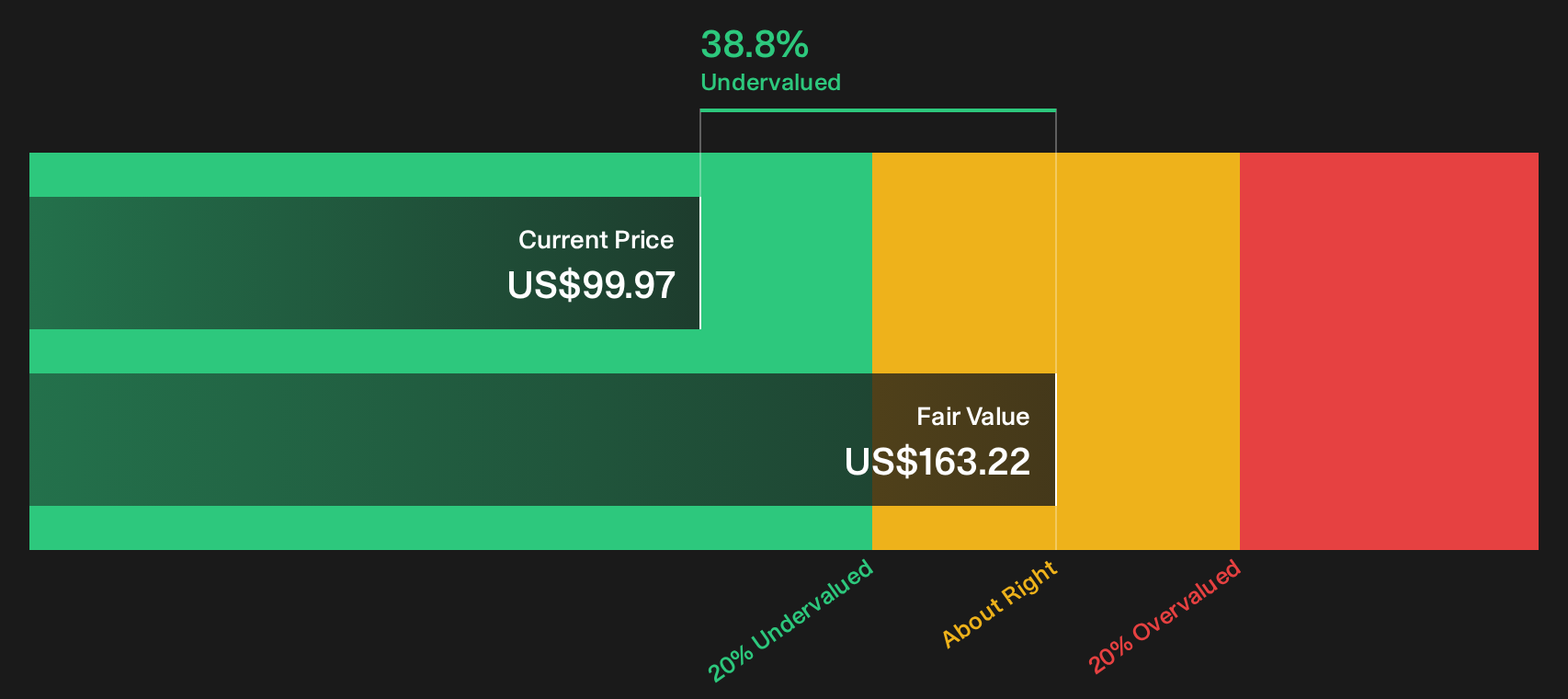
On those inputs, the 2 Stage Free Cash Flow to Equity model lands on an intrinsic value of about $163 per share, which compares to a current market price that implies a 38.6% discount. The talk of a possible Teamsters strike in 2028 helps explain why the market is cautious, even as the Discounted Cash Flow work suggests a higher value for United Parcel Service based on cash generation alone.
On this analysis, United Parcel Service appears undervalued relative to what its projected cash flows support.
Our Discounted Cash Flow (DCF) analysis suggests United Parcel Service is undervalued by 38.6%. Track this in your watchlist or portfolio, or discover 33 more high quality undervalued stocks.
Is United Parcel Service a Bargain on Earnings?
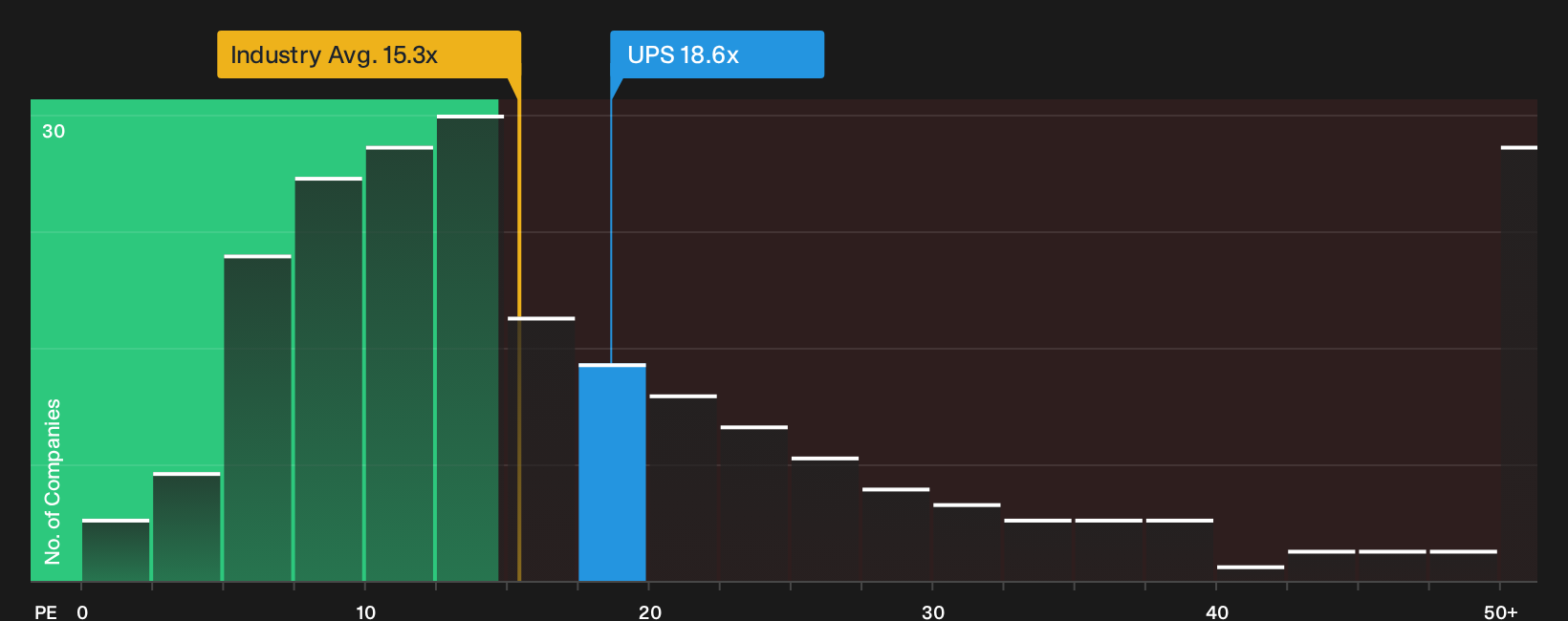
P/E works well for United Parcel Service because earnings remain the key lens most investors use to judge a mature, cash generative operator. On this metric, the stock trades on a P/E of about 18.7x. That sits below both the broader peer group on roughly 20.6x and the modelled fair multiple of about 26.2x that reflects the company’s size, margins, sector and risk profile.
Compared with the wider logistics industry, where the average P/E is near 15.3x, UPS carries a premium that points to investors assigning extra value to its scale and mix of services. The fair multiple still suggests the current earnings price tag leaves a sizable gap between what the model implies and what the market is willing to pay today.
On the P/E measure, United Parcel Service appears undervalued relative to what its earnings profile would typically support.
See what the numbers say about this price — find out in our valuation breakdown.
The United Parcel Service Narrative: What Would Justify Today's Price?
Narratives pick up where the valuation work for United Parcel Service leaves off and spell out which future paths for growth, margins and earnings would need to play out for the shares to end up worth materially more or less than today’s price on Simply Wall St’s Community page. Instead of giving a single number, they unpack the future conditions that number rests on so you can watch over time whether those assumptions still look realistic.
Community views on United Parcel Service sit far apart, with one camp leaning into cost savings and mix improvement while another focuses on execution and balance sheet strain.
Bull case: 14% undervalued
"UPS anticipates $3.5 billion in annual cost reductions for 2025 through variable, semi-variable, and fixed cost savings, positioned to exceed the revenue loss from Amazon..."
Read the full Bull Case to see why United Parcel Service could be undervalued
Bear case: 5% overvalued
"These pressures, combined with declining revenue and earnings per share across recent quarters, suggest that profitability will continue to struggle..."
Read the full Bear Case to see why United Parcel Service could be overvalued
Do you think there's more to the story for United Parcel Service? Head over to our Community to see what others are saying!
The Bottom Line
United Parcel Service screens as undervalued on both the Discounted Cash Flow (DCF) work and the P/E comparison, which converge on a similar message rather than pulling in opposite directions. The mixed overall valuation score signals that the margin of safety is not bulletproof and that investors still need to weigh business execution, labor negotiations for 2028 and how resilient cash generation proves over time. The key debate is whether UPS can deliver on cost savings and higher value logistics while keeping labor costs contained, or whether those same pressures end up justifying today’s discounted price.
This article by Simply Wall St is general in nature. We provide commentary based on historical data and analyst forecasts only using an unbiased methodology and our articles are not intended to be financial advice. It does not constitute a recommendation to buy or sell any stock, and does not take account of your objectives, or your financial situation. We aim to bring you long-term focused analysis driven by fundamental data. Note that our analysis may not factor in the latest price-sensitive company announcements or qualitative material. Simply Wall St has no position in any stocks mentioned.
Have feedback on this article? Concerned about the content? Get in touch with us directly. Alternatively, email editorial-team@simplywallst.com