


McDonald's stock has retreated over the past year, yet the valuation work points to a business that screens cheap on most checks while the Discounted Cash Flow (DCF) estimate sits only slightly above the current share price. That mix leaves investors weighing a fairly priced intrinsic value estimate against market multiples that still suggest room for upside.
- Over the past 5 years the share price has returned about 17.0%, which indicates moderate long term gains despite more recent weakness.
- Brand strength and global scale can support steady cash generation for McDonald's, while any slowdown in customer traffic or cost pressure may limit how much of that cash turns into distributable free cash flow.
- The broader valuation checks lean cheap, with McDonald's scoring 5 out of 6 on value, even as the DCF suggests the stock is roughly fairly valued with only a small discount.
The issue now is whether the current share price gives enough margin of safety if the intrinsic value estimate is roughly accurate and the market is already assigning McDonald's relatively low multiples.
Scan beyond McDonald's and hunt for other companies with similar value traits using the curated list of 31 high quality undervalued stocks.
Does McDonald's Look Fairly Valued on Cash Flow?
The Discounted Cash Flow (DCF) model estimates what McDonald's is worth based on the cash it can return to shareholders over time. On this approach, the business is treated as a mature cash generator, with cash flows expected to keep growing rather than swinging sharply.
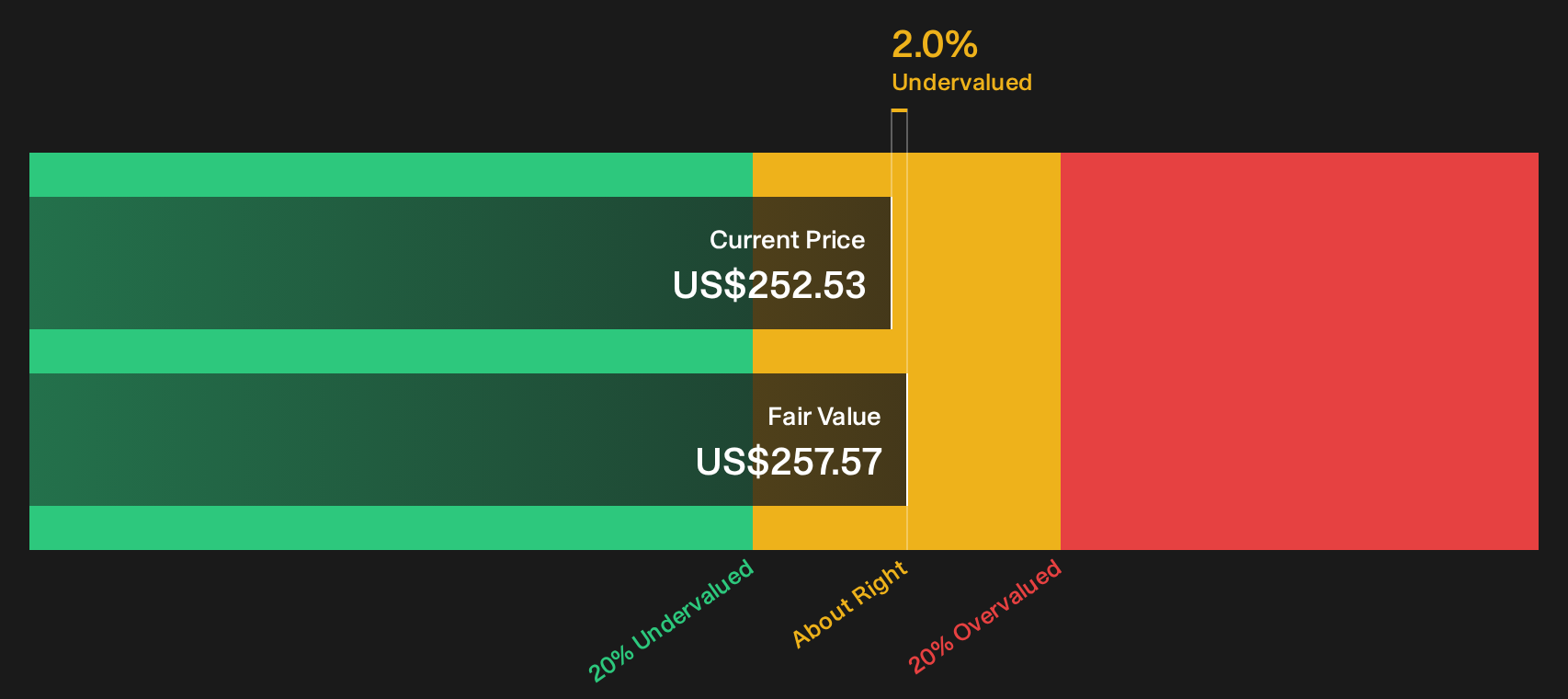
McDonald's produced about $8.2b of free cash flow over the last twelve months, and the DCF assumes that this stream continues to grow from here instead of shrinking. Based on those inputs, the model points to an intrinsic value of about $258 per share, only slightly above the recent market price, which implies the stock trades at roughly a 2.0% discount to this cash flow estimate. The long history with Chipotle that resurfaced in recent headlines helps explain why some investors still debate capital allocation, even as the current valuation already reflects steady rather than aggressive cash flow expansion.
Overall, the Discounted Cash Flow analysis suggests McDonald's stock appears roughly fairly valued with only a modest hint of undervaluation.
McDonald's is fairly valued according to our Discounted Cash Flow (DCF), but this can change at a moment's notice. Track the value in your watchlist or portfolio and be alerted on when to act.
Does McDonald's Look Undervalued on Earnings?
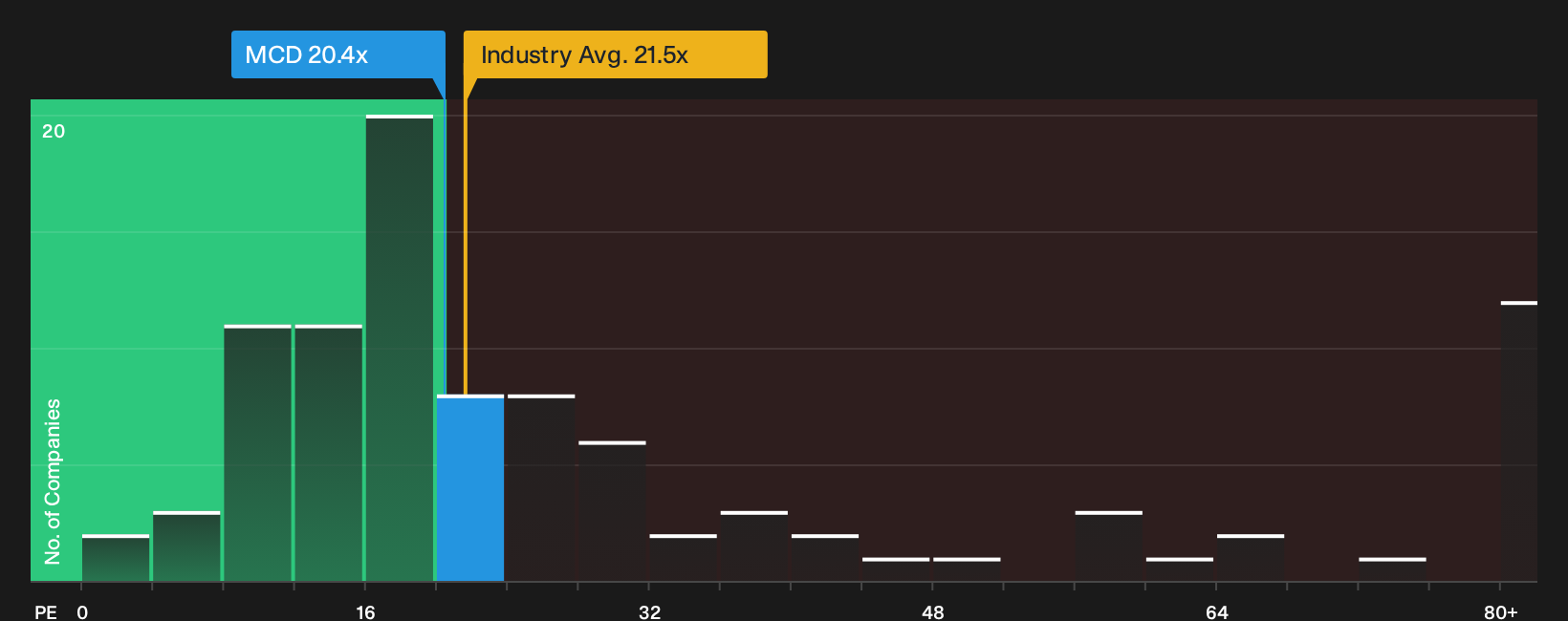
The P/E ratio suits McDonald's because earnings remain a central yardstick for a mature, cash generative franchise system. On this measure, the stock trades at about 20.3x earnings, sitting slightly below the broader hospitality sector average of roughly 21.5x and well under the peer group average of about 52.6x. That gap suggests investors are not paying a premium multiple for the brand despite its size and reach.
A more tailored yardstick, which blends McDonald's growth profile, margins, industry, scale and risk, points to a fair P/E of about 26.0x. Compared with the current 20.3x, the market price implies a discount to what this framework would expect for the business. The stock therefore screens on the low side relative to both this fair value multiple and to higher rated peers.
On the P/E metric, McDonald's stock appears undervalued compared with both a tailored fair multiple and the pricing of similar companies.
See what the numbers say about this price — find out in our valuation breakdown.
The McDonald's Narrative: What Would Justify Today's Price?
Simply Wall St Narratives pick up where the McDonald's valuation puzzle leaves off by spelling out what sort of future for growth, margins and earnings would need to unfold for the stock to be worth materially more or less than today’s price on the Community page. Instead of only giving you a single output from a ratio or model, they describe the path those figures assume so you can watch how closely reality tracks that story over time.
Community views on McDonald’s are split, with one camp leaning into the automation story and another warning that current expectations already bake in a lot of good news.
Bull case: 20% undervalued
"The accelerated rollout of technology initiatives (AI-powered order-taking, kitchen automation, edge computing, and IoT-enabled operations) is poised to materially improve operational efficiencies, reduce labor and equipment downtime costs, and ultimately enhance operating margins and EPS as tech investments mature after 2026..."
Read the full Bull Case to see why McDonald's could be undervalued
Bear case: 8% overvalued
"As you can see from the above McDonald's seems to be overvalued given that its current price of $270 dollars is above P90..."
Read the full Bear Case to see why McDonald's could be overvalued
Do you think there's more to the story for McDonald's? Head over to our Community to see what others are saying!
The Bottom Line
For McDonald's, the Discounted Cash Flow (DCF) work points to a share price that is close to intrinsic value, with only a small implied discount. The P/E checks lean more clearly undervalued, hinting that the market is not paying up for the brand's earnings profile. Taken together, these signals frame a stock that appears reasonably priced, with some potential upside if perception around earnings quality or growth prospects improves. The key factor from here is whether cash generation and margins remain strong enough for that valuation gap on earnings to close, rather than for the DCF view to prove overly optimistic.
This article by Simply Wall St is general in nature. We provide commentary based on historical data and analyst forecasts only using an unbiased methodology and our articles are not intended to be financial advice. It does not constitute a recommendation to buy or sell any stock, and does not take account of your objectives, or your financial situation. We aim to bring you long-term focused analysis driven by fundamental data. Note that our analysis may not factor in the latest price-sensitive company announcements or qualitative material. Simply Wall St has no position in any stocks mentioned.
Have feedback on this article? Concerned about the content? Get in touch with us directly. Alternatively, email editorial-team@simplywallst.com