


Holmen has delivered weak share returns over the past few years, yet a Discounted Cash Flow (DCF) estimate suggests the stock trades below its intrinsic value while market multiples look roughly in line with peers. That mix leaves investors weighing a potential valuation gap against a track record of share price declines.
- The share price has fallen about 17.5% over three years, which signals that expectations for the business have cooled meaningfully over that period.
- Future cash flow from Holmen's forestry and industrial assets can support the DCF estimate. However, any sustained pressure on profitability or capital intensity may limit how quickly that value is realised.
- The broader checks paint a mixed picture rather than a clear bargain or clear overvaluation, with Holmen scoring 3 out of 6 on value tests.
The issue now is whether Holmen's current share price already reflects this patchy history of returns, or if the intrinsic value estimate still points to material upside that the market is overlooking.
Compare Holmen's mixed three year decline with other potentially mispriced opportunities by scanning 183 high quality undervalued stocks that pair solid fundamentals with valuation support.
Is Holmen Still Cheap on Cash Flow?
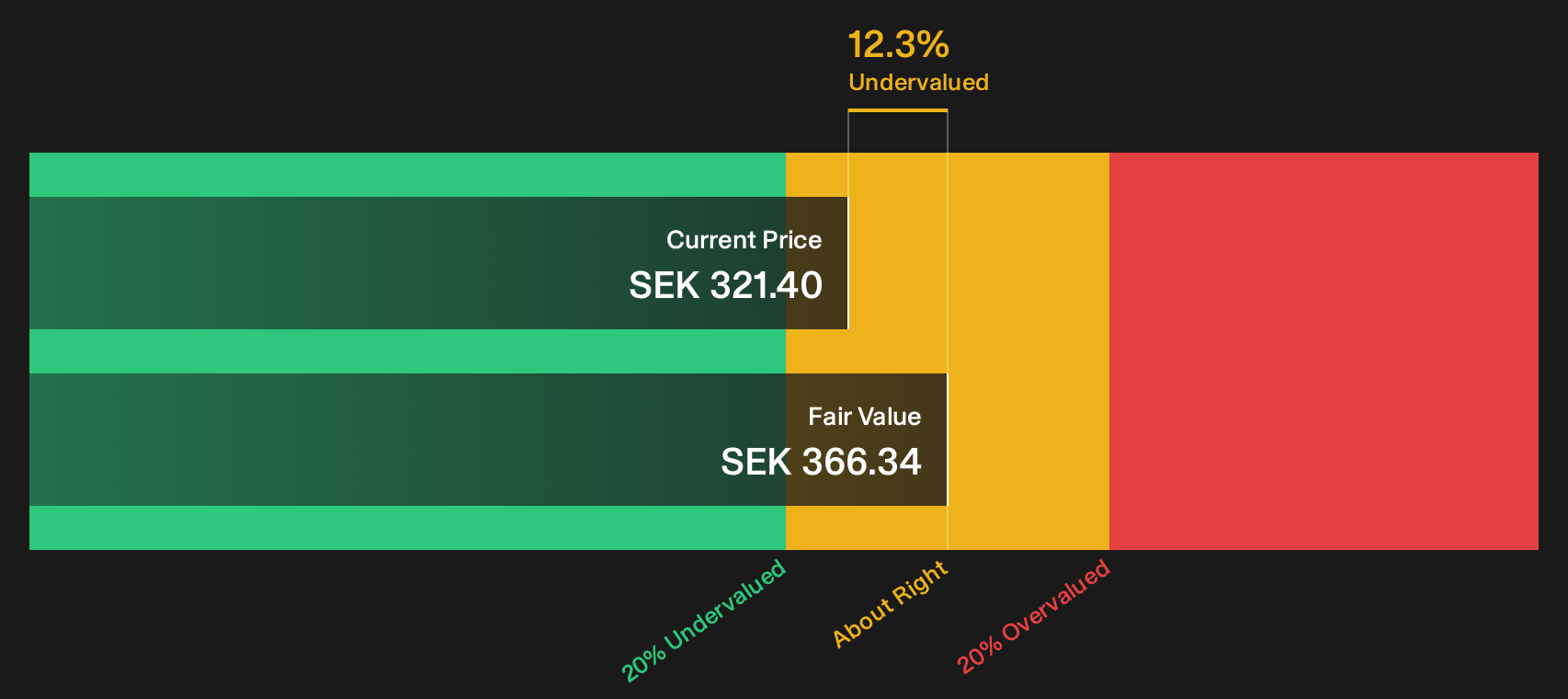
The Discounted Cash Flow (DCF) model here values Holmen through projected free cash generation to shareholders. Latest twelve month free cash flow is about SEK1.6b, and the model assumes that cash generation grows gradually from this base rather than swinging sharply in either direction. On those projections, intrinsic value lands around SEK366 per share.
That estimate compares with a current price that sits roughly 12.3% below the DCF value, which indicates that the stock appears undervalued on this framework. For readers, the key question is whether Holmen can keep turning its forestry and industrial assets into steady, recurring cash flows that resemble the pattern embedded in the model.
On this Discounted Cash Flow view, Holmen appears undervalued relative to the cash it is expected to produce.
Our Discounted Cash Flow (DCF) analysis suggests Holmen is undervalued by 12.3%. Track this in your watchlist or portfolio, or discover 183 more high quality undervalued stocks.
Where Does Holmen Sit on Earnings?
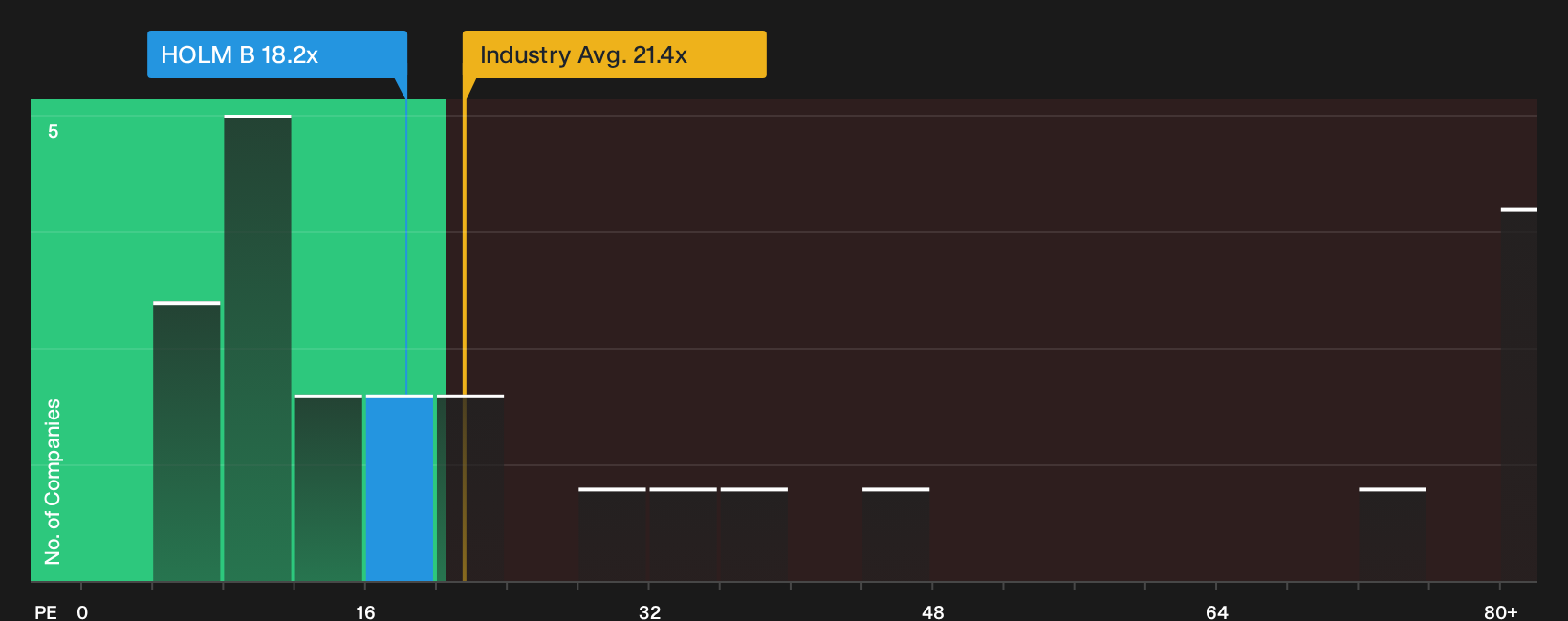
P/E suits Holmen because earnings are a central yardstick for capital heavy forestry and industrial groups. The current P/E is about 18.2x, which is above the forestry industry average of roughly 15.5x and below the broader peer group on around 26.1x. That places the stock neither at the clear bargain end of the spectrum nor at the high premium tier compared with other listed players.
The Fair P/E for Holmen is estimated at about 17.6x, only a small step below where the shares trade today. That gap suggests the current earnings multiple already lines up reasonably well with what the model implies, given this business mix, risk profile and market size. For readers, the key takeaway is that the earnings based valuation does not point to a sharp discount or rich premium that needs explaining.
On the P/E yardstick, Holmen currently looks priced at roughly fair value.
See what the numbers say about this price — find out in our valuation breakdown.
The Holmen Narrative: What Would Justify Today's Price?
Narratives on Holmen pick up where the valuation puzzle leaves off. They spell out which combinations of future growth, margins and earnings power would need to hold for the stock to be worth materially more or less than the current share price, and they sit on Simply Wall St's Community page. Each one focuses on the assumptions that sit behind a fair value view so you can compare those expectations with Holmen's actual results as they come through.
Holmen attracts sharply different stories from the community, with one camp leaning into its asset base and another focused on industry headwinds.
Bull case: 20% undervalued
"Exposure to higher value added solid bleached board and book paper grades, which serve more resilient packaging and publishing niches, may allow Holmen to defend pricing better than the broader market and support long term revenue growth and margin stability…"
Read the full Bull Case to see why Holmen could be undervalued
Bear case: 13% overvalued
"Ongoing overcapacity in both board and graphic paper, together with weak demand that management describes as clearly below pre pandemic levels, can keep pressure on pricing and utilization, which would weigh on revenue growth and operating margins if this persists…"
Read the full Bear Case to see why Holmen could be overvalued
Do you think there's more to the story for Holmen? Head over to our Community to see what others are saying!
The Bottom Line
Holmen looks modestly undervalued on the Discounted Cash Flow (DCF) view, while the current P/E suggests the market is already pricing the business at about the going rate for its peer group. That split leaves the DCF pointing to upside that hinges on steady cash conversion from forestry and industrial assets, against a multiples picture that implies no obvious mispricing. The crux is whether cash flows prove resilient enough to close that intrinsic value gap or whether the market is correctly cautious about profitability and capital demands.
This article by Simply Wall St is general in nature. We provide commentary based on historical data and analyst forecasts only using an unbiased methodology and our articles are not intended to be financial advice. It does not constitute a recommendation to buy or sell any stock, and does not take account of your objectives, or your financial situation. We aim to bring you long-term focused analysis driven by fundamental data. Note that our analysis may not factor in the latest price-sensitive company announcements or qualitative material. Simply Wall St has no position in any stocks mentioned.
Have feedback on this article? Concerned about the content? Get in touch with us directly. Alternatively, email editorial-team@simplywallst.com