


Comfort Systems USA has delivered an extremely strong run over the past few years, yet its current share price still screens below an intrinsic value estimate based on a Discounted Cash Flow (DCF) approach. After such a sharp climb, readers now face a stock that screens as fundamentally cheap on cash flows while trading at roughly in line multiples on more conventional measures.
- Over the past 5 years, Comfort Systems USA has produced a very large total return, which puts extra pressure on today’s buyers to judge whether the gains are supported by fundamentals.
- Growing demand for AI related data center work can support longer term cash generation for Comfort Systems USA, while any slowdown in project awards or integration issues with acquisitions may weaken that cash flow profile.
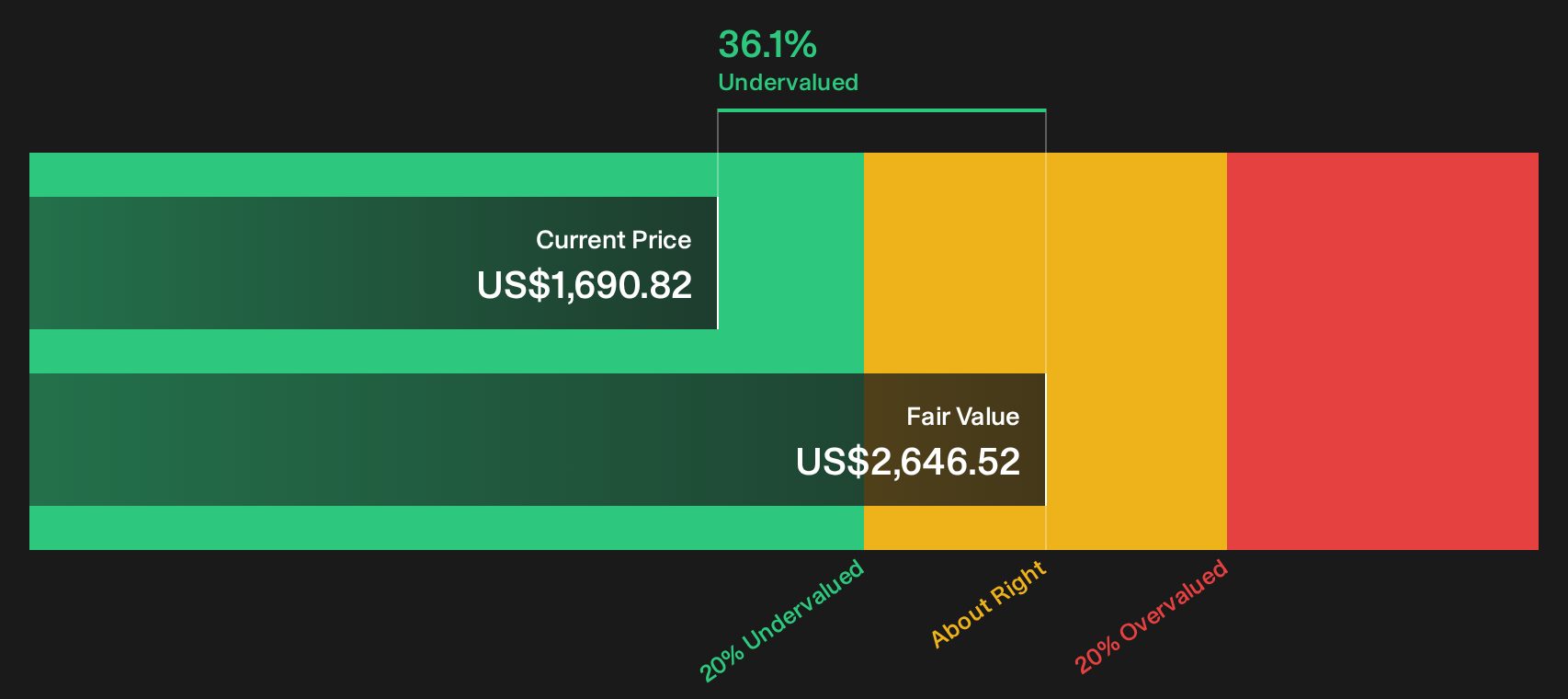
- The broader checks lean cheap, with Comfort Systems USA scoring a 5 out of 6 on value tests, and the DCF intrinsic value estimate sitting about 36.1% above the recent share price.
The issue now is whether Comfort Systems USA’s recent valuation gap to the intrinsic value estimate can reasonably persist after such an extended run in the stock.
Scan beyond Comfort Systems USA’s AI data center story, and compare it with 89 AI infrastructure stocks, which also screens as compelling on fundamentals and cash flow support.
Is Comfort Systems USA a Bargain on Cash Flow?
The Discounted Cash Flow model here looks at what Comfort Systems USA could return to shareholders in cash over time and pulls that back to today’s dollars. Comfort Systems USA is currently generating trailing twelve month free cash flow of about $2.28b, and the model assumes that this pool of cash continues to grow rather than shrink. On those projections, the intrinsic value for the equity is estimated at around $2,646.52 per share.
Compared with the latest share price, that output implies the stock trades at roughly a 36.1% discount to the model’s estimate of value, which screens as meaningfully undervalued on this basis. Recent headlines around a $14.06b backlog tied partly to AI data center work help explain why a cash flow based approach assigns such a high figure to future owner earnings. On this Discounted Cash Flow view, Comfort Systems USA appears undervalued relative to the cash the business is projected to generate.
Our Discounted Cash Flow (DCF) analysis suggests Comfort Systems USA is undervalued by 36.1%. Track this in your watchlist or portfolio, or discover 31 more high quality undervalued stocks.
Is Comfort Systems USA Fairly Priced on Earnings?
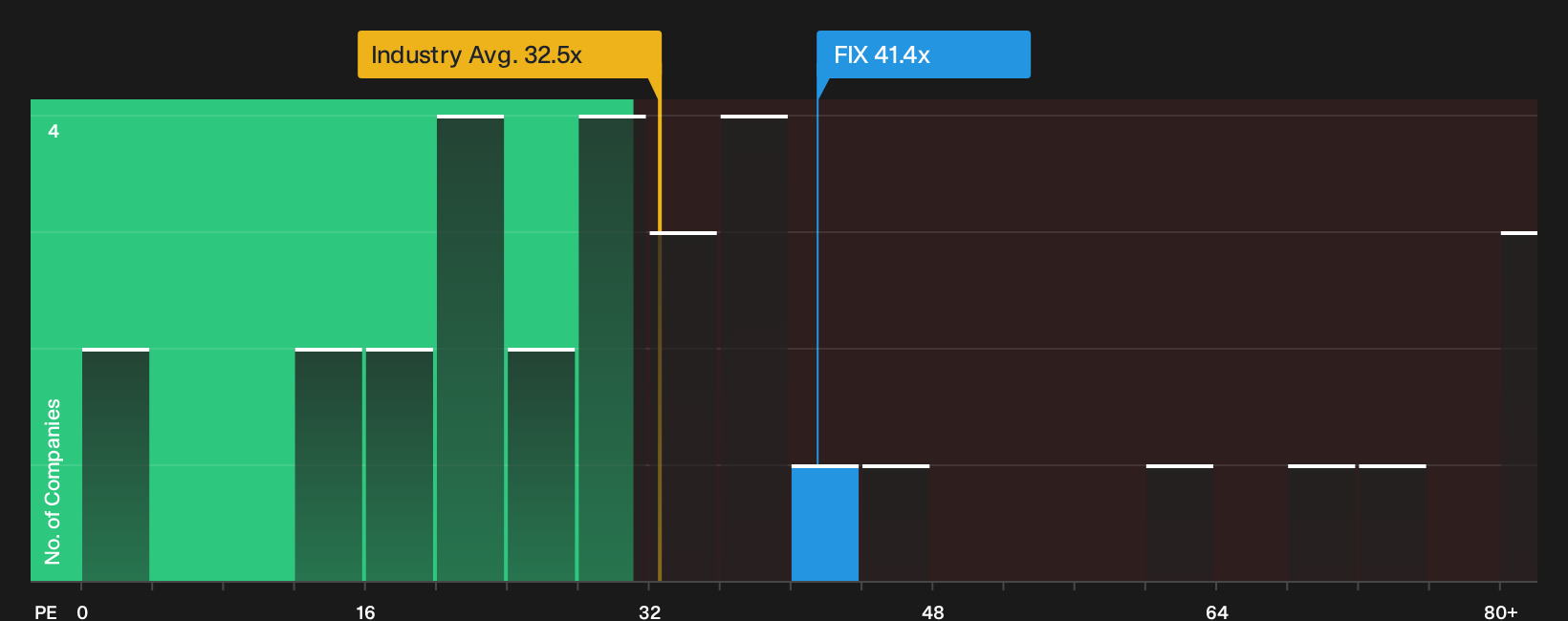
P/E works well for Comfort Systems USA because earnings are a primary anchor for how investors are sizing up the AI data center opportunity and the broader construction work tied to it. On this yardstick, the stock trades on about 41.4x earnings, compared with a construction industry average near 32.5x. That places the shares at a clear premium to the broader sector even before you consider the relatively low P/B and P/S norms in construction.
The fair P/E ratio for Comfort Systems USA is estimated at roughly 41.9x, which lands very close to the current 41.4x level, while peers cluster around 43.1x. The gap to both the fair ratio and the peer group is small enough that the current earnings multiple looks broadly aligned with what the model suggests investors might pay for this mix of growth potential, margins, scale and risk.
On the P/E lens, Comfort Systems USA looks priced roughly in line with what the earnings profile and sector peers would suggest.
See what the numbers say about this price — find out in our valuation breakdown.
The Comfort Systems USA Narrative: What Would Justify Today's Price?
Simply Wall St Narratives pick up where the valuation puzzle around Comfort Systems USA leaves off and spell out what mix of future growth, margins and earnings would need to play out for the stock to be worth materially more or less than today’s price, based on scenarios that live on the Community page. Rather than focus on a single multiple or one model result, each narrative lays out the assumptions behind its view of fair value so you can compare those against actual numbers as they come through.
One of the top community narratives on Comfort Systems USA: 23% undervalued
"Expansion in modular building and recurring service revenues enhances margin stability, operational efficiency, and long-term growth prospects..."
Read one of the top narratives on Comfort Systems USA
Do you think there's more to the story for Comfort Systems USA? Head over to our Community to see what others are saying!
The Bottom Line
Comfort Systems USA screens as undervalued on a Discounted Cash Flow (DCF) view, while the P/E work suggests the market price is roughly in line with peers and earnings quality. That mix, together with a high value score, points to a setup where the intrinsic value case leans on cash generation and the market view leans on what investors are willing to pay for construction exposure today. The real fault line is whether future cash flows from areas like AI related data centers arrive at the pace implied in the model, or whether project risk and integration challenges keep the current multiple about where it is.
This article by Simply Wall St is general in nature. We provide commentary based on historical data and analyst forecasts only using an unbiased methodology and our articles are not intended to be financial advice. It does not constitute a recommendation to buy or sell any stock, and does not take account of your objectives, or your financial situation. We aim to bring you long-term focused analysis driven by fundamental data. Note that our analysis may not factor in the latest price-sensitive company announcements or qualitative material. Simply Wall St has no position in any stocks mentioned.
Have feedback on this article? Concerned about the content? Get in touch with us directly. Alternatively, email editorial-team@simplywallst.com