


- Northern Trust expanded its Singapore unit trust servicing through a relationship with Perpetual Asia and launched a U.S. government money market fund aimed at stablecoin cash reserves, alongside winning a multi billion pound custody mandate from Warwickshire Pension Fund and reporting quarterly revenue that exceeded analyst expectations.
- The combination of stronger quarterly performance, new digital asset cash management products and deeper institutional custody relationships reflects Northern Trust’s focus on operational scale and specialised servicing rather than relying solely on broad market flows.
- We will now look at how Northern Trust's recent quarter and new stablecoin cash reserves portfolio could influence the investment narrative.
Scan how Northern Trust’s focus on scale, custody and digital assets compares with other institutions by reviewing the hand picked list of solid balance sheet and fundamentals (23 results) that may benefit from similar long term themes.
Northern Trust Investment Narrative Recap
To own Northern Trust, you need to believe that a geared up custody and asset servicing platform can keep earning solid fees even as pricing pressure and tech spending stay high. The latest quarter beat revenue expectations and showed operating leverage, but the biggest near term swing factor still looks like execution on efficiency and automation, not this single batch of announcements.
The main risk remains that fee compression and rising technology costs eventually erode margins faster than new services can offset. The Singapore unit trust build out and digital asset cash products are helpful for positioning, yet do not fundamentally change that cost versus pricing tension in the short run.
The new Stablecoin Cash Reserves Portfolio is the clearest link between Northern Trust’s strong quarter and its future catalysts. It keeps the firm in traditional U.S. government money market territory while targeting a very specific client set: stablecoin issuers and institutional investors that need tightly defined reserve management.
This product launch also introduces a different operational risk profile. Fund assets may swing around stablecoin mint and burn activity, which could pressure liquidity and yields when redemptions spike. For you as a shareholder, the key watchpoints are scale, client concentration in these reserves, and how well risk controls handle rapid inflows and outflows.
Northern Trust Earnings Path Behind the Stablecoin Story
Northern Trust's forecast story sits on some very specific numbers rather than just a general growth vibe around custody, scale and digital assets. Analysts are working off an assumption that revenue grows by 3.6% a year over the next few years and that profit margins move from 24.0% today to 25.1% by 2029. On that base, earnings are expected to reach US$2.5b by 2029 compared with earnings today of US$2.2b. That implies an earnings increase of about US$300m, which is meaningful, but not a step change that transforms the risk profile overnight.
On the valuation side, the consensus view groups those assumptions into a single 2029 picture. Forecast revenues are pegged at US$10.1b and forecast earnings again at US$2.5b in 2029. To line that up with current pricing, analysts are using a P/E of 15.0x on those future earnings, which is lower than both the current 15.2x on Northern Trust and the 39.7x industry multiple quoted for US Capital Markets. For investors, that gap indicates the story is not about a high growth rating. Instead, it is about a trust bank that is expected to compound at moderate rates while keeping its digital and custody investments under control.
Northern Trust's narrative projects forecast revenue of US$10.1b and forecast earnings of US$2.5b by 2029. This assumes 3.6% yearly revenue growth and an earnings increase of about US$300m from current earnings of US$2.2b.
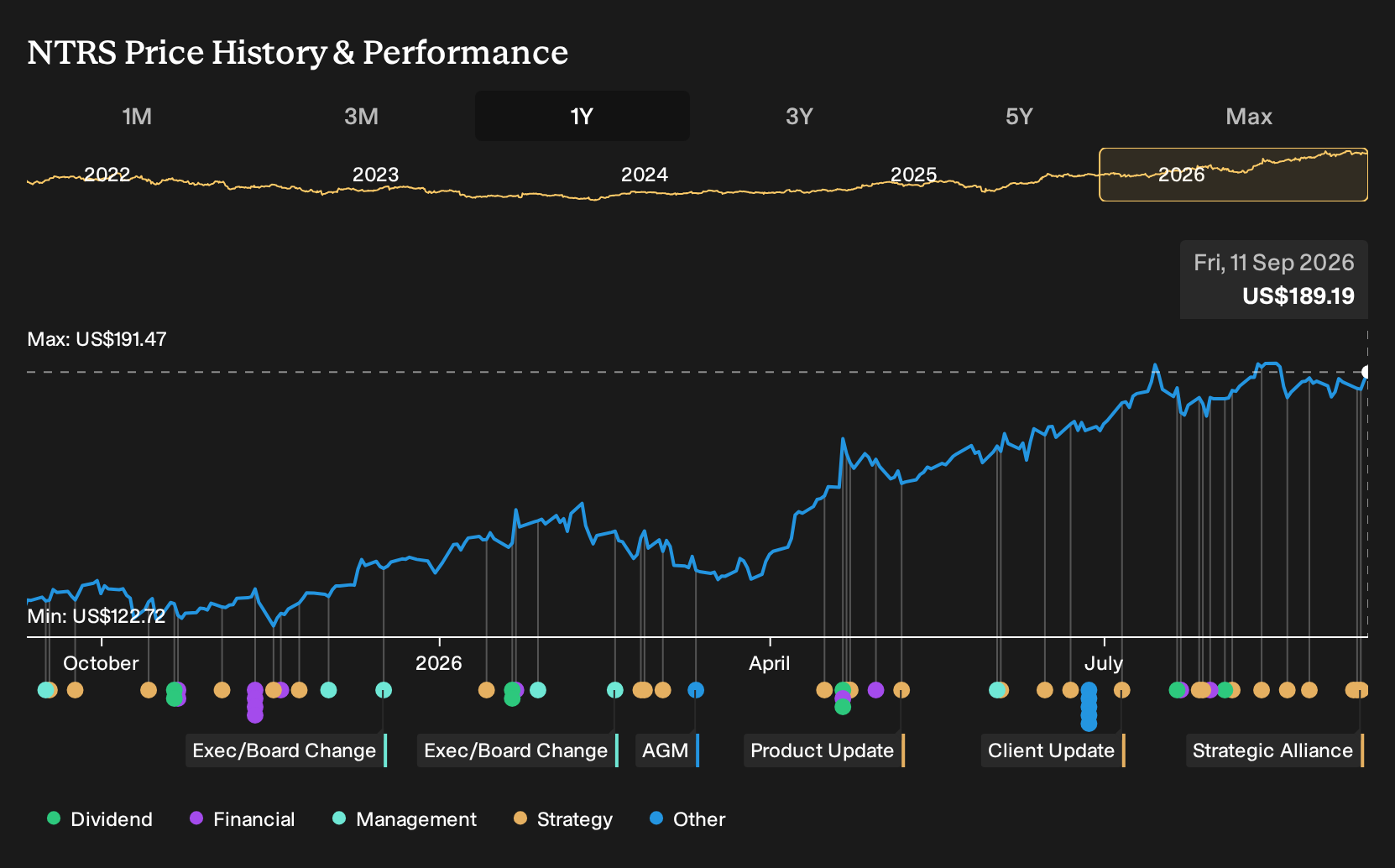
Uncover why Northern Trust's fair value indicates a 3% potential downside to its current price, which leaves little room for error.
Exploring Other Perspectives
Two fair value estimates from the Simply Wall St Community cluster tightly between about US$179.9 and US$183.8, which points to a fairly narrow band of opinion so far. You still see real disagreement in wider discussion, especially on how Northern Trust’s stablecoin reserves fund and Singapore alliance might affect fee resilience. Use that contrast and explore multiple viewpoints before leaning on any single narrative.
Explore another Northern Trust fair value estimate, including one that suggests it could be worth as much as $183.81.
Reach Your Own Conclusion
Don't just follow the ticker. Dig into the data and build a conviction that's truly your own.
- A great starting point for your Northern Trust research is our analysis highlighting 4 key rewards that could impact your investment decision.
- See our latest analysis for Northern Trust. The report includes a comprehensive fundamental analysis summarized in a single visual, the Snowflake, making it easy to evaluate Northern Trust's overall financial health at a glance.
Looking for more Northern Trust style investment ideas?
If the Northern Trust story has sharpened your thinking about scale, balance sheets and income resilience, broaden that lens beyond a single ticker and use the Simply Wall St Screener to sift through other companies with similar traits.
- If you want potential upside with less hype, start with quality first and see which companies appear in the 31 high quality undervalued stocks that already combine fundamentals with a discounted price tag.
- For investors who like getting paid while they wait, focus on income strength and stability by scanning the 6 dividend fortresses that emphasise both yield and business durability.
- If capital preservation is your first filter, concentrate on sturdier balance sheets and steadier business profiles by reviewing the 11 resilient stocks with low risk scores that score well on financial resilience.
This article by Simply Wall St is general in nature. We provide commentary based on historical data and analyst forecasts only using an unbiased methodology and our articles are not intended to be financial advice. It does not constitute a recommendation to buy or sell any stock, and does not take account of your objectives, or your financial situation. We aim to bring you long-term focused analysis driven by fundamental data. Note that our analysis may not factor in the latest price-sensitive company announcements or qualitative material. Simply Wall St has no position in any stocks mentioned.
Have feedback on this article? Concerned about the content? Get in touch with us directly. Alternatively, email editorial-team@simplywallst.com