


Pentair stock has been hit hard over the past year, yet multiple valuation checks still flag it as cheap relative to what its cash flows may justify. With the Discounted Cash Flow (DCF) intrinsic value estimate and market multiple signals both pointing to undervaluation, investors are weighing whether the market reaction to recent problems has gone too far.
- The share price is down 48.4% over the past year, which shows how sharply sentiment has turned against Pentair.
- Legal action tied to alleged misstatements around Pool segment inventory and a sharp reset in sales expectations may keep risk perception elevated even if the underlying cash generation recovers.
- A high value score of 6 suggests Pentair screens as broadly undervalued across several cross checks, including both intrinsic value estimates and earnings based multiples.
The issue now is whether Pentair's current price already reflects the legal and business setbacks, or if the discount to intrinsic value still leaves room for more downside risk than upside potential.
Spot opportunities beyond Pentair by reviewing curated 31 high quality undervalued stocks that also show signs of disconnect between recent share price moves and underlying cash flow potential.Does Pentair Look Undervalued on Cash Flow?
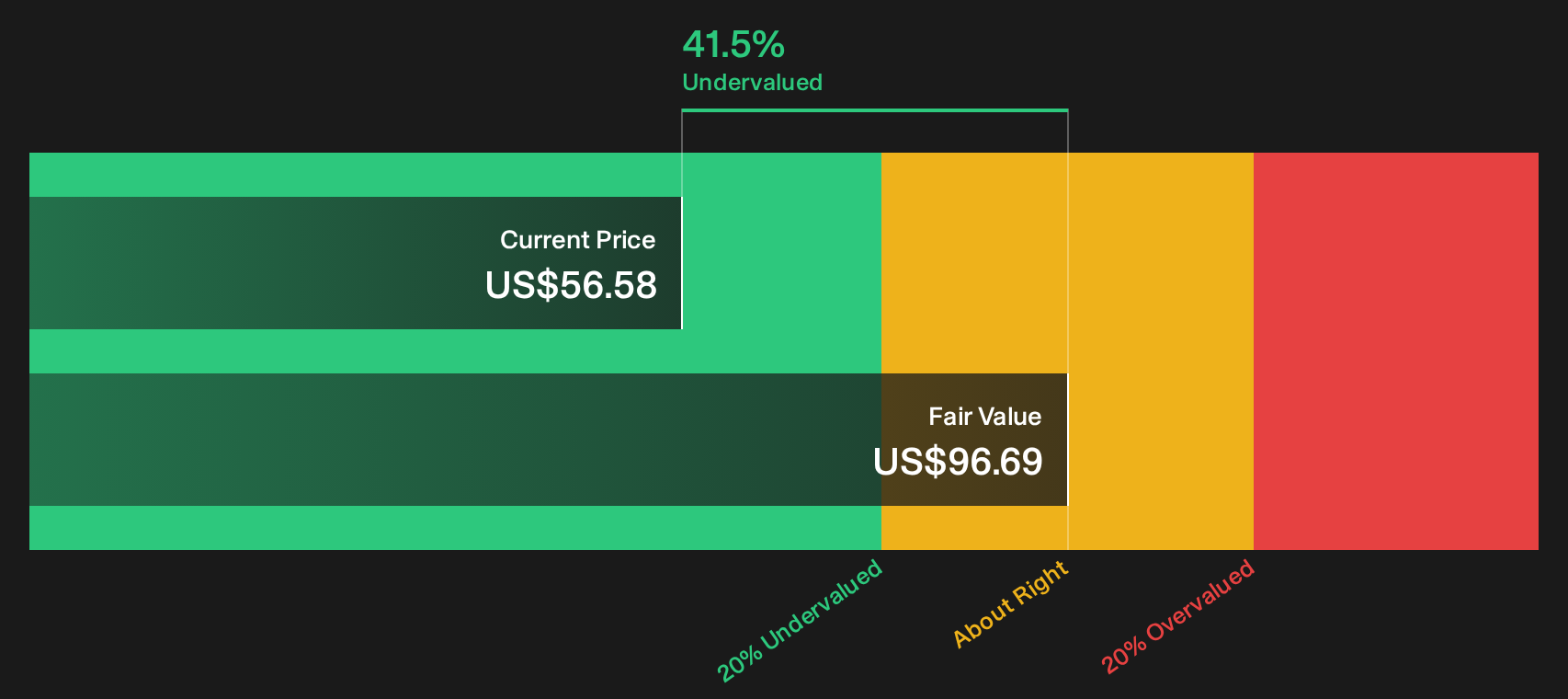
The Discounted Cash Flow (DCF) model here focuses on what Pentair can generate in free cash over time, not just next quarter’s earnings print. Pentair produced about $678.9 million of free cash flow over the last twelve months, and the model assumes those cash flows keep growing rather than shrinking. On that basis, the 2 Stage Free Cash Flow to Equity approach points to an intrinsic value of roughly $96.69 per share.
That estimate implies the stock trades at about a 41.5% discount to the cash flow value indicated by the DCF. The recent securities fraud class action tied to Pool segment destocking and guidance resets helps explain why the market is pricing Pentair so cautiously, even with these projected cash flows.
On this DCF view, Pentair appears undervalued relative to what its projected cash generation suggests.
Our Discounted Cash Flow (DCF) analysis suggests Pentair is undervalued by 41.5%. Track this in your watchlist or portfolio, or discover 31 more high quality undervalued stocks.
Is Pentair Still Cheap on Earnings?
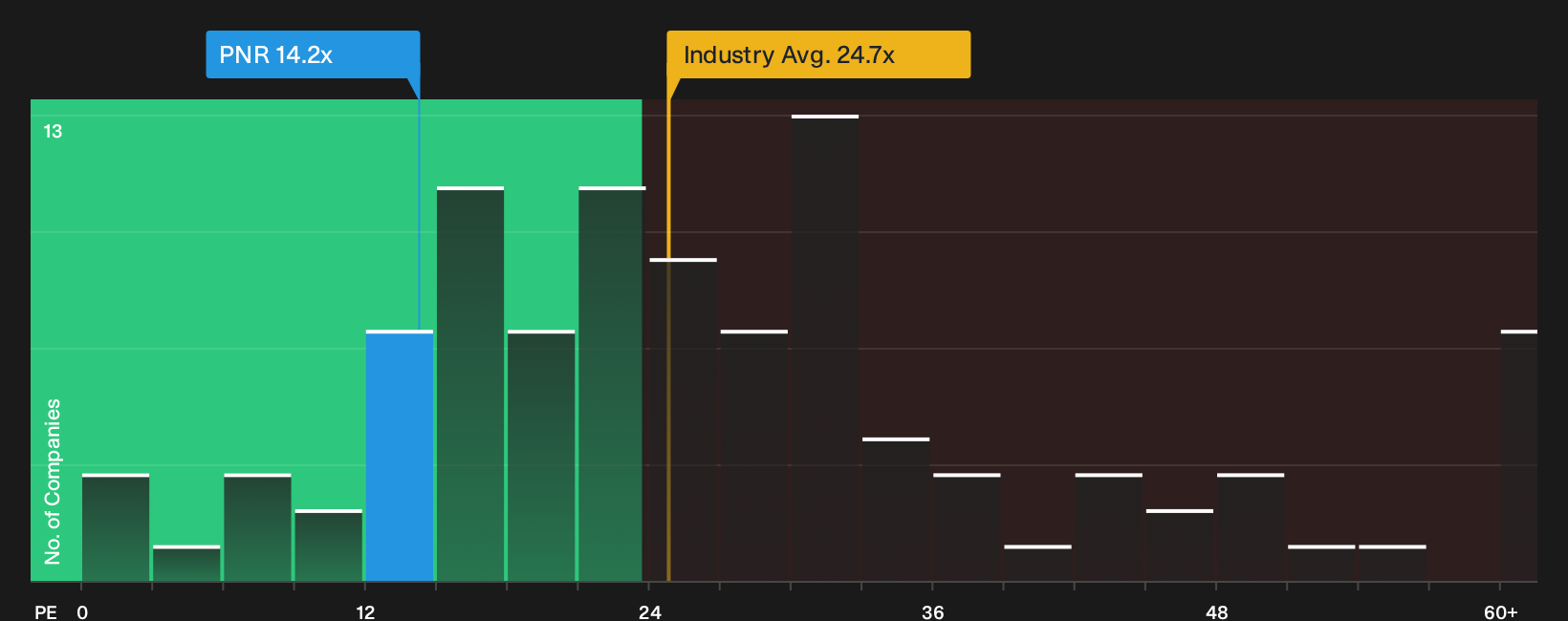
P/E works well for Pentair because earnings remain a key anchor for how investors value established industrial businesses. On this measure, the stock trades on a P/E of about 14.2x, compared with roughly 24.7x for the wider Machinery industry and 25.9x for direct peers. That is a wide gap for a company still generating positive earnings.
The fair P/E ratio implied by the model is 23.1x, which reflects what investors might typically pay for Pentair given its sector, profitability profile and risk picture. Set against the current 14.2x, the shares trade well below that benchmark, which aligns with the discount indicated by the DCF work.
On a pure earnings multiple check, Pentair stock appears undervalued relative to both its industry and a tailored fair P/E yardstick.
See what the numbers say about this price — find out in our valuation breakdown.
The Pentair Narrative: What Would Justify Today's Price?
Pentair Narratives on Simply Wall St pick up where the valuation work leaves off by explaining which potential paths for revenue, margins and earnings would need to occur for the current share price to appear too low or too high. Rather than stopping at a single model output, these scenarios outline the specific future assumptions behind each figure, so you can follow how Pentair's actual results compare over time through the Community page.
One of the top community narratives on Pentair: 26% undervalued
"Rising demand for advanced water technologies and sustainability is fueling growth opportunities and margin expansion across Pentair's core markets..."
Read one of the top narratives on Pentair
Do you think there's more to the story for Pentair? Head over to our Community to see what others are saying!
The Bottom Line
Pentair screens as undervalued on both the Discounted Cash Flow (DCF) intrinsic value work and the earnings multiple checks, which is rare alignment for two different frameworks. The gap mainly reflects how heavily recent legal issues and perception of execution risk are weighing on the share price relative to the cash flow profile outlined earlier. What matters most from here is whether Pentair can sustain the cash generation implied in the intrinsic value estimate while resolving the legal overhang, since that will decide whether the current discount proves to be a value trap or a genuine opportunity.
This article by Simply Wall St is general in nature. We provide commentary based on historical data and analyst forecasts only using an unbiased methodology and our articles are not intended to be financial advice. It does not constitute a recommendation to buy or sell any stock, and does not take account of your objectives, or your financial situation. We aim to bring you long-term focused analysis driven by fundamental data. Note that our analysis may not factor in the latest price-sensitive company announcements or qualitative material. Simply Wall St has no position in any stocks mentioned.
Have feedback on this article? Concerned about the content? Get in touch with us directly. Alternatively, email editorial-team@simplywallst.com