


Fluor stock has already delivered a very strong 5 year run for shareholders, yet the current share price still screens as cheap on both an intrinsic value check and on market multiples.
- Over 5 years, Fluor has returned 249%, which puts long term holders in a very different position from anyone trying to decide whether fresh capital still makes sense at today's level.
- The company’s project driven model can support valuation if cash flows continue to convert reliably from its backlog. However, execution missteps or cost overruns on large contracts may hurt future profitability and weigh on what investors are willing to pay.
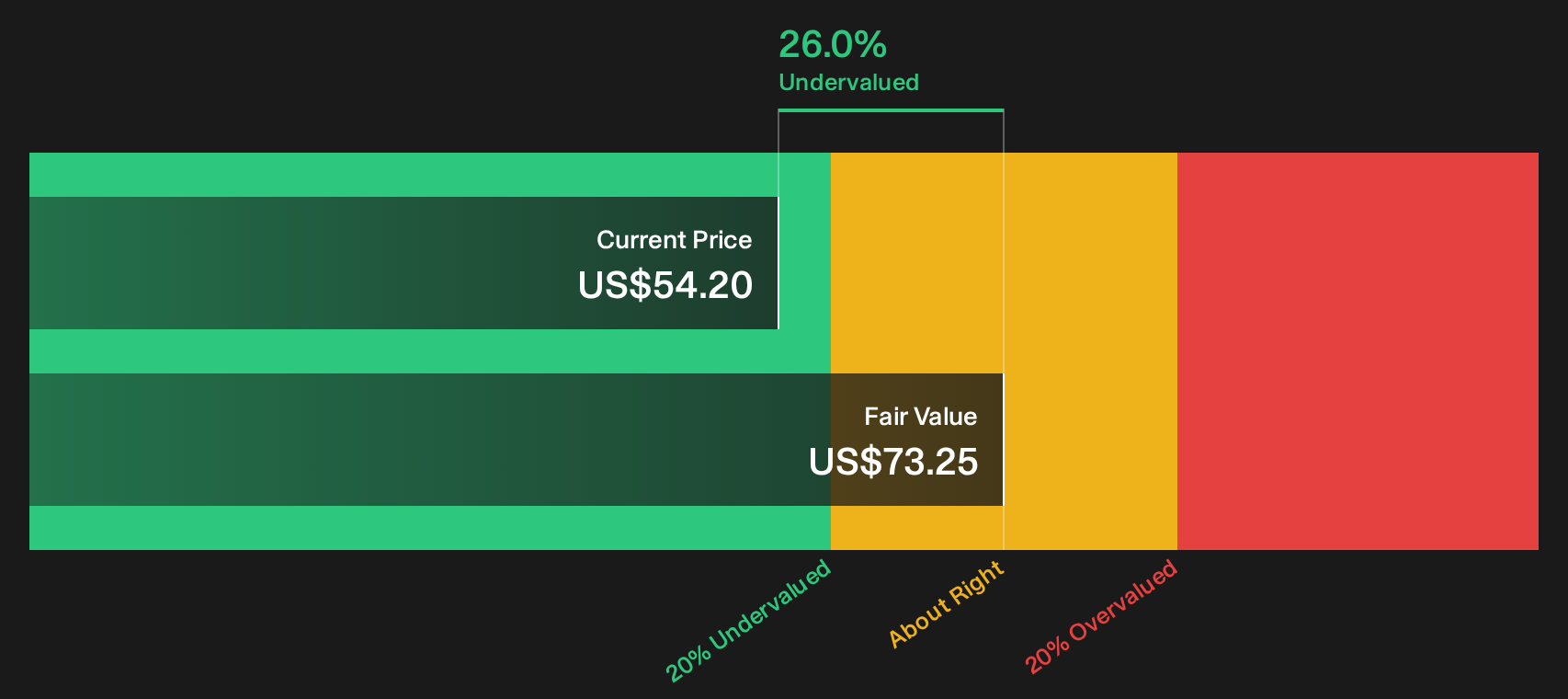
- On a broad set of checks, including a Discounted Cash Flow (DCF) estimate that sits about 26% above the market price, Fluor scores 5 out of 6, which points to the stock looking inexpensive rather than fully priced.
For investors, the debate is whether Fluor’s recent share price level already reflects this strong 5 year track record or if the current discount to intrinsic value leaves more room for upside over time.
Scan beyond Fluor and size up other potential value stories with 31 high quality undervalued stocks, which our models flag as trading below intrinsic worth on both cash flow and multiples.
Is Fluor Still Cheap on Cash Flow?
The Discounted Cash Flow (DCF) model here values Fluor on the cash it could return to shareholders over time. The latest twelve month free cash flow is a loss of $385.3 million, so the thesis rests on a recovery in project cash generation rather than current figures.
Analysts feeding into this 2 Stage Free Cash Flow to Equity model assume growing free cash flow from 2027 onward, which lifts the estimated intrinsic value to about $73 per share. Against the prevailing market price, that implies roughly a 26% discount based on these projections, even though the P/S multiple already sits well below the wider Construction industry average.
On these cash flow assumptions and current pricing, Fluor stock appears undervalued in this model.
Our Discounted Cash Flow (DCF) analysis suggests Fluor is undervalued by 26.0%. Track this in your watchlist or portfolio, or discover 31 more high quality undervalued stocks.
Is Fluor a Bargain on Sales?
P/S works well for Fluor because investors often focus on its backlog and revenue run rate more than near term earnings swings.
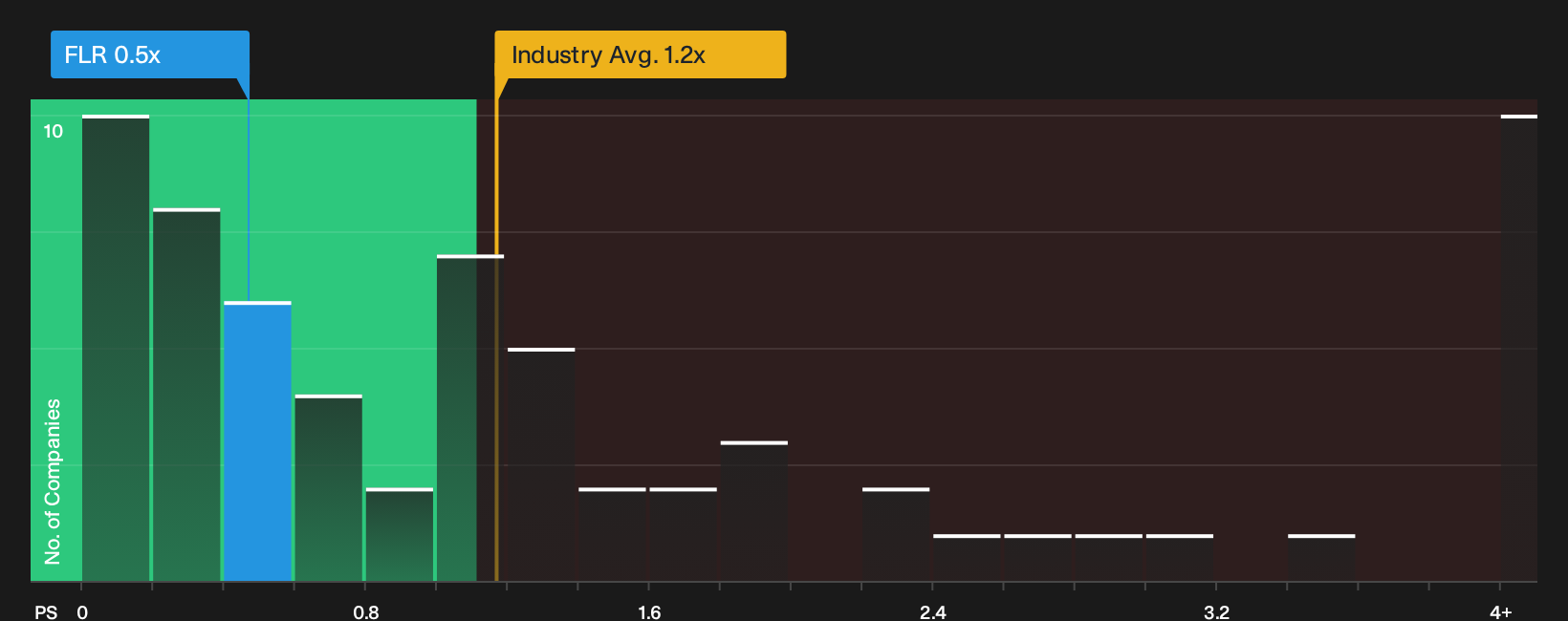
The stock trades on a P/S ratio of 0.5x, compared with a Construction industry average of 1.2x and a peer group average of 1.7x. The fair P/S ratio from the model is 0.8x, which sits between the current market level and the broader sector benchmarks. That gap suggests the market is applying a steeper discount to Fluor’s sales than the model implies based on its size, risk profile and business mix.
Even allowing for project risk and lumpier cash conversion, the share price reflects a sizeable markdown compared with what this framework indicates as a fair sales multiple.
On the P/S ratio, Fluor stock appears inexpensive relative to both its industry and the fair multiple implied by the model.
See what the numbers say about this price — find out in our valuation breakdown.
The Fluor Narrative: What Would Justify Today's Price?
Simply Wall St Narratives for Fluor pick up where the valuation puzzle leaves off. Each scenario spells out what would need to happen to Fluor's growth, margins and earnings for the shares to be worth materially more or less than today’s price. It also sets out the assumptions behind its fair value so you can track how those expectations line up with actual results on the Community page over time.
The Fluor community splits sharply, with one camp leaning into multi year project momentum and the other focused on contract risk and changing end markets.
Bull case: 11% undervalued
"Fluor's shift from revitalizing the capital structure to focusing on generating cash and earnings under its new strategy could drive earnings growth and improve net margins..."
Read the full Bull Case to see why Fluor could be undervalued
Bear case: 14% overvalued
"Fluor’s continued reliance on large, complex, fixed-price contracts exposes it to elevated execution risk and potential for significant cost overruns or write-downs..."
Read the full Bear Case to see why Fluor could be overvalued
Do you think there's more to the story for Fluor? Head over to our Community to see what others are saying!
The Bottom Line
Fluor screens as undervalued on both the Discounted Cash Flow (DCF) intrinsic value estimate and on sales based multiples, which is a rare alignment for a project driven contractor. The real swing factor is whether future projects convert to cash in line with backlog and avoid large cost overruns that could erode that implied upside. For readers, the key question is simple: Is the current discount compensation for genuine execution risk on complex contracts, or is the market overpricing that risk and underestimating Fluor’s ability to turn booked work into durable cash flow?
This article by Simply Wall St is general in nature. We provide commentary based on historical data and analyst forecasts only using an unbiased methodology and our articles are not intended to be financial advice. It does not constitute a recommendation to buy or sell any stock, and does not take account of your objectives, or your financial situation. We aim to bring you long-term focused analysis driven by fundamental data. Note that our analysis may not factor in the latest price-sensitive company announcements or qualitative material. Simply Wall St has no position in any stocks mentioned.
Have feedback on this article? Concerned about the content? Get in touch with us directly. Alternatively, email editorial-team@simplywallst.com