


Reliance (RS) moves into focus ahead of management’s upcoming appearance at the Jefferies Global Industrials Conference on 9 September 2026, which gives investors fresh context for the recent share performance.
Over the past month, Reliance’s share price return is down 7.7%, and the 90-day share price return is also weaker. Yet the year-to-date share price return of 33.26% and 1-year total shareholder return of 37.63% show that longer term momentum is still intact.
Scan how Reliance compares with other metals and materials players by reviewing list of solid balance sheet and fundamentals (23 results) in the same corner of the market.
Reliance now trades only modestly below the average analyst target after a sharp pullback from recent highs. Is that small discount a cautious market mispricing, or a fair reflection of the risks investors see?
Most Popular Narrative: 4% Undervalued
The most followed narrative pegs Reliance’s fair value at $409.50, just above the latest close at $394.21. That frames today’s pullback as a modest discount to that view.
Heightened data center construction, electrification projects, and publicly funded infrastructure spending (schools, hospitals, airports) are driving robust demand for Reliance's specialty steels and engineered materials. This is resulting in market share gains and recurring volume growth, which is poised to benefit both revenue and operating leverage.
Want to see how this Reliance thesis is built? The narrative leans on measured revenue gains, firmer margins, and a future earnings multiple that assumes investors keep paying up for that mix.
Result: Fair Value of $409.50 (UNDERVALUED)
Have a read of the narrative in full and understand what's behind the forecasts.
Still, that cautiously optimistic Reliance story hinges on trade policy not disrupting demand and on cost inflation not squeezing already thin profit margins.
Find out about the key risks to this Reliance narrative.
Another View: What Reliance’s P/E Is Telling You
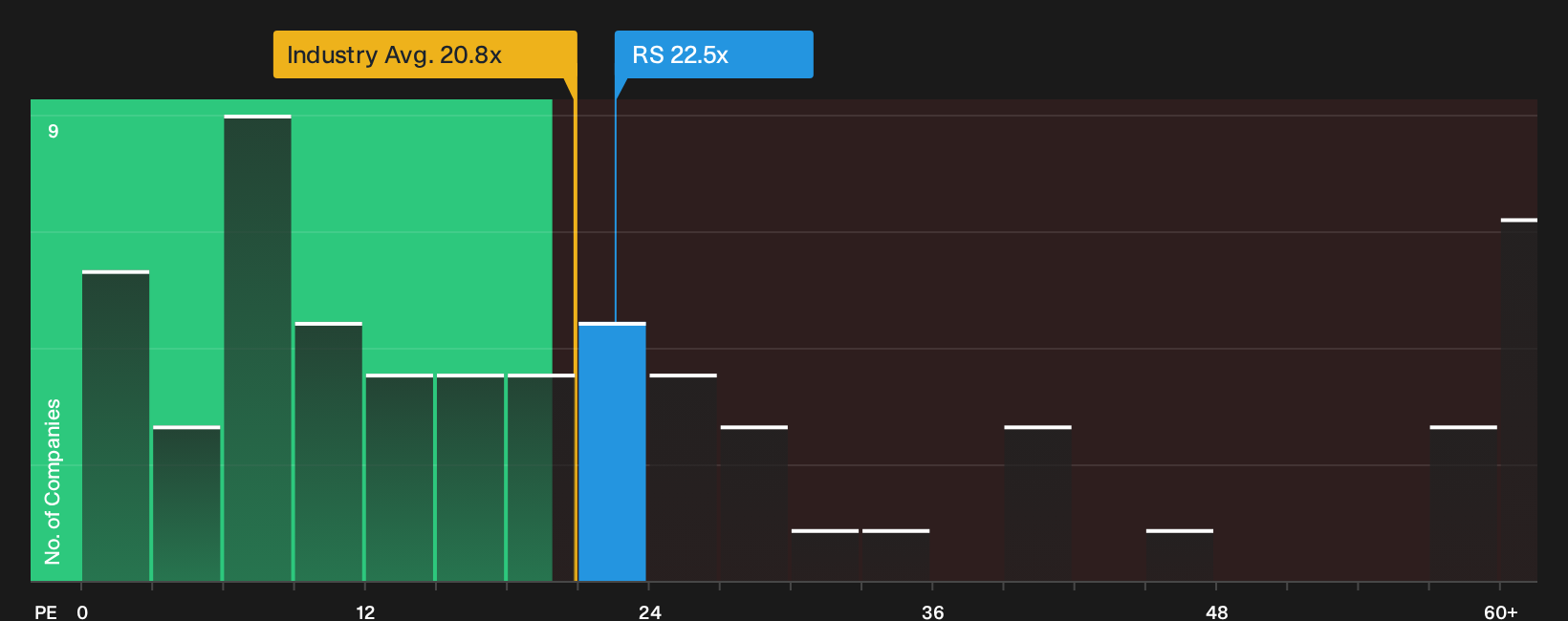
A second lens on Reliance focuses on the valuation multiple. The stock trades on a P/E of 22.5x, compared with 20.7x for the US Metals and Mining group and a fair ratio estimate of 19.4x. That premium points to higher valuation risk if sentiment cools.
For investors comparing this pricing to earnings power, the key question is whether Reliance’s quality and steadier profile justify paying a higher multiple, or whether the gap to the fair ratio is where future downside could emerge if expectations reset, especially after a strong 1-year total return.
See what the numbers say about this price — find out in our valuation breakdown.
Next Steps
Mixed signals across Reliance’s valuation and narrative can feel messy. Move quickly, review the underlying data, and weigh both the 1 key reward and 1 important warning sign.
Looking for more Reliance-sized investment ideas?
If Reliance has sharpened your thinking, do not stop there. Broaden your watchlist with fresh candidates that fit clear, disciplined filters tailored to different goals.
- Target resilient upside by reviewing 16 high quality undiscovered gems that combine strong business quality with less crowded investor attention.
- Strengthen your income stream with 6 dividend fortresses that focus on companies offering higher yields backed by solid fundamentals.
- Dial down portfolio stress through 11 resilient stocks with low risk scores designed to spotlight businesses with more robust risk profiles.
This article by Simply Wall St is general in nature. We provide commentary based on historical data and analyst forecasts only using an unbiased methodology and our articles are not intended to be financial advice. It does not constitute a recommendation to buy or sell any stock, and does not take account of your objectives, or your financial situation. We aim to bring you long-term focused analysis driven by fundamental data. Note that our analysis may not factor in the latest price-sensitive company announcements or qualitative material. Simply Wall St has no position in any stocks mentioned.
Have feedback on this article? Concerned about the content? Get in touch with us directly. Alternatively, email editorial-team@simplywallst.com