


PayPal Holdings is in an unusual spot, with the share price down about 80% over five years while broad valuation checks now flag the stock as looking cheap rather than expensive.
- The roughly 80% decline over five years points to a market that has sharply reset expectations for PayPal’s future earning power.
- New products like the PYUSDX stablecoin platform can support sentiment around long term growth, while ongoing layoffs and restructuring may keep investors focused on execution risk and on cost savings actually feeding through to profit.
- A high value score of 5 indicates that the broader checks suggest PayPal looks cheap on current fundamentals.
The issue now is whether today’s discounted share price already reflects the operational challenges, or if the current valuation still leaves room for a further reset.
Spot 31 high quality undervalued stocks that face similar reset expectations to PayPal Holdings, where sentiment is bruised but headline valuation checks now flag them as looking cheap on current fundamentals.Is PayPal Holdings a Bargain on Earnings?
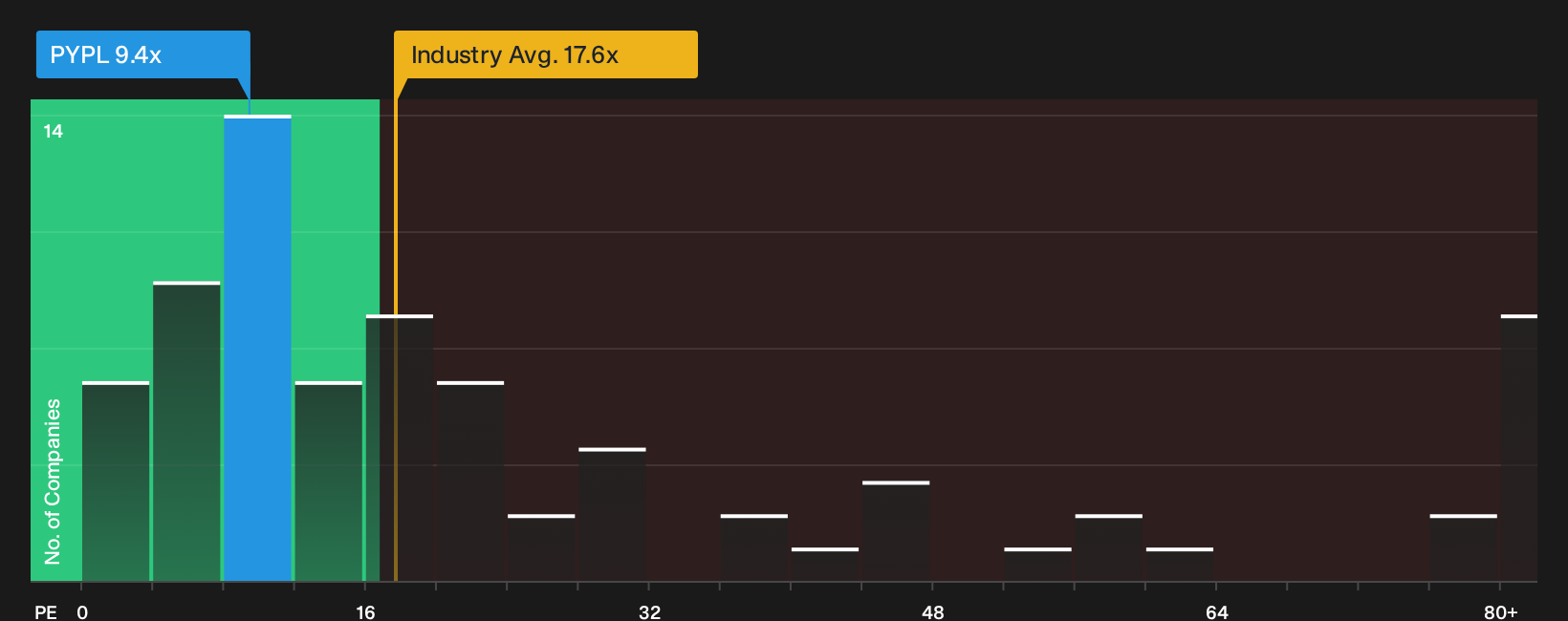
The P/E ratio fits PayPal Holdings because earnings remain a key anchor for how investors frame the mature payments and fintech space. On this yardstick, PayPal trades at roughly 9.4x earnings, against an industry average near 17.6x and a peer group closer to 43.3x. That is a wide gap for a business still closely tied to global ecommerce and digital wallets.
The fair P/E multiple implied by the model is about 15.7x, which is above where the stock currently changes hands. Even after news around the PYUSDX stablecoin platform and ongoing restructuring efforts, the current P/E still prices PayPal at a sizeable discount to what the tailored fair ratio suggests. For readers, this indicates that the market is assigning a cautious earnings multiple compared with both sector norms and the framework that adjusts for PayPal’s size, margins and risk profile.
On the P/E multiple alone, PayPal Holdings appears undervalued relative to both its tailored fair ratio and broader industry benchmarks.
See what the numbers say about this price — find out in our valuation breakdown.
The PayPal Holdings Narrative: What Would Justify Today's Price?
Simply Wall St Narratives for PayPal Holdings pick up where the P/E puzzle leaves off. They set out the specific paths for PayPal Holdings' growth, margins and earnings that would need to play out for the shares to be worth materially more or materially less than the current price. They sit on the stock's Community page so you can see how sentiment and assumptions evolve over time. Where a single ratio or valuation model gives one number, these stories spell out the future that number relies on so you can judge whether it is still on track.
The community is split on PayPal Holdings, with one camp leaning into an asset light cash engine and the other fixated on structural threats to digital wallets.
Bull case: 34% undervalued
"Because while the dream of a PayPal Bank is dead, the reality of PayPal as a cash-generating machine remains very much alive…"
Read the full Bull Case to see why PayPal Holdings could be undervalued
Bear case: 68% overvalued
"The increasing global adoption of government-backed digital currencies is likely to reduce reliance on third-party digital payment platforms like PayPal…"
Read the full Bear Case to see why PayPal Holdings could be overvalued
Do you think there's more to the story for PayPal Holdings? Head over to our Community to see what others are saying!
The Bottom Line
PayPal Holdings screens as undervalued on earnings, with the current P/E sitting well below both tailored fair value estimates and sector averages. That discount only really pays off if the business can keep converting its payments footprint into steady profit while restructuring and product shifts land cleanly. The core question is whether the lower multiple reflects temporary caution or a lasting reset in how investors view PayPal’s competitive position and execution risk.
This article by Simply Wall St is general in nature. We provide commentary based on historical data and analyst forecasts only using an unbiased methodology and our articles are not intended to be financial advice. It does not constitute a recommendation to buy or sell any stock, and does not take account of your objectives, or your financial situation. We aim to bring you long-term focused analysis driven by fundamental data. Note that our analysis may not factor in the latest price-sensitive company announcements or qualitative material. Simply Wall St has no position in any stocks mentioned.
Have feedback on this article? Concerned about the content? Get in touch with us directly. Alternatively, email editorial-team@simplywallst.com