


SEI Investments has almost doubled investors' capital over the past five years. However, its current share price sits between two conflicting signals, with an Excess Returns intrinsic value estimate pointing to a discount while traditional market multiples lean the other way.
- The stock has delivered a 91.6% total return over five years, which puts extra weight on whether recent gains already reflect the business outlook.
- Fresh research on high net worth clients and held away assets can support expectations for additional fee revenue. At the same time, any slowdown in asset consolidation or weaker flows would quickly pressure what investors are willing to pay.
- The broader valuation checks form a mixed picture rather than a clear bargain or clear overvaluation, with SEI Investments scoring 4 out of 6 on value tests.
The issue now is whether SEI Investments' current price already embeds most of its asset gathering potential or still leaves room relative to the intrinsic value estimate.
Compare SEI Investments with other asset gatherers by scanning hand picked solid balance sheet and fundamentals stocks screener (23 results) that could offer similar fee based resilience.
Is SEI Investments a Bargain on Excess Returns?
The Excess Returns model estimates what SEI Investments can earn on each dollar of shareholder equity after covering its cost of capital. For SEI Investments, the framework leans on a Stable EPS of $7.27 per share against a Cost of Equity of $1.79 per share, which implies an excess return of $5.47 for every share. That excess sits on top of a Book Value base of $20.83 per share and an Average Return on Equity of 31.78%, pointing to a business that the model treats as capable of generating returns above its equity hurdle.
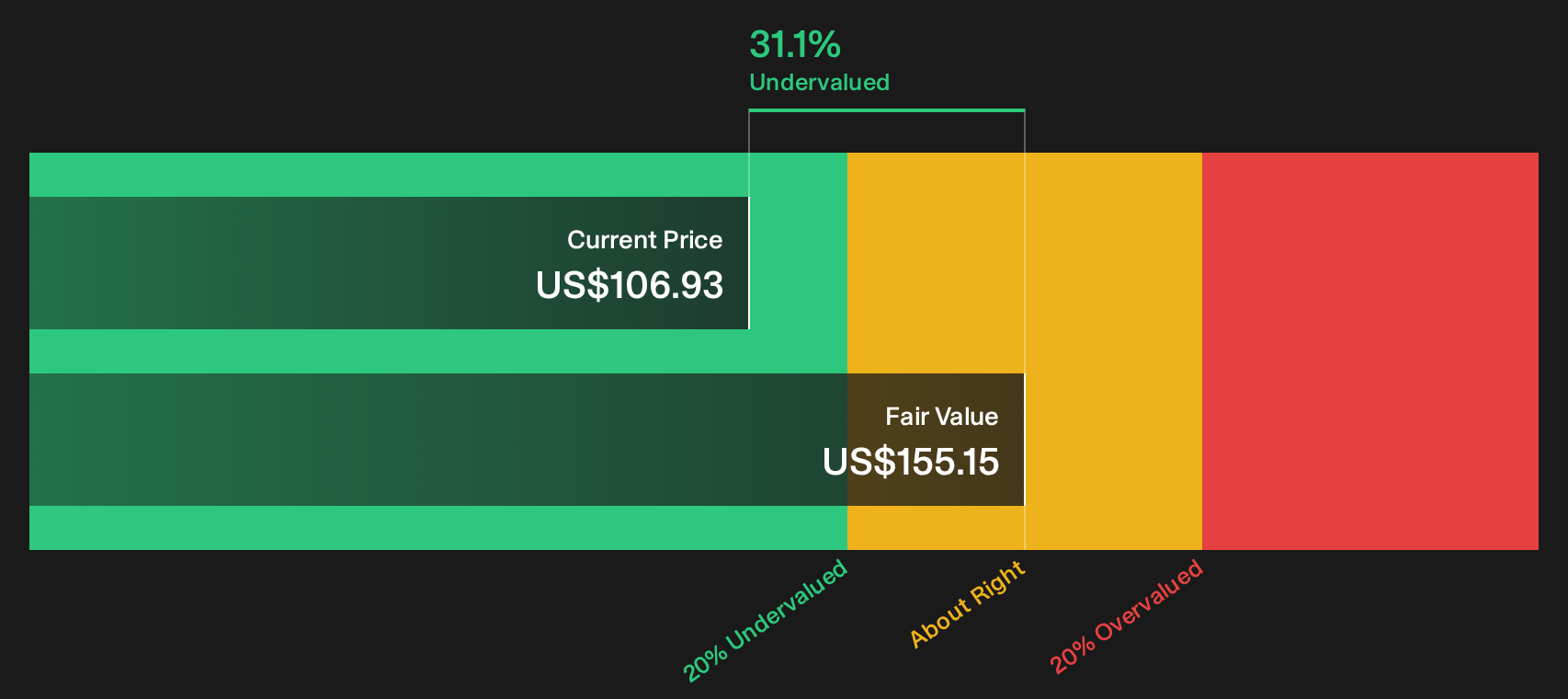
Feeding those inputs into Excess Returns, along with a Stable Book Value estimate of $22.87 per share, produces an intrinsic value of $155.15 per share. Compared with the current share price, this implies the stock is 31.1% undervalued. SEI’s recent research highlighting untapped held away assets helps explain why the model ascribes value to future equity returns even if the market is more cautious on how much of that opportunity converts to fees.
On this Excess Returns view, SEI Investments screens as undervalued relative to what its projected equity returns would justify.
Our Excess Returns analysis suggests SEI Investments is undervalued by 31.1%. Track this in your watchlist or portfolio, or discover 31 more high quality undervalued stocks.
Does SEI Investments Look Pricey on Earnings?
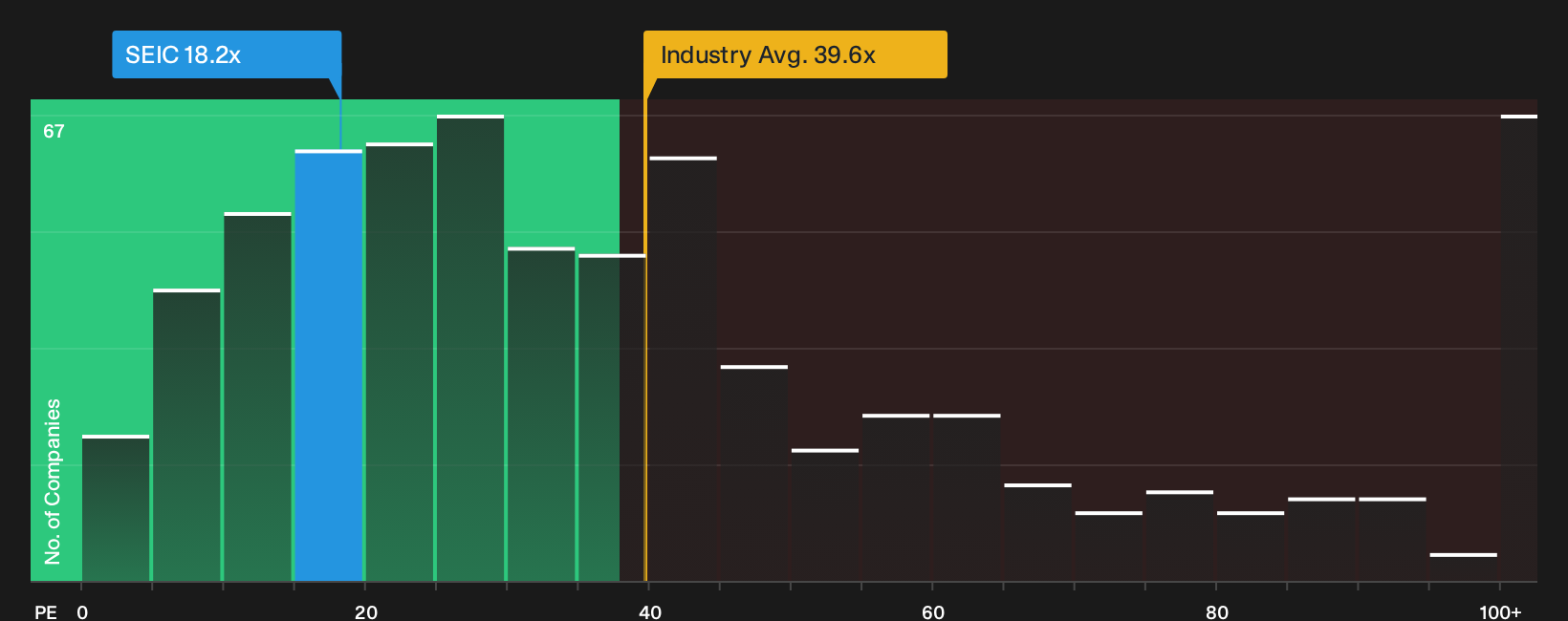
The P/E lens fits SEI Investments well because earnings remain the key driver of how investors frame its value. On this measure, the stock trades at about 18.2x earnings, which is lower than both the Capital Markets industry average of roughly 39.6x and the peer group on about 21.3x. That relative position can look modest at first glance, especially against an industry where plenty of companies carry much richer tags.
The fair P/E that blends SEI Investments’ size, profitability and risk profile comes out nearer 12.6x. The current 18.2x level therefore sits well above what this tailored yardstick suggests would be reasonable, even if it still looks restrained compared with the broader sector. For investors weighing the Excess Returns signal against this market multiple, the P/E check points to a stock that already asks for a healthy earnings premium.
On the preferred P/E benchmark, SEI Investments screens as overvalued, with its earnings multiple running meaningfully above the model’s fair level.
See what the numbers say about this price — find out in our valuation breakdown.
The SEI Investments Narrative: What Would Justify Today's Price?
Simply Wall St Narratives pick up where the excess returns and P/E signals leave you with questions about SEI Investments' pricing. Narratives explain which paths for future growth, profitability and earnings would need to hold for the stock to be worth materially more or less than today. Each one treats SEI Investments' fair value as a hypothesis about the business that can be checked against how the story develops over time. They are available on the Community page.
Community narratives on SEI Investments are split sharply, with one camp leaning into AI and platform leverage while the other focuses on margin strain and capital trade offs.
Bull case: 8% undervalued
"SEI's continued and proactive investment in modern technology platforms targeting scalability, automation, and cost efficiency positions the company to capitalize on increasing demand for digital transformation and outsourcing within financial services…"
Read the full Bull Case to see why SEI Investments could be undervalued
Bear case: 9% overvalued
"Ongoing investments in IMS technology, hiring ahead of client onboarding and platform enhancements are expected to keep margins relatively flat or slightly lower into 2026…"
Read the full Bear Case to see why SEI Investments could be overvalued
Do you think there's more to the story for SEI Investments? Head over to our Community to see what others are saying!
The Bottom Line
SEI Investments looks cheap on the intrinsic value estimate from the Excess Returns model, which prices in strong returns on equity over time. The P/E view points the other way and flags the stock as overvalued relative to its tailored earnings multiple, which reflects how much optimism is already baked into the current price. That split comes from different sensitivities, with the intrinsic value lens anchored on capital intensity and equity returns, while the market multiple leans on growth expectations and where peers trade. The key question now is whether SEI Investments can convert its asset-gathering opportunity into durable fee growth without eroding margins.
This article by Simply Wall St is general in nature. We provide commentary based on historical data and analyst forecasts only using an unbiased methodology and our articles are not intended to be financial advice. It does not constitute a recommendation to buy or sell any stock, and does not take account of your objectives, or your financial situation. We aim to bring you long-term focused analysis driven by fundamental data. Note that our analysis may not factor in the latest price-sensitive company announcements or qualitative material. Simply Wall St has no position in any stocks mentioned.
Have feedback on this article? Concerned about the content? Get in touch with us directly. Alternatively, email editorial-team@simplywallst.com