


The Zhitong Finance App learned that with global AI leaders such as Anthropic, OpenAI, and SpaceXAI founded by Musk unanimously calling for a slowdown in the development of cutting-edge AI models, the global stock market also re-estimated the cooling of investment growth expectations related to the AI computing power industry chain and rising oil prices, the risk of a new round of interest rate hikes by the Federal Reserve. SK Hynix fell more than 5% in early trading in the Korean stock market. As of Monday, SK Hynix fell more than 3%. As of Monday, the Korea KOSPI Index, which has the title of “AI computing power is trending past the standard” 3 % However, many senior Wall Street analysts said that the latest developments will not have a lasting impact on the industry and are unlikely to disrupt the long-term AI computing power trading theme bull market logic.
At a time when the global semiconductor sector's collective trend is weakening due to market concerns related to “AI deceleration,” the latest “China AI Path: From 8.5 trillion yuan capital expenditure to triple computing power” research report, the latest research report of Wall Street financial giant Morgan Stanley shows that China's AI computing power industry is expected to enter a new stage driven by a sharp expansion in the domestic chip supply chain, AI cloud computing capital investment, and the commercialization wave of AI reasoning: that is, 2026-2030, hyperscale cloud computing power companies, large telecom operators, and other emerging AI players Accumulation The investment of about 8.5 trillion yuan, or about 1.3 trillion US dollars, will support the increase in IT power capacity in China from 26 GW in 2025 to 81 GW in 2030.
Morgan Stanley's accurate meaning of “triple AI computing power infrastructure expenditure” is that the capacity has reached about 3.1 times the original; GW measures the power capacity of IT-side devices. The actual overall computing power of the AI computing power cluster also depends on chip performance, memory bandwidth, high-speed optical interconnection efficiency within the cluster, and the overall energy consumption utilization rate of the power system.
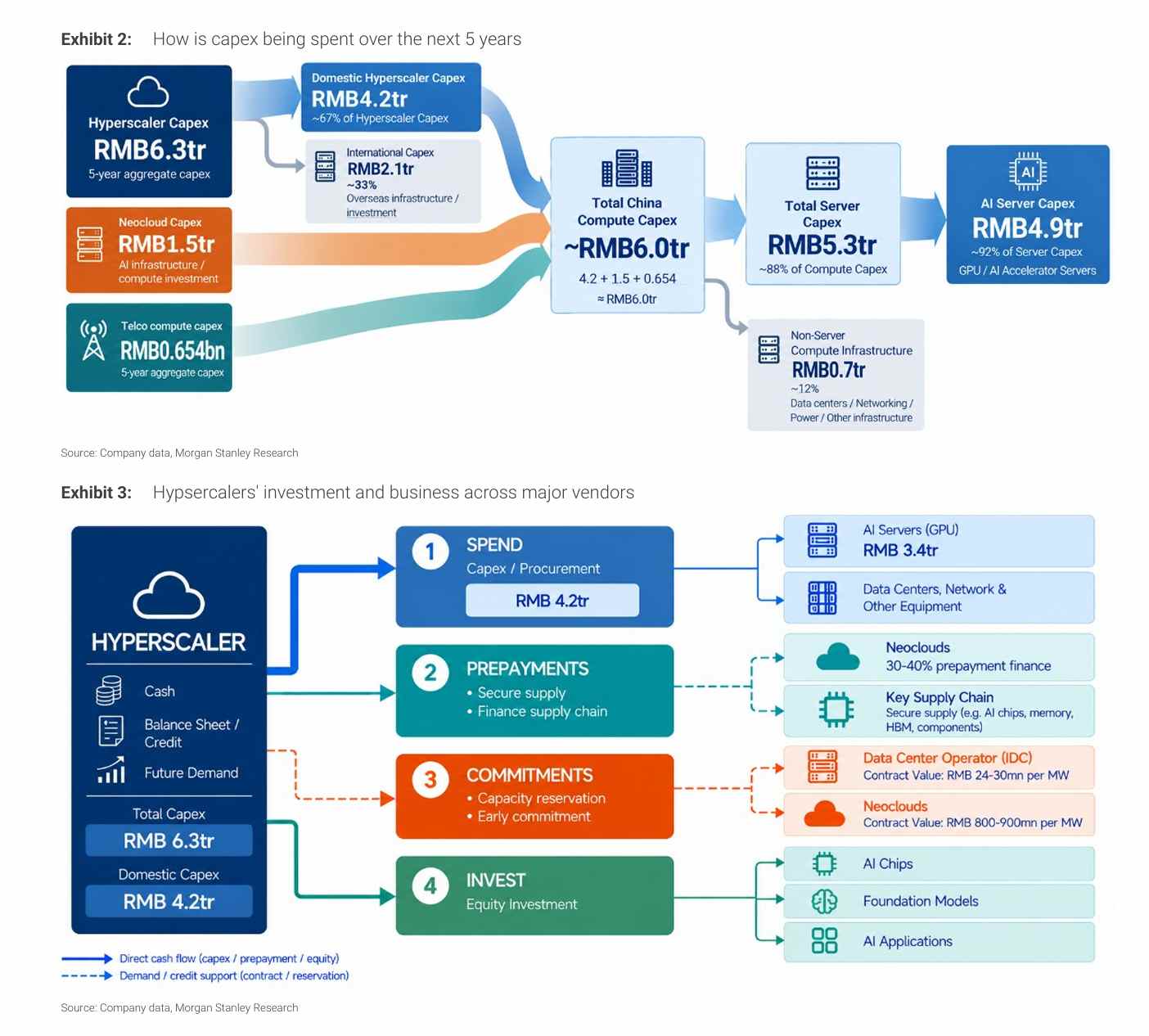
According to the Morgan Stanley forecast report, this investment is expected to cover both domestic construction and overseas expansion of about 2 trillion yuan, so it cannot all be considered a purchase order for AI computing power infrastructure within China. Its investment judgment focuses on three interrelated aspects: improving the supply of domestic GPUs and ASICs, enabling demand previously bound by chips to be implemented; large cloud vendors support the industry chain through capital expenditure, advance payments, long-term contracts, and equity investments; and cloud platforms then turn equipment investment into continuous revenue through GPU leasing, model services, and third-party model hosting.
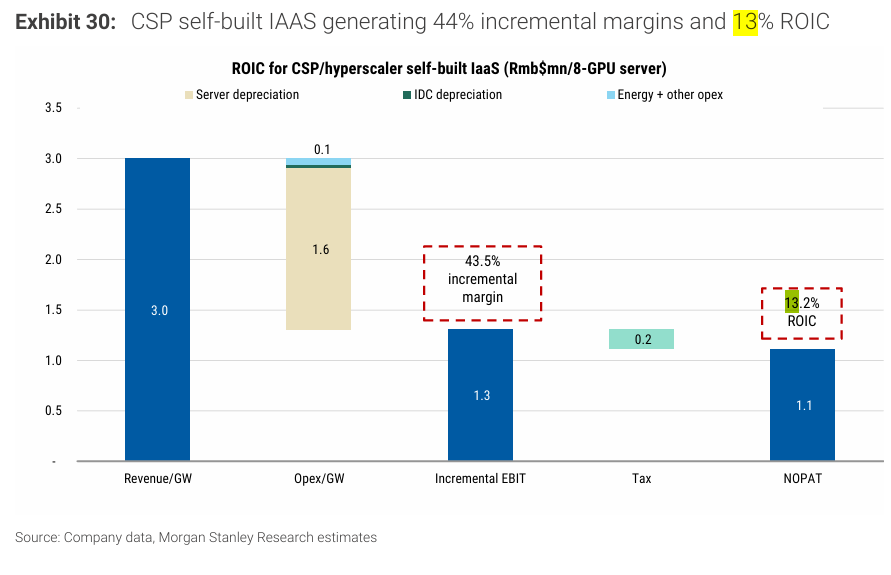
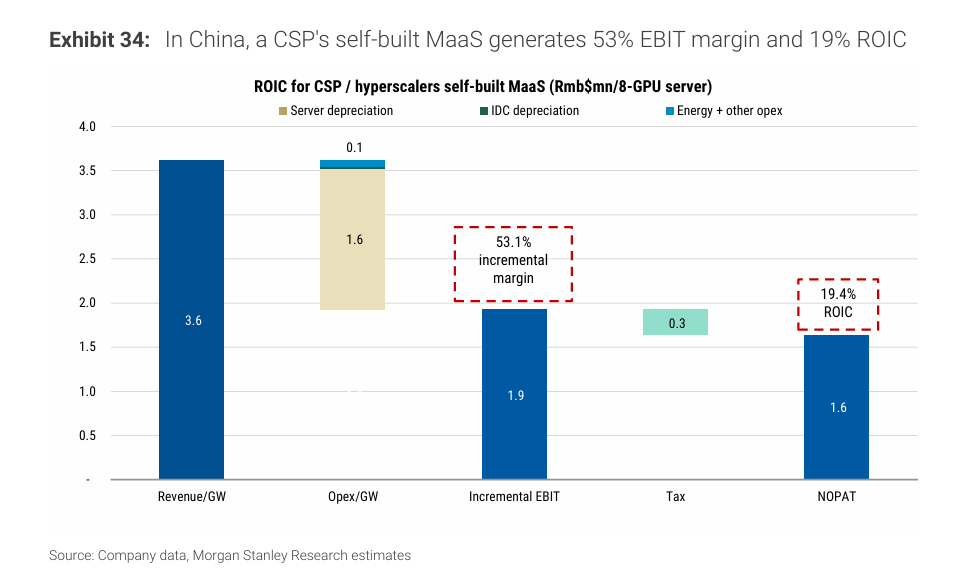
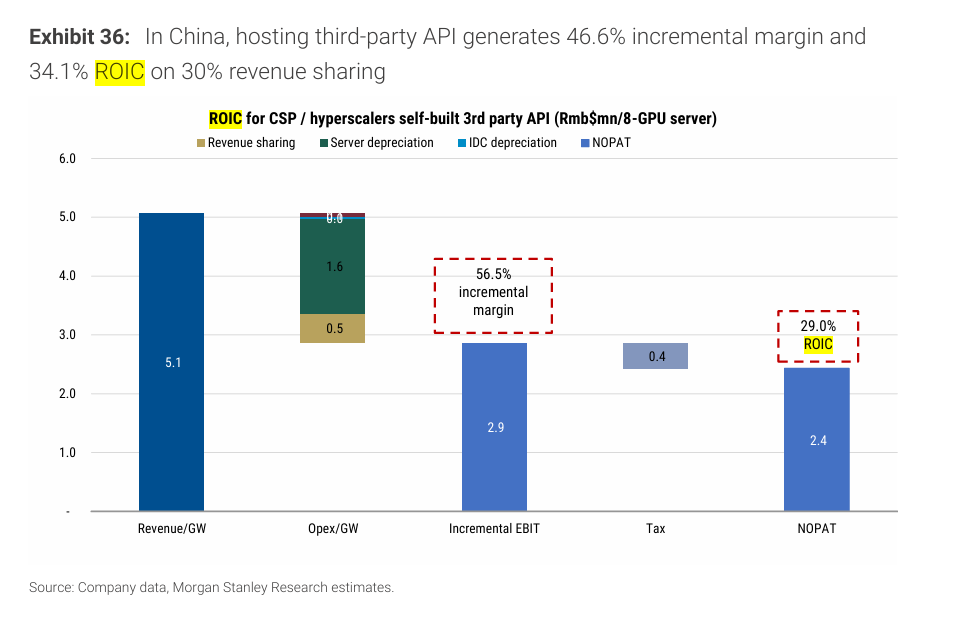
In addition, the Dama analyst team added that the business model determines the difference in return — the benchmark ROIC for China's computing power infrastructure solutions has increased from about 13% of leasing its own GPU to about 19% of self-developed model services and about 29% of third-party model hosting; the next-generation chip hardware solution based on domestic replacement is about 9.1%, which still depends on performance and cost improvements. The report's most valuable judgment is that it links “capital investment - usable computing power - paid reasoning - return on capital” to provide an investment framework that can be continuously tested for China's AI industry chain.
In other words, under different business and hardware assumptions, Morgan Stanley estimates that the benchmark ROICs for the three types of solutions in the Chinese market (enterprises buy their own servers, rent GPU computing power to customers, that is, IaaS with their own infrastructure), run self-developed models with their own computing power (enterprises own computing infrastructure, run self-developed models and charge through model APIs), and run third-party AI models with their own computing power (enterprises run third-party models on their own computing infrastructure, provide API services to customers, and divide them into models), respectively) %, 19%, and 29%; among them, if the third-party model service uses the next-generation domestic server assumed in the report (in the third-party model service model described above, the core AI hardware system is replaced with the hypothetical next-generation domestic chip solution), the benchmark ROIC is about 9.1%. These are the results of the economic model of the project unit. They cannot be regarded as the company has achieved returns, nor do they constitute a conclusion that upgrading the business model will inevitably increase profits.
Where will 8.5 trillion yuan flow: Domestic chips open up room for capacity expansion, and actual cash flow determines the speed of construction
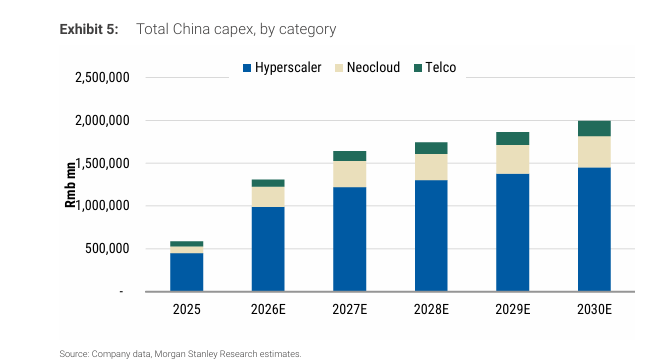
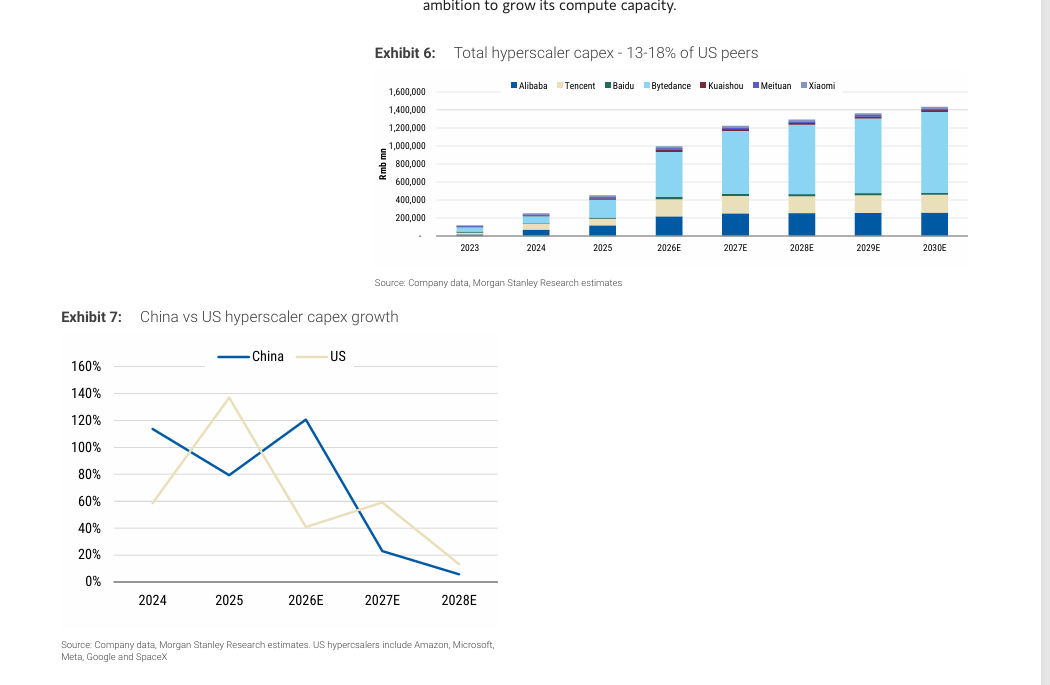
Internet giants are the absolute mainstay of capital expenditure, but the three types of investors are tasked with different tasks. Morgan Stanley expects the cumulative capital expenditure of hyperscale cloud vendors and major Internet companies to be around 6.3 trillion yuan from 2026 to 2030, of which it will reach 995 billion yuan in 2026, an increase of 121% over the previous year, higher than the 41% reported by the same caliber US counterpart; further increase 23% to about 1.2 trillion yuan in 2027, and rise to about 1.4 trillion yuan in 2030.
At the company level, Damo estimates that Alibaba's annual capital expenditure from 2026 to 2030 is estimated to be 217 billion yuan to 259 billion yuan, Tencent's forecast range is 193 billion to 200 billion yuan, and Baidu is 20 billion to 24 billion yuan. What is behind Ali's more active investment is the revenue visibility of AI GPU computing power infrastructure services and model services: According to the report, its annual MaaS revenue operating rate for the June quarter has exceeded 10 billion yuan, and is expected to reach 30 billion yuan by the end of the year; Damo said that this figure is an annualized revenue operating rate and cannot be considered as realized revenue for the whole year.
The second pillar is an emerging computing power cloud enterprise, with an investment of about 1.5 trillion yuan over five years. The annual scale will rise from 234 billion yuan in 2026 to 363 billion yuan in 2030. More than 95% of the investment is expected to be used to procure high-performance AI server clusters around AI GPU/ASICs to undertake high-end computing power supplementation and rental supply functions. The third pillar is the operator, which calculates the relevant capital expenditure of about 653 billion yuan over five years. The annual scale has increased from about 81 billion yuan to 179 billion yuan, mainly serving the AI needs of government enterprises, state-owned assets, and sovereignty. The operator calculates about half of the relevant budget for computer rooms, networks, etc., and more than 75% of the remaining equipment investment is expected to target GPUs or ASICs. It can be seen from this that 8.5 trillion yuan includes servers, storage, networks, data centers, and overseas construction, and directly equating this to the size of the AI chip market would clearly overestimate chip revenue.
The economic value of localization is first reflected in increasing deliverable supply, and only then in improving the cost of computing power per unit. The Damo research report predicts that domestic AI chip shipments will increase from 1.1 million in 2025 to 2.4 million units in 2026, 4.8 million units in 2027, and reach 11 million units in 2030; the corresponding market size will expand from 94 billion yuan to 646 billion yuan, and domestic chips are expected to account for 70% to 85% of server deployment from 2025 to 2030.
On the capacity side, 55 GW will be added, with leading cloud vendors contributing 34 GW, 9 GW from operators' internal and government enterprise needs, and 12 GW from other Internet companies and AI laboratories; leading Chinese cloud vendors are also expected to add about 13 GW of overseas capacity, for a total of 47 GW globally.
According to the Damo research report, annual orders for third-party data centers are expected to increase from 6.1 GW in 2026 to 11 GW in 2030, with about 70% of incremental orders falling in western regions such as Inner Mongolia and Ningxia. In terms of engineering, this provides opportunities for domestic GPUs, ASICs, servers, optical interconnects, power supply and distribution, and liquid cooling, but “cheap power and computer rooms” cannot automatically offset the cost of inefficient computation: the report estimates that the deployment cost of domestic inference equipment will rise from about US$19 billion per GW in 2026 to US$22 billion in 2027, mainly affected by supercluster configurations and memory price increases; this caliber includes support for memory, CPU, and network, and is not a pure chip price.
The report also clearly indicates that the model has not fully taken into account subsequent memory price increases, and capital expenditure may be revised as a result. For Chinese AI companies, what really needs to be optimized is the cost per million effective tokens after meeting latency and reliability requirements, as well as the paid throughput that can be generated per watt and per yuan of capital; the number of chips, power capacity, and commercial output must be measured separately.
Financing capacity will determine which companies can turn expansion plans into stable operating assets. Morgan Stanley believes that the domestic investment of Ali, Tencent, and Baidu can generally receive operating cash flow and cash reserve support. Among them, Tencent is relatively steady; Ali's competitive investment in local life and whether Baidu's search business can stabilize may still change its ability to cover cash.
Overseas capital expenditure of about 2 trillion yuan is required to compete with foreign debt repayment, dividends, and repurchases, and may be supplemented by selling portfolios, issuing bonds, or equity financing. Emerging computing power cloud companies are significantly more sensitive to debt. Financial leasing usually covers 30% to 40% of the investment, the rental interest rate is about 5%, and the bank loan interest rate is about 3% to 4%. Customer advance payments can relieve pressure during the construction period, but they cannot be mistaken for long-term repeatable operating profits.
According to the Damo forecast report, the five-year construction capital expenditure of independent data center vendors is estimated to be about 569 billion yuan. Project loans usually cover 60% to 80% of the cost, operating cash flow can only cover about 10% to 15% of capital expenses, and the rest depends on REITs, asset securitization, and equity financing; this is another layer of infrastructure estimates, and should not be directly added to 8.5 trillion yuan without dealing with overlapping caliber.
Damo's forecast for the four major North American tech giants provides a corresponding comparison: the operating cash flow of the four giants is expected to increase from US$739 billion in 2026 to US$1.23 trillion in 2028, and demand for new debt falls from US$238 billion to US$90 billion, but these cash flow expectations include advertising, e-commerce, and traditional cloud businesses, which cannot all be attributed to AI. At the same time, the data center capital expenditure of the four major North American tech giants was 1.47 trillion and 1.64 trillion US dollars respectively in 2027 and 2028, so the more accurate conclusion for the Big Four is that the investment growth rate fell to about 12% in 2028, and the total still increased by about 170 billion US dollars — this also means that the slowdown in investment growth can coexist with the increase in computing power usage. The key is whether the built assets can be put into operation in a timely manner, obtain customers, and continue to generate cash.
From “buying computing power” to “selling results”: How Astra's big model is changing the pricing of memory chip demand and AI return on investment
The GPT-6 Astra model recently launched by OpenAI and the RSI technology path focused on by AI leaders are expected to become the two core driving forces driving the exponential expansion of AI computing power demand, namely the AI big model with better performance, the use of a wider range of AI application tools, and the next generation AI training path with stronger computing power requirements, which are an important basis for the continued growth in AI computing power infrastructure demand.
The investment significance brought by Astra is to improve the success rate and economic viability of complex tasks, so that companies are willing to deploy more agents and handle more professional tasks; Wall Street financial giant Morgan Stanley's recent emphasis on “shifting from demand debates to physical supply constraints on AI themes” is a new round of AI computing power resource demand expansion mechanism brought about by Astra, the most advanced model. The statement by the OpenAI product manager that demand is unprecedented and that the company may suspend new Pro subscriptions can be described as an important sign that AI computing power service capacity is under pressure recently.
As AI moves from a single round of question-and-answer to programming, research, office, and cross-software operation, a paid task may include planning, multiple model calls, tool execution, result verification, and continuous storage of work states; expanding the scope of enterprise adoption will also increase the number of tasks running at the same time. However, a stronger model may complete the same task with fewer tokens and retries, and OpenAI's Astra release material also revealed some efficiency improvements, so a “stronger model” cannot be directly deduced as “every task consumes more computing power.” A more reasonable growth mechanism is: the cost of tasks is reduced and the success rate is increased, so that tasks that are not economical can be automated; when the demand for new tasks exceeds the reduction in resource consumption per task, the total computing power demand will only accelerate growth.
According to the minutes of the SanDisk Technology conference previously released by Goldman Sachs, the long-term agreement covers about 50% and 67% of the planned shipments for the 2027 and 2028 fiscal years, reflecting order visibility; whether it can be realized into higher profits also depends on product certification, customer share, price, and cost per bit. For leaders in China's AI computing power industry chain, the same mechanism means that the expansion of domestic GPUs and ASICs will drive the demand for supporting memory, SSD, high-performance Ethernet network infrastructure and data center CPUs, optical interconnect chips, and software optimization requirements, but who obtains these orders still depends on specific procurement systems and product competitiveness.
The Dama analyst team said that whether the huge investment scale of AI can accelerate the achievement of a strong profit trajectory ultimately depends on the combined effects of paid throughput, unit sales price, and capital efficiency. Damo's benchmark estimates are as follows: its own GPU leases about 13.2% ROIC, self-developed model services are about 19.4%, and its own computing power hosts third-party models and provides about 29% of the API; the third solution bears 10% of model revenue share and assumes that running a third-party model has a performance discount, which cannot be understood as simply reselling an external API. Damo said that the overall procurement costs and upfront costs associated with the performance ratio, token throughput, and utilization rate surrounding high-end AI server clusters are relatively high, which is the main reason why GPU rental returns are lower than the US plan.
The benchmark price for the next generation domestic server is assumed to be 4 million yuan, and the inference performance is 30% of the overseas comparison plan, thus obtaining 9.1% ROIC and a payback period of about 3.6 years; when the performance ratio changes by 20% to 40%, the ROIC range is about 0.3% to 17.9%. This shows that the value of HBM3e, software and hardware collaboration, and cluster optimization is to increase billable throughput; the separation of pre-filling and decoding may be more effective for long input tasks, but actual benefits are also affected by initial token delays, output delays, and KV cache transmission, and it is not yet possible to determine that domestic projects generally “have crossed the profit qualification line”.
In terms of investment strategy, Damo said investors should simultaneously examine the hardware vendor's order quality and capital discipline, cloud platform payment utilization rate and unit gross profit, and whether the model company's revenue growth can cover training and inference costs. Based on this, Morgan Stanley favors Alibaba, Tencent, Jinshan Cloud, Century Internet, and domestic computing power companies such as MiniMax, Smart Spectrum, and Cambrian, Tianshu Smartchip, and Haiguang Information; these are the latest domestic computing power stock selection directions in the Dama Research Report, and ROIC still has to be assessed in conjunction with capital costs, competitive pressure, and current valuations.