


The Zhitong Finance App learned that Japanese memory chip maker Kioxia Holdings (Kioxia Holdings) is considering raising at least $10 billion by issuing depository certificates (ADR) in the US to join a group of AI-related companies to seize the deepest capital pool in the world. People familiar with the matter said that Kioxia is already discussing possible issuance within next year with banks such as Bank of America, Goldman Sachs, and J.P. Morgan Chase. Notably, the day this plan surfaced coincided with concerns about AI deceleration triggering a sell-off in global chip stocks — Nasdaq 100 futures fell 1.6% at the beginning of the session.
Transaction Highlights: Liquidity, Shareholder Structure and Index Incorporation
People familiar with the matter, who requested anonymity due to the privacy of the matter, said that after buying back billions of dollars of shares in Japan, the Tokyo-based storage manufacturer hopes to obtain more dollar liquidity by going public in the US; issuing ADR may also allow Kioxia to enter the semiconductor-focused US stock index. Currently, the consideration is still in the early stages, and details such as the distribution scale and bank lineup may change. Representatives from Kioxia, Goldman Sachs, and J.P. Morgan declined to comment, while Bank of America did not respond to requests for comment.
Kioxia has previously stated that it plans to release ADR in the spring of 2027, but no further details have been disclosed; if the latest news is implemented, it means that the distribution scale will first be determined to reach the level of 10 billion US dollars or more, and the time may also be ahead of schedule. Global semiconductor companies and other AI-related companies are seeking to capitalize on the popularity of investment in this sector — South Korean memory chip manufacturer SK Hynix went public in the US in July to raise US$26.5 billion, setting a record for the highest initial public offering of shares by a foreign company.
Kioxia is a key supplier of global NAND flash memory, and NAND is currently the most beneficial storage link in AI infrastructure construction. According to industry data quoted by AInvest, the NAND market has a supply gap of about 4-5% throughout the year in 2026. TrendForce expects contract prices to rise another 70-75% month-on-month by mid-2026; enterprise-grade SSDs account for 43% of NAND market revenue in the first quarter and are expected to exceed 60% by the end of the year, and servers now account for more than 40% of NAND bit requirements.
From Toshiba's abandonment to Japanese stock tycoaster: 400% roller coaster in a year
The predecessor of Kioxia was Toshiba's memory chip business, the pioneer of NAND flash technology. The business was acquired by a consortium led by Bain Capital in 2018 and renamed Kioxia the following year. It raised only 120 billion yen when it was listed in Tokyo in December 2024. The AI construction boom completely rewrote its fate: According to reports, Kioxia surpassed Toyota on June 12 this year to become the listed company with the highest market capitalization in Japan. At one point, the market capitalization surpassed 44 trillion yen (about 274 billion US dollars). At one point, it rose by more than 670% during the year, ranking first in the MSCI World Index.
Since then, the stock price has adjusted along with the sector. Kioxia's Tokyo-listed shares are still up nearly 400% this year, with a current market capitalization of about $180 billion — about one-third of the June peak. In July of this year, the performance guidelines announced by Kioxia were conservative and were interpreted by the market as falling short of expectations; the company immediately announced a stock split of 1 to 3 and a repurchase plan of up to 800 billion yen (about 5.2 billion US dollars) to expand the shareholder base and reduce stock price fluctuations. In May of this year, S&P and Fitch simultaneously upgraded Kioxia's rating to BBB-, entering the investment level for the first time.
Financial ambition: operating profit in a single quarter exceeds that of the previous fiscal year
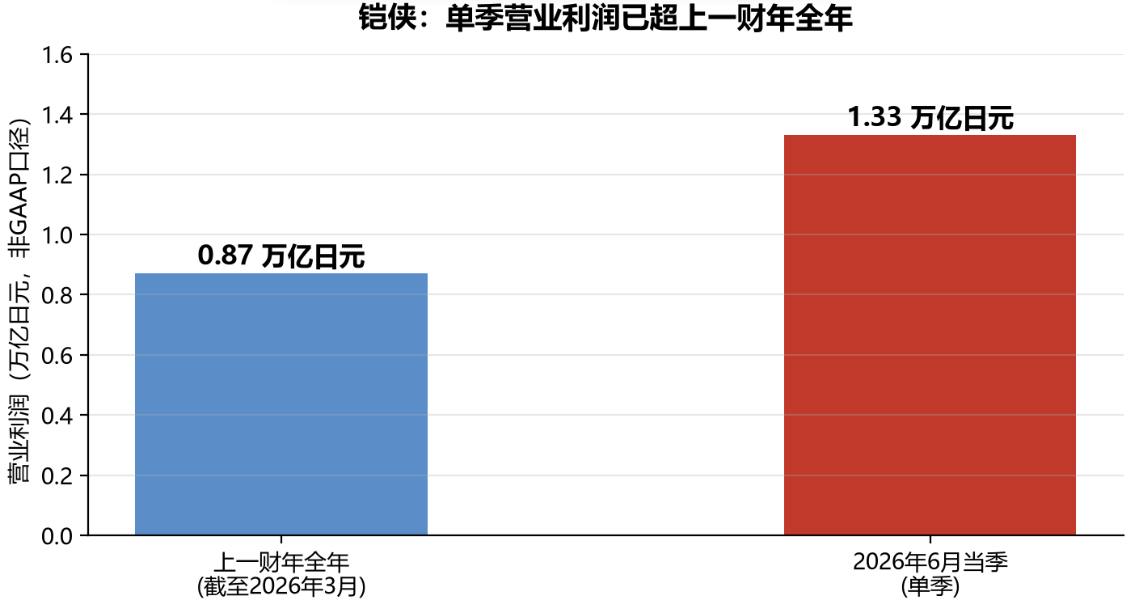
What supports this capital operation is textbook-level cyclical performance. According to the company's financial report, in the latest quarter ending June, Kioxia's revenue reached 1.77 trillion yen, up 415% year on year, and the overall average sales price rose 70% month-on-month; non-GAAP operating profit was 1.33 trillion yen, and the operating profit margin was as high as 75% — the operating profit for a single quarter has already exceeded 870 billion yen for the entire previous fiscal year. Non-GAAP net profit for the quarter was 887 billion yen, free cash flow surged 3.4 times month-on-month to 827 billion yen, and the company paid off all 408 billion yen of priority debt and transferred to net cash. Cash and equivalents reached a record amount of 791 billion yen. Kioxia confirmed in February this year that all of its 2026 NAND production capacity has been locked in by customers, and that some hyperscale cloud customers have also proposed long-term supply requirements covering 2027 to 2028.
Headwind: AI deceleration storm hit at launch
The problem is timing. The analysis points out that as Kioxia weighed this issuance, the stock market was being stirred up by expectations that AI development might slow down — after US AI giants discussed introducing safety barriers and impact assessments for the most advanced models over the weekend, the NASDAQ 100 futures initially fell 1.6%, and the Philadelphia Semiconductor Index ETF fell 5.7% at one point. Today, the Asian market has been digested first: Kioxia itself closed down 6.4% in Tokyo, SK Hynix closed down 6.4%, Samsung Electronics closed down 4.1%, and SoftBank closed down 10.7%. Capital events on the same track are also changing: the $2 trillion valuation IPO in the Anthropic sprint was overshadowed by the security narrative and market speculation that it would need to revise the S-1 file, and OpenAI has made it clear that it will not go public in 2026.
Institutional views
The interpretation of this release is polarized. According to many sources, an increase of nearly 400% during the year means that Kioxia has sufficient “book income” to be realized regardless of recent sentiment, and management's buybacks and stock splits since this year — which were meant to pave the way for stable stock prices before major capital events — will logically extend to the US to seek a deeper pool of investors; if the issuance is implemented, this will be one of the largest US listings in the history of Japanese companies. It is also a landmark event where the AI capital cycle is highly concentrated in the storage sector. Lumida News's analysis points directly to the core point: SK Hynix's $26.5 billion ADR release landed at the peak of AI infrastructure enthusiasm in July, and Kioxia is now considering a similar move, just as this enthusiasm shows the first real crack in the AI security debate — the subscription situation for the $10 billion distribution will be a real-time test of whether the demand for memory chip exposure can withstand the current AI deceleration narrative.
The cautious approach focuses on the risk of the cycle peaking. AInvest's analysis indicates that the rise of Chinese manufacturers and the release of new global production capacity after 2027 may cause supply to exceed demand in the medium term, making it difficult to maintain the current operating margin of 75%; Kioxia relies on data centers and enterprise-grade SSDs for over two-thirds of its revenue, while smartphones and notebooks still account for nearly 40% of NAND demand and is shrinking. Gokhshtein's research suggests two verifying points: the discounted premium of the issuance terms compared to the Tokyo listing — which will reveal whether US capital sees the AI storage story as overheated or still undervalued; and the 2027 fiscal year guidance when ADS was launched — it will answer whether this surge was an early overdraft or a leading indicator of real profit growth.