


- Equinor, through its 45% partnership interest in Smackover Lithium with Standard Lithium, reported a positive Preliminary Economic Assessment for the Franklin lithium project in East Texas. The assessment outlines up to 70,000 tonnes of annual battery-grade lithium carbonate capacity over a 20-year modelled life and a US$3.5b initial capital cost estimate.
- The PEA points to high lithium concentrations, upgraded mineral resources and the potential to reuse flowsheet work from the South West Arkansas Project. Taken together, these factors underline how Equinor is extending beyond traditional hydrocarbons into battery materials linked to the energy transition.
- The focus now shifts to how Equinor's investment narrative could evolve as this large scale lithium brine project targets battery-grade output.
Equinor Investment Narrative Recap
To own Equinor, you need to buy into a story where a large oil and gas producer gradually builds out profitable low carbon and transition businesses without losing discipline on capital and returns. The Smackover Lithium PEA fits that picture as a long dated option, but it does not change that near term earnings still hinge on upstream output and trading results.
For the next couple of years, the most important swing factor remains execution on existing petroleum projects and how commodity markets evolve. The biggest current risk is that revenue and earnings are expected to decline over the next 3 years while dividend payments have been uneven. As a result, any large new project spend, including lithium, heightens scrutiny on cash allocation.
The Franklin PEA is the standout new disclosure linked to this theme. It sketches out up to 70,000 tonnes a year of battery quality lithium carbonate capacity, a 20 year modelled life and a US$3.5b initial capital requirement. It uses a flowsheet closely related to the South West Arkansas project to reduce technical uncertainty.
For you as an Equinor shareholder, the relevance sits in future optionality rather than immediate impact. The project could diversify cash flows away from ageing oil and gas fields, but it also adds execution, permitting and cost risk in a new commodity where the firm has limited operating history, all while the core business already faces forecast declines in revenue and earnings.
What The Current Forecasts Say About Equinor
Equinor's lithium move only really makes sense when set against what analysts already expect from the core business. Consensus models point to relatively modest revenue expansion, with forecasts for 1.6% annual top line growth over the next three years and an uplift in profit margins from 5.3% today to 7.3% by 2029. That margin improvement is where most of the heavy lifting happens in the earnings story.
Analysts currently factor in earnings of $5.5b today rising to a central forecast of $8.0b by 2029, with the most optimistic views at $9.4b and the most cautious at $7.1b. That implies roughly a $2.5b increase in profit on the base case. For you as a shareholder, the range across those estimates matters as much as the midpoint, because it shows there is no single agreed view on how Equinor balances upstream maturity, renewables and projects like Smackover Lithium over the rest of the decade.
On these assumptions, the market story around Equinor leans on two moving parts. Modest revenue growth and better margins combine into higher forecast earnings, while a lower P/E multiple is used to justify current price targets. The framework in the Simply Wall St report assumes a future P/E of 11.7x on the projected $8.0b of earnings, compared with 15.2x today and a current GB Oil and Gas industry multiple of 15.5x. All of these are discounted back using a 6.65% to 6.7% rate.
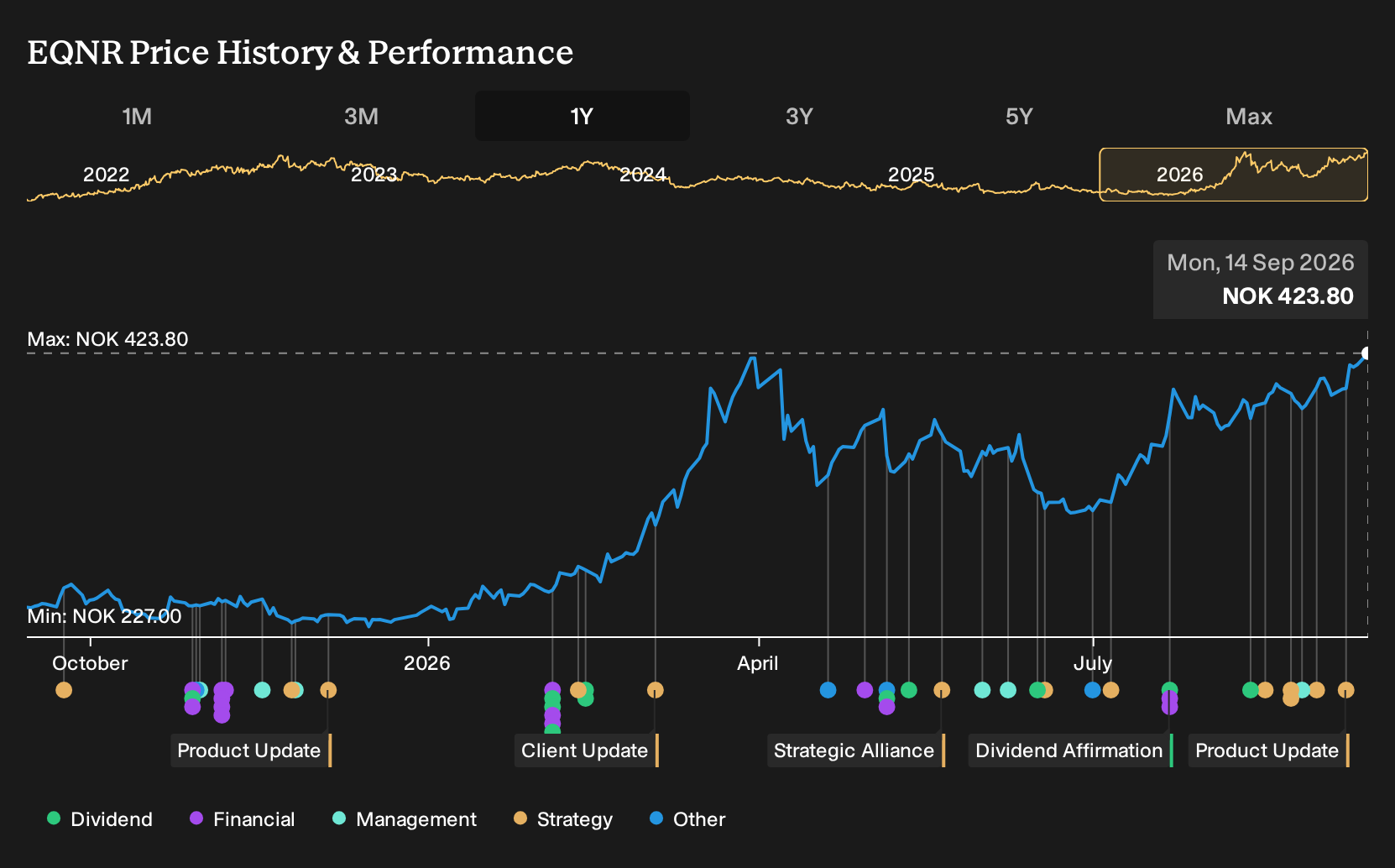
That valuation bridge translates into a consensus price target of NOK349.12 compared with a share price reference of NOK329.5, an implied upside of 5.6%. Analysts see limited mispricing in the stock on their central scenario. For you, this sets a relatively tight margin of safety around any extra capital the business commits to lithium and other transition ventures, because the equity story is already anchored on efficient capital use and disciplined returns.
Equinor's narrative projects $109.3b revenue and $8.0b earnings by 2029. This requires 1.6% yearly revenue growth and roughly $2.5b earnings increase from $5.5b today.
Uncover why Equinor's fair value indicates an 18% potential downside to its current price that leaves little room for error.
Exploring Other Perspectives
One alternate view says the real risk for Equinor is shrinking oil and gas demand rather than project execution. Those bearish analysts were already modelling revenue sliding to about $80.7b and earnings easing to $6.8b by 2029 before this Franklin PEA. You can read that as a much more cautious story that might shift as lithium details sink in.
Explore 6 other Equinor fair value estimates, including one that suggests as much as 35% downside from the current price.
The Verdict Is Yours
Disagree with existing narratives? Extraordinary investment returns rarely come from following the herd, so consider forming your own view.
- A useful starting point for your Equinor research is our analysis highlighting 2 key rewards and 2 important warning signs that could impact your investment decision.
- See our latest analysis for Equinor. The report includes a comprehensive fundamental analysis summarized in a single visual, the Snowflake, which allows you to review Equinor's overall financial health at a glance.
Looking For More Equinor-Sized Ideas?
If Equinor's lithium story has you thinking about how to balance opportunity and risk, it can help to scan a wider field of stocks with clear filters on quality, value and resilience.
- For investors who want a focus on value and quality together, start with a curated set of 190 high quality undervalued stocks that combine stronger fundamentals with pricing that may look more conservative.
- If income is a priority, consider companies with sturdier payouts by filtering for 161 dividend fortresses that concentrate on higher yield potential backed by established operations.
- Readers who care most about financial resilience can narrow the universe quickly using a list of solid balance sheet and fundamentals (194 results) to highlight businesses with sturdier leverage and liquidity profiles.
This article by Simply Wall St is general in nature. We provide commentary based on historical data and analyst forecasts only using an unbiased methodology and our articles are not intended to be financial advice. It does not constitute a recommendation to buy or sell any stock, and does not take account of your objectives, or your financial situation. We aim to bring you long-term focused analysis driven by fundamental data. Note that our analysis may not factor in the latest price-sensitive company announcements or qualitative material. Simply Wall St has no position in any stocks mentioned.
Have feedback on this article? Concerned about the content? Get in touch with us directly. Alternatively, email editorial-team@simplywallst.com