


The Zhitong Finance App learned that the yield on US 10-year treasury bonds has risen to the highest level in nearly 20 years, becoming the latest milestone in the global bond sell-off trend. This round of sell-off was driven by soaring energy prices, rising debt levels, and inflationary pressure.
The “anchor of global asset pricing” broke through 5%, and the Fed's anti-inflation reputation faced a major test
On Tuesday, the 10-year US Treasury yield, known as the “anchor of global asset pricing,” once rose 4 basis points to 5.02%, surpassing the peak set in 2023 and reaching the highest level since 2007. The recent round of rising yields followed the rise in global oil prices, and Middle Eastern oil supply risks are rising.
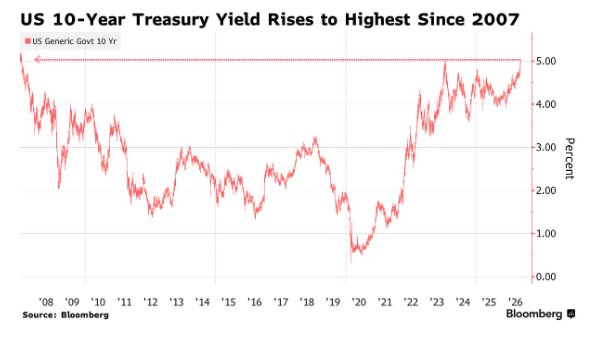
Pressure on the bond market heightened the tense situation ahead of the Federal Reserve's interest rate decision on Wednesday. Investors expect Federal Reserve officials to raise short-term borrowing costs for the first time since July 2023. If the Federal Reserve does not raise interest rates, or if Federal Reserve Chairman Kevin Walsh suggests that monetary tightening in the next few months will be less intense than the current price in the money market, bond investors may demand higher yields to withstand the risk of inflation.
BMO capital market strategist Will Hartman said, “If the Federal Reserve keeps interest rates unchanged this week, it will most likely damage its credibility in fighting inflation. “The market is not only vulnerable to unexpected setbacks, but also vulnerable to 'dovish interest rate hires' — that is, bitmaps or press conferences send a signal of more patience.”
Dalip Singh, chief global economist at PGIM Credit, said: “The more the Federal Reserve can demonstrate its inflationary resilience, the more likely it is to reduce the risk premium at the back end of the US debt curve in the medium term.”
The US Treasury yield is particularly important because it is the basis for pricing other types of loans. In the stock market, it is also used as a discount rate to measure the present value of expected profits over the next few years. The higher the yield, the smaller the present value after conversion of forward profits. Furthermore, high bond yields may trigger capital outflows from the stock market, as higher returns will attract investors to bonds.
The Middle East conflict, AI debt issuance and deficits are intertwined, and the pressure to sell off the bond market is difficult to overcome
Since the US launched military action against Iran at the end of February, disrupting the Middle East's oil and gas supply, global bond yields have continued to rise. In addition to this, large borrowing by companies to spend on artificial intelligence is also one of the drivers. This has not only led to a surge in market debt, but also stimulated the already resilient US economy.
The rise in yields made the Trump administration even more difficult, as it had a ripple effect in the market, driving up the costs of mortgages and other loans ahead of November's midterm elections. Earlier this month, US President Trump threatened that if the Federal Reserve did not cut interest rates, he would cut off all US trade with some countries. This move would almost certainly increase bond sell-off by inciting concerns about inflation. US Treasury Secretary Scott Bessent tried to curb the rise in bond yields by increasing Treasury debt buybacks, but such operations did not work.
Meanwhile, the amount of debt issued by governments continues to rise, both to refinance maturing bonds and to cover fiscal deficits. At this point, major central banks are no longer buying large amounts of government bonds through quantitative easing, and demand from other traditional buyers is also cooling down, causing the market to rely more on investors who are more price sensitive.
Phoebe White, head of US interest rate strategy at UBS Group, said, “Since we have seen no signs of weakness in the real economy, and the supply and demand dynamics in the US Treasury bond market are very different from 2007, there is limited room for long-term yield to decline. Structural demand for US Treasury bonds, particularly from foreign official investors, has weakened significantly.”
J.P. Morgan's team of strategists led by Jay Barry said they expected a rate hike this week, but they are “biased” on long-term US debt due to traders likely reacting to the Federal Reserve statement and the Wash press conference. Others are also wary, believing that if the Federal Reserve surprises investors, the sell-off may restart.
“If the Federal Reserve doesn't raise interest rates, the sell-off of long-term bonds could become more disorderly,” said Ed Al Husseini, portfolio manager at Columbia Threadneedle.