


The Zhitong Finance App learned that ECB Vice President Boris Vujcic (Boris Vujcic) warned that market valuations are soaring, mainly driven by the AI boom, making it easier for the stock market to face the risk of a pullback.
“We haven't seen such price-earnings ratios, forward price-earnings ratios in a long time, if not unprecedented,” the Croatian official said on the ECB podcast “Euro Matters” released on Tuesday. “These valuations may eventually prove reasonable, but they may not.”
He warned that “the exposure is huge and growing,” and added: “We must be very careful and closely monitor the situation, because with so much exposure and so much investment pouring in, this will definitely pose a risk to repricing the stock market.”
The “chorus” of central bank governors
Vujicic's remarks have further strengthened the growing consensus among central bankers, regulators, and investors: the valuations of major AI companies may be too high, and if the valuations of these companies suddenly fall, it may trigger a wider global market correction. Just a day ago, ECB President Christine Lagarde also said bluntly on Monday that the AI industry's asset valuation is “very high” and that a pullback is “entirely possible” — but no one can predict when it will happen.
This is not an isolated statement from within the ECB. According to reports, the analysis published on August 17 by five ECB economists (Malin Andersson, Johannes Breckenfelder, Stefano Corradin, Kalin Nikolov, and Maria Antonietta Viola) has determined that “a correction in current stock market valuations is possible,” and for the Eurozone, it will “be a financial stability issue, not just a private issue” — in other words, the shock will not only be caused by Technology stock investors are responsible for themselves.
The timing of implementation of the warning is worth paying attention to
The comments come as AI developers such as Anthropic PBC and OpenAI are in conflict with US President Donald Trump's administration over their calls for the entire industry to slow down AI development. This proposition has already triggered a sell-off in technology stocks, and has also caused outsiders to question whether the global data center construction boom can continue.
In fact, US stocks have already given intuitive footnotes overnight. At the close of trading on Monday, the three major US stock indices fell collectively. But the real hardest hit area was the semiconductor sector — the Philadelphia Semiconductor Index, which fell sharply by 5.86% in a single day, the biggest drop since July 1.
On the same night, US 10-year Treasury yields surpassed 5% intraday, the first time since October 2023. Moreover, after experiencing a brief tariff scare in 2025, margin debt on US stocks soared 77% to more than $1.5 trillion in 14 months, facing the triple impact of “historical valuation levels, rising risk-free interest rates, and a slowdown in AI.”
Just how extreme is the valuation?
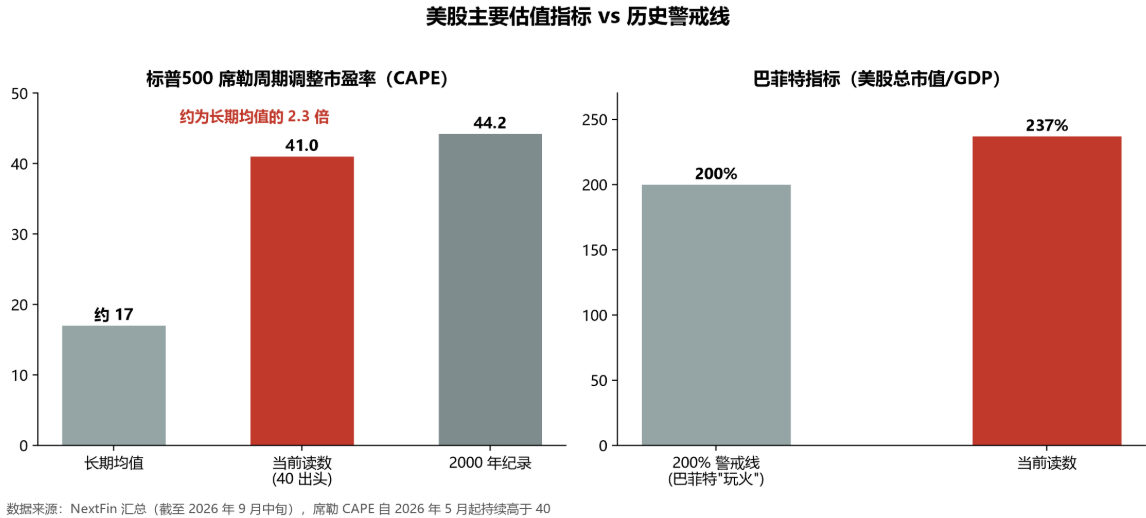
What supports Vujcic's “rare for many years” judgment is a set of valuation data that can go down in the annals of history. According to industry information platform NextFin, the S&P 500's Shiller CAPE (Shiller CAPE) has continued to stand at 40 since May 2026 — the only time in history that has remained above this level for several consecutive months. Precisely before the Internet bubble peaked in March 2000, the current reading is in the early 40, close to the historical record of 44.2, about 2.3 times the long-term average of 17.
The breadth of overheated valuations goes beyond price-earnings ratios. The “Buffett Index,” which compares the total market value of US stocks to GDP, has climbed to over 237%, far exceeding the 200% “play with fire” warning line set by Buffett himself. Since the start of the current bull run in October 2022, the S&P 500 has risen 127%, the Dow has risen 95%, and the NASDAQ has risen 161%, mostly driven by AI infrastructure spending.
The rally also showed a rare high concentration: the Big Seven (Apple, Microsoft, Nvidia, Google, Amazon, Meta, Tesla) account for more than 35% of the S&P 500 market value; the top ten companies in the index account for about 38% of market capitalization, while their profit accounts for only 31% (as of the beginning of 2026, according to NextFin summary). This concentration means that the loss of a few stocks will become a market-wide event rather than a controlled sector rotation.
For Europe, the exposure is real. According to the analysis of the ECB economist team mentioned above, Eurozone households hold the top seven US stocks by market capitalization of around €44 billion, and pension and insurance funds have similar exposure levels — and quite a few of them form “involuntary” centralized positions through passive index tools.
What's different this time: the cushioning is thinner
Compared to when the Technet bubble burst in 2000, the most critical difference is probably not the bubble itself, but the ammunition that underpins it. In 2000, the Federal Reserve had room to cut interest rates drastically, and the government could support it. The analysis points out that there is clearly less policy space left from today's starting point — interest rates are already low, and public debt is already high. Once a pullback occurs at the same time as broader market instability, it will be difficult for policymakers to easily calm it down — this is the core logic of the ECB's elevating it as a “financial stability issue.”
In the podcast, Vujcic also listed the two major potential dangers of the financial system: geopolitical risk and fiscal policy. The former “can quickly change prices and market attitudes,” while in the latter, some countries have “unsustainable financial situations in the long run.”
“We have learned from past experience that what is unsustainable is unsustainable,” he said. Resolve these issues sooner rather than later. “This is also an aspect we have to monitor very closely because these markets are also likely to experience repricing, and possibly relatively quickly.”
Geopolitical risks are not out of nowhere: Brent crude oil reached $107 per barrel on Monday, and the Middle East conflict's disruptions in inflation and the bond market are putting secondary pressure on valuation repricing. On the interest rate side, the CME FedWatch tool shows that the probability that the market is betting on the Federal Reserve's interest rate hike of 25 basis points in September is close to 90%; Macro Risk Advisors analysis even warns that the interest rate hike that may start this week may trigger a 10% correction in the S&P 500 index.
Central bank restraint: warning does not equal absolute bearishness
Notably, the ECB exercised considerable restraint while issuing the warning. According to reports, the analysis clearly indicates that it is not predicting a collapse; the timing of the pullback is “unknown in advance” and can only be confirmed after the fact; moreover — this is also important for investors who are in a hurry to clear their positions — “this does not mean that the current price is the ceiling.” If AI were truly transformative, valuations could still be “much higher” in the future, even after a single reset.
In other words, what the ECB is trying to unravel is the “success of AI” and “the safety of current stock prices,” a problem tied together by this long and narrow round of upward errors. The technical maturity of AI is one thing; the price investors pay for it is quite another — what Vujcic and his colleagues are really worried about is the latter.