


New York Times (NYT) drew fresh attention after announcing that Executive Vice President and Chief Human Resources Officer Jacqueline Welch will step down, with her separation effective January 1, 2027.
Against this leadership change backdrop, New York Times shares recently closed at US$70.34, with a 1-month share price return of 8.57% but a 3-month share price decline of 4.73%. The 1-year total shareholder return of 20.14% and 3-year total shareholder return of 72.10% point to momentum that has built over a longer horizon.
Compare New York Times with a curated group of media and digital content peers that also show strong fundamentals using our 15 high quality undiscovered gems for potential ideas beyond this headline.
Bulls see New York Times as a durable digital subscription story, while bears see a rich price after the latest pop. Which case do the current earnings and cash flow multiples actually support?
Most Popular Narrative: 9% Undervalued
New York Times last closed at $70.34, while the most widely followed narrative points to a fair value estimate of about $77.67 using a 9.28% discount rate.
Robust growth in digital subscriptions driven by an expanding portfolio of bundled offerings (news, Cooking, Games, The Athletic) and a focus on direct consumer relationships positions the company to capture more recurring revenue, strengthen ARPU, and reduce churn. This directly supports long-term revenue and margin expansion.
See why 14 investors see New York Times as 9% undervalued.
Result: Fair Value of $77.67 (UNDERVALUED)
Still, the New York Times story depends on defending referral traffic from big tech and on pricing power that could be tested if promo subscribers churn significantly.
Find out about the key risks to this New York Times narrative.
Another View On New York Times Valuation
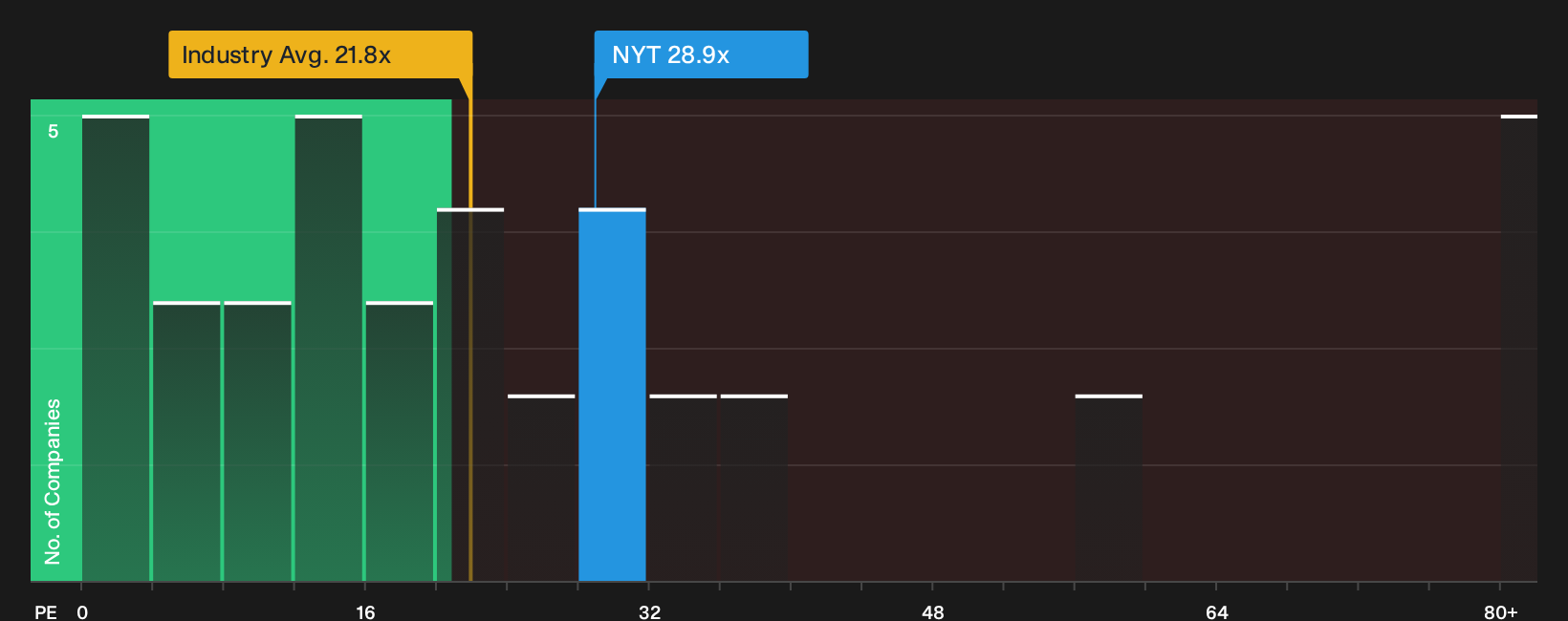
On earnings multiples, New York Times looks far less forgiving. The stock trades at a P/E of 28.9x compared with 21.8x for the wider US Media group and 16x for its peer set, while the fair ratio sits at 18.9x. That gap points to real valuation risk if sentiment cools.
To stress test whether this richer P/E still makes sense for you, take a closer look at how the numbers stack up in our valuation breakdown, including the fair ratio context, through See what the numbers say about this price — find out in our valuation breakdown..
Next Steps
Mixed headlines on New York Times can pull you in either direction, so it pays to inspect the details yourself and move quickly while sentiment is fresh. To see why some investors highlight potential upsides, review the 2 key rewards.
Looking For More Ideas Beyond New York Times?
If New York Times has you thinking harder about valuation and quality, do not stop here. Broader idea hunting can sharpen your next move.
Use the Simply Wall St screener to explore a wider range of opportunities that other investors might overlook.
- Target resilient potential compounders with dependable finances by scanning our list of solid balance sheet and fundamentals (23 results).
- Search for potentially mispriced quality by reviewing the 35 high quality undervalued stocks that may not fully reflect fundamentals yet.
- Consider potential income ideas by checking out 6 dividend fortresses that may help anchor a portfolio with cash distributions.
This article by Simply Wall St is general in nature. We provide commentary based on historical data and analyst forecasts only using an unbiased methodology and our articles are not intended to be financial advice. It does not constitute a recommendation to buy or sell any stock, and does not take account of your objectives, or your financial situation. We aim to bring you long-term focused analysis driven by fundamental data. Note that our analysis may not factor in the latest price-sensitive company announcements or qualitative material. Simply Wall St has no position in any stocks mentioned.
Have feedback on this article? Concerned about the content? Get in touch with us directly. Alternatively, email editorial-team@simplywallst.com