


- Silicon Labs recently opened a new R&D laboratory at its Austin headquarters, supported by a $23 million grant from the Texas Semiconductor Innovation Fund, to expand advanced chip design, testing, and validation for its wireless and IoT portfolio.
- The upgraded facility allows Silicon Labs to work on more advanced wafer process technology nodes, which could influence product complexity, development costs, and time to market for its secure wireless platforms.
- This article examines how Silicon Labs' investment narrative is affected by the state backed Austin R&D expansion and upgraded equipment.
Silicon Laboratories Investment Narrative Recap
To own Silicon Laboratories, you need to believe its tight focus on low power wireless IoT can support durable demand even as competition intensifies and basic connectivity chips risk becoming more commoditized. The big swing factor is whether the Series 2 and Series 3 platforms can turn design wins in smart home, healthcare, and industrial uses into sustained revenue at healthy gross margins.
Right now, the key near term catalyst is execution on that IoT design win pipeline while the business is still reporting a loss of $39.1 million on $855.9 million of revenue. The Austin R&D expansion may help product velocity but does not, by itself, change the central risk that Silicon Laboratories remains unprofitable and exposed to pricing pressure from larger rivals and low cost competitors.
The Texas Semiconductor Innovation Fund backed Austin lab opening is the most relevant recent announcement. It directly ties into Silicon Laboratories' ability to develop and validate its Series 3 platform, which targets secure, AI capable wireless connectivity for smart home, industrial, healthcare, commercial, and smart city deployments. That platform sits at the core of the current growth story.
Upgraded tools that support more advanced wafer process nodes can shorten product development cycles and reduce technical risk in bringing new IoT chips to market. The flip side is higher fixed R&D and equipment costs layered onto a business that is still unprofitable and faces the structural threats of OEMs designing chips in house and potential commoditization of basic wireless connectivity.
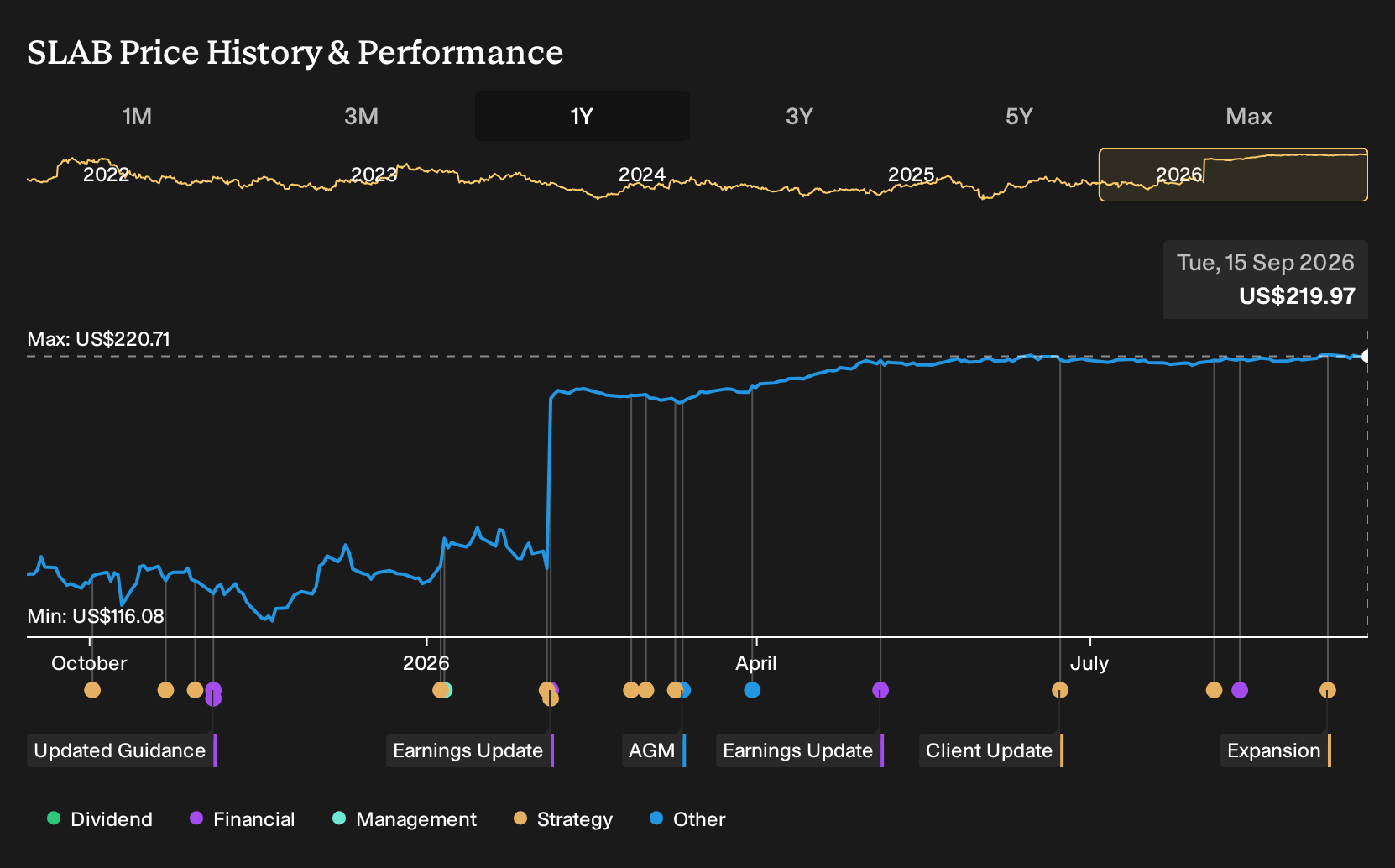
Silicon Laboratories' narrative projects US$1.3b revenue and US$214.1 million earnings by 2029. This assumes 15.6% yearly revenue growth and an earnings increase of about US$264.4 million from earnings today, which currently reflect a US$50.3 million loss.
Uncover why Silicon Laboratories' fair value indicates that Silicon Laboratories is roughly in line with its current price.
Exploring Other Perspectives
One alternate angle around Silicon Laboratories focuses on margin risk rather than growth. The most cautious analysts worried that Series 2 and Series 3 might not convert today’s opportunity funnel, which could pull gross margin away from recent 60% ranges. Even so, they still penciled in about US$1.3b revenue and roughly US$217.5 million earnings by 2029 before this Austin lab news. That wide gap in confidence shows how sharply opinions can differ, so use the ribbon cutting as a cue to review several viewpoints instead of relying solely on the consensus line.
Explore another Silicon Laboratories fair value estimate, including one that suggests it could be worth just $222.86.
Reach Your Own Conclusion
Don't just follow the ticker. Dig into the data and build a conviction that's truly your own.
- A great starting point for your Silicon Laboratories research is our analysis highlighting 2 key rewards and 1 important warning sign that could impact your investment decision.
- See our latest analysis for Silicon Laboratories. The report includes a comprehensive fundamental analysis summarized in a single visual, the Snowflake, making it easy to evaluate Silicon Laboratories' overall financial health at a glance.
Looking For More Ideas Beyond Silicon Laboratories?
Once you have a view on Silicon Laboratories, it can help to compare the opportunity set across other parts of the market using the Simply Wall St Screener. That way you can see how its risk, growth potential, and balance sheet stack up against a wider field of potential investments.
- If resilience matters most to you, scan a 11 resilient stocks with low risk scores that screens well on overall risk and business stability.
- For investors hunting for potential value, weigh Silicon Laboratories against a 35 high quality undervalued stocks that combines solid fundamentals with below estimated fair values.
- If balance sheet strength is your filter, compare it with a list of solid balance sheet and fundamentals (23 results) that pairs healthy finances with consistent fundamentals.
This article by Simply Wall St is general in nature. We provide commentary based on historical data and analyst forecasts only using an unbiased methodology and our articles are not intended to be financial advice. It does not constitute a recommendation to buy or sell any stock, and does not take account of your objectives, or your financial situation. We aim to bring you long-term focused analysis driven by fundamental data. Note that our analysis may not factor in the latest price-sensitive company announcements or qualitative material. Simply Wall St has no position in any stocks mentioned.
Have feedback on this article? Concerned about the content? Get in touch with us directly. Alternatively, email editorial-team@simplywallst.com