


The Zhitong Finance App learned that as DBS Group Holdings Limited increases its gold storage capacity and other banks are considering similar measures, Singapore's plans to build a major gold hub are being further promoted.
DBS Bank, the largest bank in Southeast Asia, said the bank has increased treasury storage space this year to meet the growing needs of private wealth customers and institutional clients. According to people familiar with the matter, OCBC has also contacted precious metal storage service providers to obtain more storage space. Another person familiar with the matter said that Deutsche Bank is also considering expanding storage capacity. People familiar with the matter added that the scale of each bank's treasury capacity expansion is still under discussion, and related plans may also change.
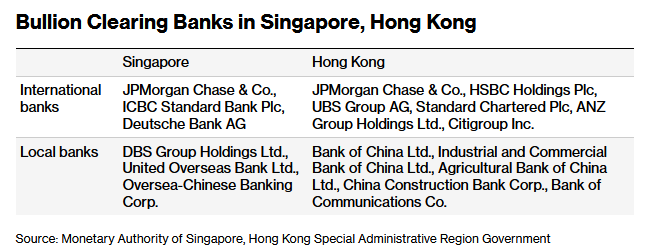
Expanding treasury capacity is critical to Singapore's plans to launch a gold clearing system as part of the country's strategy to push itself into a global precious metals hub. All clearing banks require sufficient capacity to store and settle large amounts of gold.
Banks usually sign contracts with logistics service providers, who are responsible for storing and transporting gold. However, some banks, including Singapore-based OCBC Bank, also operate their own vaults. Third-party agencies rent space in private facilities, such as Le Freeport, a high-security facility in Singapore — known as the “Asian Fort Knox” and owned by a cryptocurrency billionaire. According to the relevant operators, privately owned facilities in Singapore can currently store at least 2,200 tons of gold, of which Le Freeport can store 1,700 tons and The Reserve can store 500 tons.
Le Freeport's operator said in an interview in May that demand for gold storage has continued to rise in recent years, and its underground vault space is close to full capacity. Several people familiar with the matter said that some banks may not be able to store gold in their underground treasury, and underground vaults are the preferred location for banks because they are safer and have a stronger load-bearing capacity, so they can stack more gold bars than the upper floors.
Singapore's ambition to promote itself as a global precious metals hub is progressing at the same time as its regional competitor Hong Kong. In recent months, both cities have been advancing relevant plans to take advantage of the strong market demand for gold, and many banks are still optimistic about the long-term prospects of this asset, which is favored by investors and viewed as an alternative means of storing wealth.
Hong Kong began trial operation of the new gold clearing system in July, while actively attracting foreign banks to store gold locally. Hong Kong also promised to expand its total gold storage capacity to 2,000 tons within three years. According to people familiar with the matter who participated in related discussions, Singapore is also considering introducing a price benchmark for gold traded and settled in the region, similar to the gold exclusive price code “HAU” introduced in Hong Kong in July.
In addition, Singapore also plans to launch a gold clearing system this year. Many banks, including J.P. Morgan Chase and Deutsche Bank, will participate in this plan. The Singapore Exchange will establish an OTC clearing mechanism by the end of 2026, and interbank transactions are expected to gradually expand starting next year.
The clearing system will be consistent with the industry's standard for large gold bars, the London Bullion Market Association delivery framework, and will also use the kilogram gold bar delivery and settlement standards used by major Chicago and Shanghai exchanges.
Yan Jinyong, Deputy Prime Minister of Singapore and Chairman of the Monetary Authority of Singapore, said at the Asia-Pacific Precious Metals Conference on Monday: “We are not trying to replace an already established gold trading and liquidity center. Instead, Singapore can be a trusted node in the global gold ecosystem — connecting regional demand to global liquidity and supporting market activity during the Asian trading session.”
Singapore Exchange Group CEO Luo Wencai said that Singapore's new clearing system will become a “basic layer for the settlement and settlement of gold flows during the Asian trading period.” “We are also exploring the launch of physical delivery gold futures contracts to provide the market with an exchange-based price discovery and risk management tool,” he added.
Hong Huimei, chief country manager at J.P. Morgan Chase Singapore, said, “As investors' demand for global gold continues to grow, we are seeing Singapore play a complementary role with other major hubs to play its own role by supporting liquidity across time zones and meeting changing customer needs.”
Yan Jinyong said, “The gold market can play its best role when the liquidity and infrastructure between regions are interconnected. With a mature clearing infrastructure and a strong market ecosystem, Singapore can support a more seamless global market, spanning different time zones — from Asia to Europe to America.”
Yan Jin said that the Monetary Authority of Singapore will also launch the central bank's gold treasury service by October this year, and allow foreign monetary authorities to cooperate with a group of selected banks headquartered in Singapore to actively manage gold holdings. Attracting sovereign reserves will significantly increase the liquidity of the local market and strengthen Singapore's position as a global trading center. He also said that the central bank will also expand the scope of tax exemptions for eligible funds and family offices to invest in physical precious metals.
As the government pushes to strengthen the Singapore gold industry, some local banks are also launching related products to meet growing demand. Singapore's largest bank, DBS, will allow customers to hold tokenized gold in the second half of this year. Meanwhile, OCBC's institutional customers and high-net-worth customers can now trade and store gold through the bank.