


The Zhitong Finance App learned that according to a recent study by BloombergNEF, the capital allocated by global banks to the energy industry last year increased 15% compared to 2024, and the amount of transactions arranged and underwritten reached 2.3 trillion US dollars. BloombergNEF wrote on Thursday that against the backdrop of growing demand driven by the popularity of artificial intelligence (AI) data centers, refrigeration technology, and electric vehicles, banks increased their financing efforts in the low-carbon sector, and the scale of related transactions increased 16% to the highest level in five years. Meanwhile, the volume of transactions supporting oil, gas, and coal increased 13% last year.
The study sorted out the role of the global financial system in driving a low-carbon transition. BloombergNEF estimates that for every dollar invested in fossil fuels, banks will need to send $4 to clean energy to achieve net zero emissions targets. According to BloombergNEF's 2025 data study, the industry is still far from that target — banks spend only 97 cents on clean energy for every dollar they spend on fossil fuels.
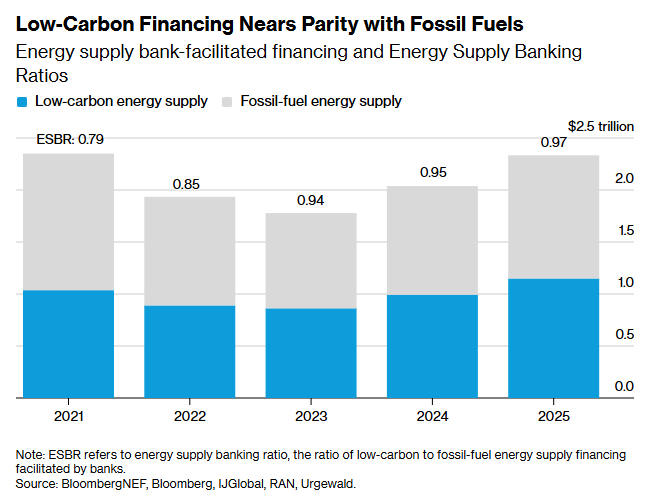
The scale of low-carbon financing is close to the same as fossil fuel financing
However, these overall figures mask significant regional differences. Wall Street banks, for example, lag far behind their European peers in low-carbon financing. Among the major North American banks studied by BloombergNEF, with the exception of Citigroup (C.US), other banks have increased their capital allocation to the energy industry, but a larger proportion of financing has gone to the fossil fuel energy supply sector.
Meanwhile, in Europe, NatWest Group Plc became the bank with the highest green transaction allocation compared to fossil fuel investments. BloombergNEF said that for every dollar the bank invests in fossil fuels, it invests $6.42 in clean energy.
BloombergNEF said that in the Asia-Pacific region, based on the scale of energy supply transactions, Mitsubishi UFJ Financial Group was still the largest bank last year. BloombergNEF also said that most of the energy financing carried out by the bank last year went to fossil fuels.
At the same time, BloombergNEF said that Asia “showed a clear split between the Bank of Japan and the Bank of China,” and pointed out that the 10 Chinese banks analyzed in the study all allocated more capital to clean energy rather than fossil fuels last year. BloombergNEF said that the Agricultural Bank of China “has improved the most in terms of this ratio,” and for every dollar it invests in fossil fuels, it invests $3.44 in clean technology.
From a global perspective, BloombergNEF said that J.P. Morgan Chase (JPM.US) allocated more capital to the energy industry than any other bank, leading to 100 billion US dollars in related transactions. BloombergNEF said that “the scale of low-carbon financing has declined slightly, while the scale of fossil fuel financing continues to grow”. For every dollar invested in fossil fuels, the bank only invests 63 cents in clean energy.