


- EAIGLE and Loblaw Companies expanded their partnership in September 2026 to roll out AI powered gate automation across multiple Canadian distribution centres, aiming to shorten processing times, improve driver experience and capture more accurate real time freight and yard data.
- The move turns Loblaw Companies distribution gates into data rich checkpoints that feed existing WMS, TMS, YMS and ERP systems, which could influence how investors think about logistics efficiency, operating costs and execution risk in the wider automation program.
- Next, the focus will be on how Loblaw Companies wider investment narrative shifts as AI powered yard automation becomes a larger operational lever.
Scan how Loblaw Companies is leaning into AI driven efficiency, and then line it up against a curated set of 60 AI infrastructure stocks that could benefit from the same infrastructure tailwinds.
Loblaw Companies Investment Narrative Recap
To own Loblaw Companies, you need to believe the grocery and pharmacy chain can keep turning its broad retail footprint, growing healthcare presence and digital platforms into steady earnings, even as competition and regulation stay intense. The recent EAIGLE rollout sits squarely in that story. It touches logistics efficiency and data quality, which tie directly into execution on everyday operations rather than changing the headline growth profile.
In the near term, the key swing factor is how effectively Loblaw Companies converts its ongoing spending on automation, discount formats and digital into margin resilience, especially with revenue forecast to grow 3.6% per year and earnings 4.32% per year. The biggest risk remains pressure on profitability from value focused formats, supply chain volatility and regulatory scrutiny on pricing, which could matter more to the investment case than incremental gains at distribution gates.
The EAIGLE yard automation expansion lines up cleanly with one of the clearest existing catalysts for Loblaw Companies. Analysts already highlight AI driven supply chain work and retail automation as a lever for lower logistics, inventory and labor costs. Turning the gate into a live data checkpoint reinforces that operational theme and supports the idea of gradual efficiency gains rather than a step change in growth.
Another recent thread that connects here is the push into healthcare through pharmacy clinics and services, which aims to deepen customer relationships while the retail network gets more digitized in the background. As the Giving Shelter campaign shows, the Shoppers Drug Mart ecosystem also carries reputational and community expectations. That creates potential upside from customer loyalty, while at the same time keeping execution and regulatory risk front and center if pricing, ESG concerns or service quality slip while capital is tied up in automation projects.
What The Current Loblaw Companies Forecasts Assume
Loblaw Companies sits on a fairly tight analyst script. The current consensus ties its long term AI and automation work, including the EAIGLE rollout, to gradual shifts in revenue, profit mix and valuation rather than a dramatic reset of the business model.
At a high level, analysts are building their models on revenue growth of 3.1% a year over the next three years. That is paired with an assumed slip in profit margins from 4.1% today to 3.9% in three years, which suggests expectations for modest cost pressure or more mix coming from lower margin discount formats even as logistics initiatives aim to trim waste.
Earnings forecasts stay close to where the retailer is today. Consensus points to earnings of CA$2.8b by 2029, compared with current earnings of CA$2.7b. That is an increase of about CA$0.1b, which is small in absolute terms for a business of this scale and frames the EAIGLE yard automation program as one of several levers intended to support that step up rather than transform it.
Analysts are also baking in a shrinking share count, with expectations that shares outstanding will fall 2.8% per year for the next three years. For existing holders, that type of reduction can support earnings per share even if absolute profit growth is relatively muted, which again ties the Loblaw Companies story back to execution on capital returns and operational tweaks rather than big swings in top line assumptions.
The discount rate used in the main external report, at 6.43%, acts as the bridge between those future cash flows and today’s valuation work. It is a key ingredient in how analyst models translate projected revenue and earnings into present value, but for readers it is more useful as a reminder that even small shifts in perceived risk or policy rates can move what looks reasonable on a DCF output.
How Analyst Valuation Frames Loblaw Companies AI And Automation Bets
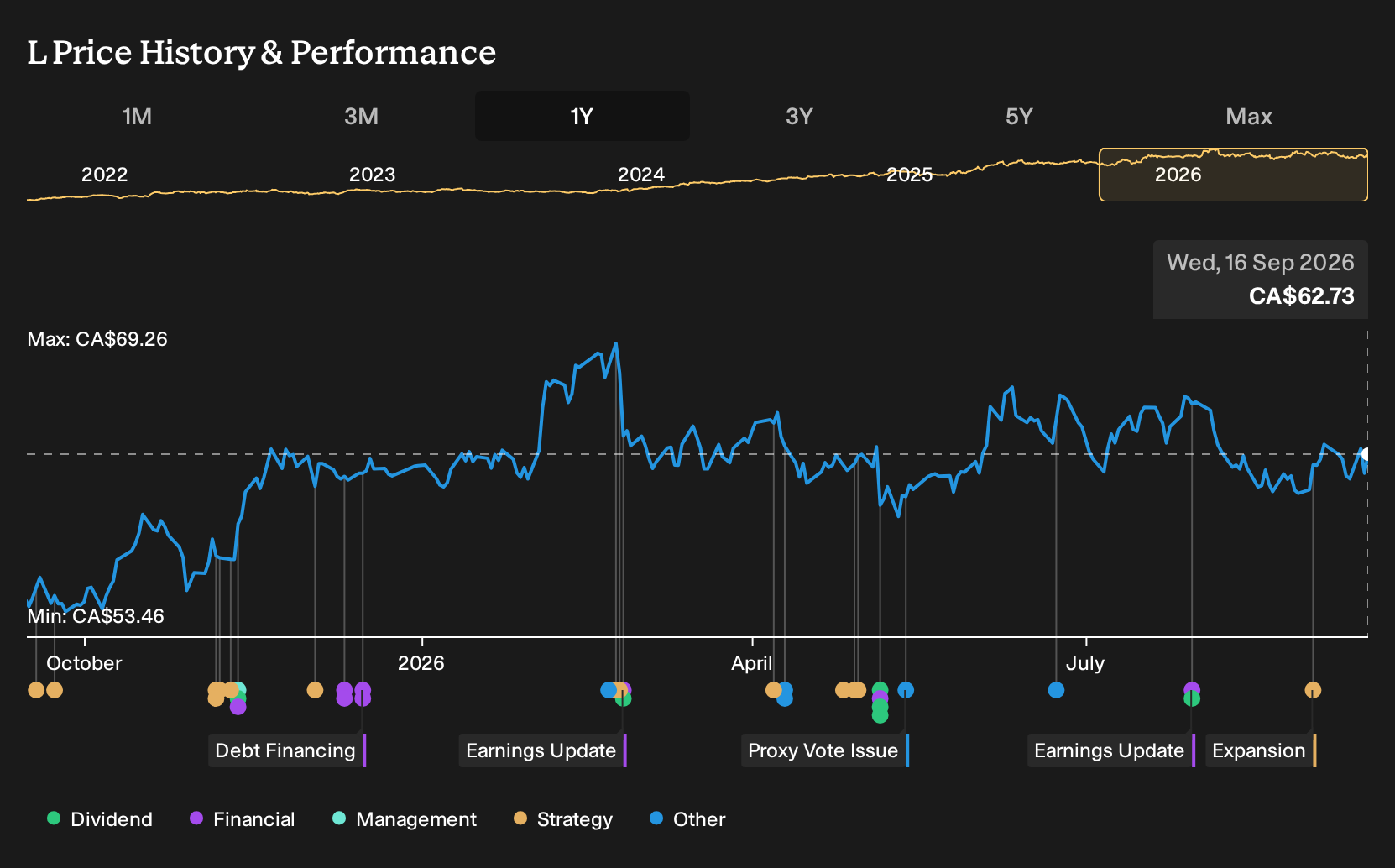
On valuation, the knot to untangle is how much you are willing to pay for those projected numbers. The consensus price target sits at CA$68.8 per share, only 4.3% above the current share price of CA$65.81, which signals that analysts on average see Loblaw Companies as broadly in line with their view of fair value.
There is still a meaningful spread between views. The most optimistic target reaches CA$76.0, while the most cautious sits at CA$43.0. That gap reflects different readings of how resilient grocery and pharmacy spending will be, how sharply margins might compress, and how effectively projects like AI powered yard automation convert into lower operating costs instead of just higher complexity.
For the consensus target to make sense, analysts outline a specific 2029 snapshot. Their models point to CA$71.4b in revenue and CA$2.8b in earnings, supported by a P/E of 31.3x on those 2029 earnings, based on a 6.4% discount rate in that part of the valuation narrative. That multiple sits above both Loblaw Companies current P/E of 28.5x and the broader Canadian consumer retailing sector at 19.4x, which implies that the retailer is being modeled as a higher quality or more resilient operator than the average peer.
Stepping back, that P/E stretch is where readers may want to spend most of their attention. If you think AI enabled logistics, pharmacy expansion, ESG work and digital distribution all mesh cleanly and support consistent earnings, a premium versus the sector can look reasonable. If you are more focused on execution risk in automation projects, regulatory scrutiny on pricing or the cost of staying competitive online, then paying up for the Loblaw Companies story could feel less comfortable.
Loblaw Companies' narrative projects CA$71.4b revenue and CA$2.8b earnings by 2029, based on analyst models. This path assumes 3.1% yearly revenue growth and an earnings increase of about CA$0.1b from current earnings of CA$2.7b.
Uncover why Loblaw Companies' fair value indicates a 10% potential upside to its current price that could narrow quickly.
Exploring Other Perspectives
The bearish cohort leans heavily on e-commerce disruption risk. Before this EAIGLE news, those analysts were pencilling in CA$70.6b of 2029 revenue and CA$3.5b of earnings, yet still landed on a CA$53.58 target. That is a much harsher view than consensus. As Loblaw Companies scales yard automation, these narratives may evolve.
Explore 4 other Loblaw Companies fair value estimates, including one that suggests as much as 21% downside from the current price!
Decide For Yourself
Don't just follow the ticker; dig into the data and build a conviction that's truly your own.
- A great starting point for your Loblaw Companies research is our analysis highlighting 2 key rewards and 1 important warning sign that could impact your investment decision.
- See our latest analysis for Loblaw Companies. The report includes a comprehensive fundamental analysis summarized in a single visual, the Snowflake, making it easy to evaluate Loblaw Companies' overall financial health at a glance.
Looking for more investment ideas beyond Loblaw Companies?
Once you have a view on Loblaw Companies, it can help to widen the lens and compare it with other businesses that fit different risk and return profiles using the Simply Wall St Screener.
- If capital preservation sits high on your list, start with a basket of companies that show more resilient profiles through 1 resilient stocks with low risk scores.
- For readers who care most about financial strength and clean balance sheets, line up candidates using the list of solid balance sheet and fundamentals (6 results).
- If you prefer stories that have not yet attracted broad attention, scan the 9 high quality undiscovered gems and see which ones you want to research next.
This article by Simply Wall St is general in nature. We provide commentary based on historical data and analyst forecasts only using an unbiased methodology and our articles are not intended to be financial advice. It does not constitute a recommendation to buy or sell any stock, and does not take account of your objectives, or your financial situation. We aim to bring you long-term focused analysis driven by fundamental data. Note that our analysis may not factor in the latest price-sensitive company announcements or qualitative material. Simply Wall St has no position in any stocks mentioned.
Have feedback on this article? Concerned about the content? Get in touch with us directly. Alternatively, email editorial-team@simplywallst.com