


- Teradyne opened a semiconductor-focused office in Bengaluru in 2026 to support India’s manufacturing, packaging, and test build-out under the India Semiconductor Mission.
- The Bengaluru hub puts Teradyne closer to AI-driven chip and electronics production in India, tying its test equipment directly into new local fabrication and packaging capacity.
- The next focus will be on how this India expansion could reshape Teradyne's investment narrative around AI test demand and global exposure.
Scan beyond Teradyne and pinpoint other chip and automation plays tied to AI build outs with the curated 38 robotics and automation stocks.
Teradyne Investment Narrative Recap
To own Teradyne, you need to believe AI test demand, semiconductor automation and robotics can support a long runway of projects across multiple regions. Record Q2 2026 revenue with more than 60% tied to AI shows where the action is today. The Bengaluru office fits that story but does not change the near term earnings driver, which remains AI compute and networking test capacity.
The biggest swing factor still sits in how smoothly that AI hardware cycle translates into orders and margins through 2027, while memory and robotics stay tougher. Key risks remain geopolitics, tariffs and a choppy product mix that can move gross margins around even when headline demand looks strong.
The most relevant recent development alongside the India move is Teradyne’s push into silicon photonics testing through the Quantifi Photonics acquisition. AI data centers lean heavily on high speed optical connections. That puts efficient photonics test near the same customers the Bengaluru hub wants to support as India builds fabrication, packaging and system capacity.
For you as an investor, that pairing matters because it links a new geographic beachhead with a product area that sits close to AI networking and high bandwidth interfaces. Execution risk sits in integrating new test platforms while managing tariffs, robotics softness and margin swings. Analyst optimism around earnings growth can support sentiment, but business delivery on these projects is what really counts.
Teradyne's current earnings are US$1.2b and analysts project earnings of US$2.2b by 2029, which implies an increase of US$1b. To reach that level, the consensus view assumes revenue growth of 17.8% per year, with Teradyne generating forecast revenue of US$7.3b and earnings of US$2.2b in 2029.
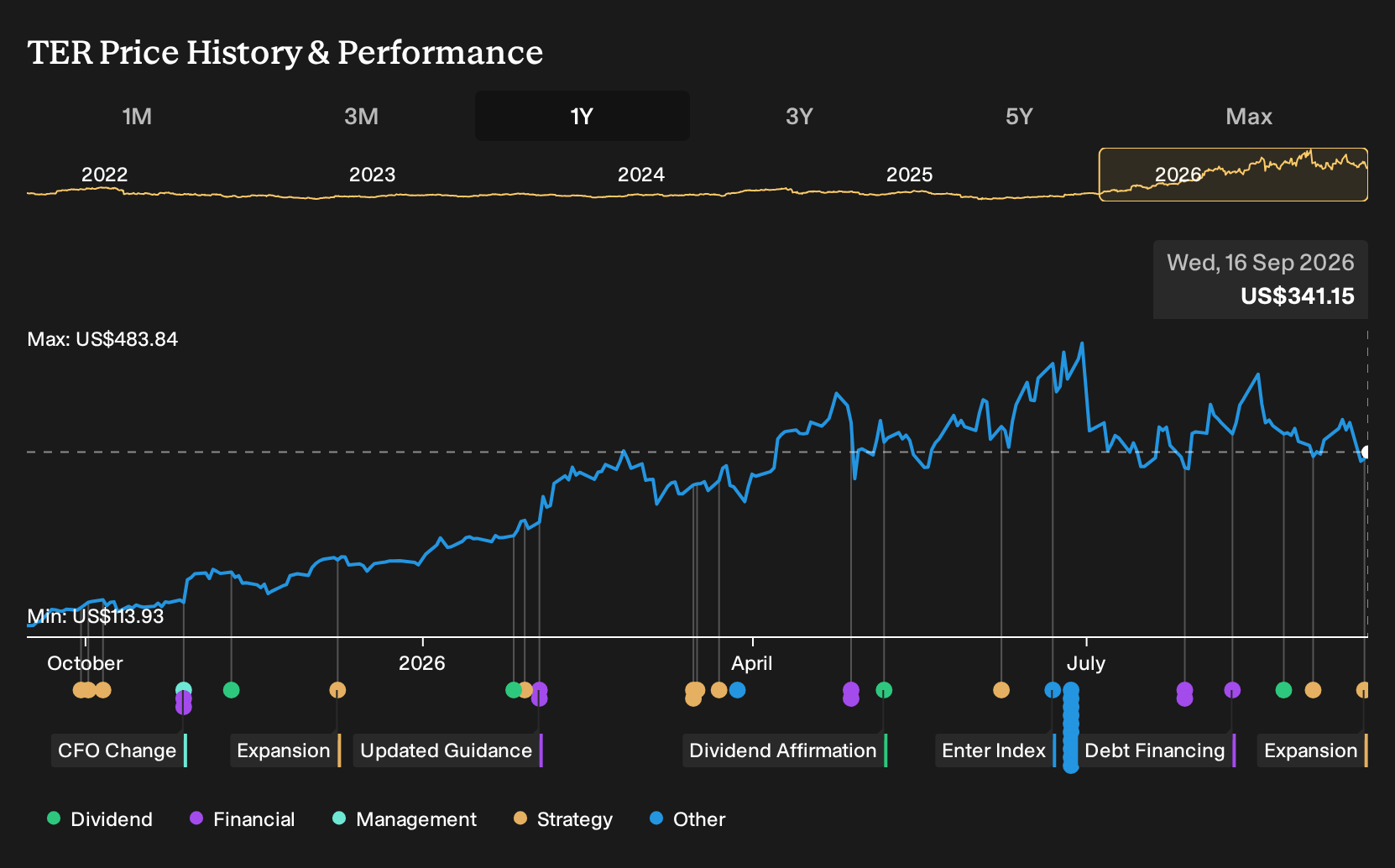
Uncover why Teradyne's fair value indicates a 30% potential upside to its current price, which could close faster than many investors expect.
Exploring Other Perspectives
One sharp contrast comes from the bearish view that AI chip spending could cool, leaving Teradyne with softer demand for testers. Those analysts were only penciling in about US$6.7b of revenue and US$1.9b of earnings by 2029 before this India office news. That gap shows how widely opinions can differ, so consider both perspectives carefully before forming your own view on what might change next.
Explore 4 other Teradyne fair value estimates, including one that suggests as much as 30% downside from the current price.
Form Your Own Verdict
Don't just follow the ticker. Dig into the data and build a conviction that's truly your own.
- A great starting point for your Teradyne research is our analysis highlighting 3 key rewards and 2 important warning signs that could impact your investment decision.
- See our latest analysis for Teradyne. The report includes a comprehensive fundamental analysis summarized in a single visual, the Snowflake, making it easy to evaluate Teradyne's overall financial health at a glance.
Looking For More Investment Ideas Beyond Teradyne?
If Teradyne has sharpened your thinking about where AI hardware, testing, and automation might go next, it can help to line it up against other opportunities. The Simply Wall St Screener lets you filter for very different styles of stocks, so you can see how Teradyne compares on quality, balance sheet strength, income potential, or valuation.
- For investors who care most about quality at a reasonable entry point, consider scanning a focused 33 high quality undervalued stocks that currently clear a high bar on fundamentals.
- If capital preservation and stability are higher on your checklist, filter for stocks with resilient profiles using the 11 resilient stocks with low risk scores to see which businesses may offer a smoother ride.
- When you want to get ahead of the crowd, you can look through a curated 16 high quality undiscovered gems that pair solid financials with lower investor attention today.
This article by Simply Wall St is general in nature. We provide commentary based on historical data and analyst forecasts only using an unbiased methodology and our articles are not intended to be financial advice. It does not constitute a recommendation to buy or sell any stock, and does not take account of your objectives, or your financial situation. We aim to bring you long-term focused analysis driven by fundamental data. Note that our analysis may not factor in the latest price-sensitive company announcements or qualitative material. Simply Wall St has no position in any stocks mentioned.
Have feedback on this article? Concerned about the content? Get in touch with us directly. Alternatively, email editorial-team@simplywallst.com