


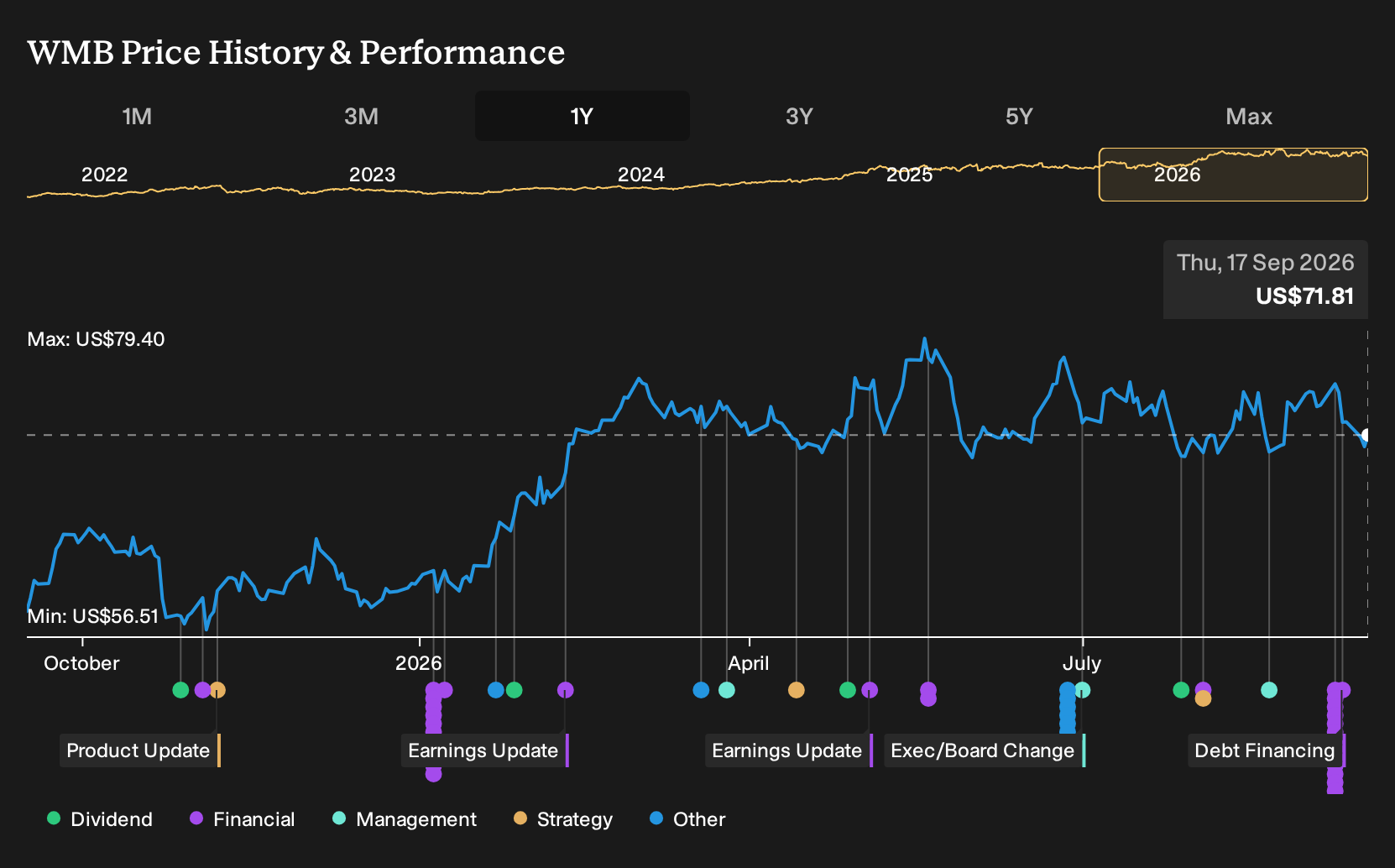
- Williams Companies completed multiple fixed-rate senior note offerings totaling about US$2.75b across maturities from 2029 to 2056, with coupons between 5.000% and 6.400% and customary covenants around liens, asset sales and redemption terms.
- The business is reaffirming its Northeast Supply Enhancement construction and Q4 2027 service timeline despite a vacated New Jersey water-quality certification, which keeps regulatory risk and project execution squarely in focus.
- We will now look at how Williams Companies' investment narrative intersects with this reaffirmed NESE timeline and regulatory uncertainty.
Scan how Williams Companies fits into the midstream story and then size up a hand picked group of peers with 11 resilient stocks with low risk scores built around balance sheet resilience and measured risk.
Williams Companies Investment Narrative Recap
For Williams Companies, you need to be comfortable owning a capital intensive natural gas infrastructure business that leans on long haul pipes, fee based contracts and a deep project backlog into LNG and power demand. The short term swing factor is how quickly new capacity, such as Northeast Supply Enhancement, moves from construction to cash flow. The recent New Jersey certification setback, which management does not see changing its Q4 2027 service goal, keeps permitting risk very real but does not yet look like a thesis breaking event.
The bigger risk right now sits around balance sheet flexibility. Williams carries meaningful leverage, its dividend is not well covered by free cash flow, and earlier analysis flagged debt coverage by operating cash flow as a pressure point. Any slowdown in project execution, higher construction costs or tougher rate outcomes could tighten that gap and make funding choices more sensitive, especially if major projects face further regulatory delays or scope changes.
The clearest link to all of this is the recent issuance of US$2.75 billion of fixed rate senior notes maturing between 2029 and 2056. Williams Companies has locked in long dated funding at coupons between 5.000% and 6.400%, with covenants that limit liens and major asset sales. Those bonds are senior unsecured, so they sit alongside other key obligations and directly shape future interest costs.
For investors, the question is how that new debt supports or stretches the thesis around NESE and the broader expansion pipeline. If the proceeds help keep multi year projects on schedule, the financing can support the contracted backlog that analysts already include in their earnings expectations. If permitting or demand trends weaken, that same layer of obligations could amplify the risk flagged in earlier work that debt is not comfortably covered by operating cash flow, raising the bar for execution on every major project now under way.
Williams Companies' current narrative points to revenues of US$17.0b and earnings of US$4.6b by 2029, based on analysts' assumption of 11.3% yearly revenue growth and an earnings increase of about US$1.5b from US$3.1b today.
Uncover why Williams Companies' fair value indicates a 19% potential upside to its current price that could narrow quickly.
Exploring Other Perspectives
Some of the most optimistic analysts focus on Williams Companies’ potential earnings uplift from projects like Socrates and Power Express rather than the debt load itself. They were already penciling in US$17.9b of revenue and US$4.8b of earnings by 2029. You now need to weigh that upbeat view against fresh borrowing and evolving regulatory pressure.
Explore 4 other Williams Companies fair value estimates, including one that suggests potential upside of up to 515% from the current price.
Reach Your Own Conclusion
Don't just follow the ticker. Dig into the data and build a conviction that's truly your own.
- A great starting point for your Williams Companies research is our analysis highlighting 3 key rewards and 3 important warning signs that could impact your investment decision.
- See our latest analysis for Williams Companies. The report includes a comprehensive fundamental analysis summarized in a single visual, the Snowflake, making it easy to evaluate Williams Companies' overall financial health at a glance.
Looking for more investment ideas beyond Williams Companies?
If Williams Companies has sharpened your thinking about pipelines, balance sheets and long term contracts, use that same lens to size up other opportunities using the Simply Wall St Screener.
- For investors who want income with some defence, scan a curated set of income focused stocks with 6 dividend fortresses and see which ones line up with your yield and risk comfort.
- If value and quality matter most to you, filter for businesses that pair solid fundamentals with pricing that still looks reasonable using 29 high quality undervalued stocks to spot candidates for deeper research.
- When balance sheet strength is non negotiable, zero in on companies with robust financial footing through a list of solid balance sheet and fundamentals (23 results) that lets you stack resilience side by side.
This article by Simply Wall St is general in nature. We provide commentary based on historical data and analyst forecasts only using an unbiased methodology and our articles are not intended to be financial advice. It does not constitute a recommendation to buy or sell any stock, and does not take account of your objectives, or your financial situation. We aim to bring you long-term focused analysis driven by fundamental data. Note that our analysis may not factor in the latest price-sensitive company announcements or qualitative material. Simply Wall St has no position in any stocks mentioned.
Have feedback on this article? Concerned about the content? Get in touch with us directly. Alternatively, email editorial-team@simplywallst.com