


After reaching a new high in stock prices, the intensity of the game on the Luyuan Group (02451) market seems to have further strengthened.
Zhitong Finance noticed that as soon as the market opened on September 17, Luyuan Group, which is one step away from a new high in stock prices, went up strongly. At one point, the intraday increase was over 5%, and the stock price hit HK$17.35, setting a new high since the company went public in October 2023. On the last trading day, the stock had just closed with a rise of 16.88%. The sharp rise for two consecutive days has brought the stock price of this electric two-wheeler company to the next level.
According to the news, Luyuan has continued to catalyze recently. The company's robotics business has moved from signing contracts to mass production and delivery. According to reports, the cooperation with Alu Robotics enabled Luyuan Group to receive more than 100,000 sets of high-precision planetary deceleration joint modules and 10,000 complete robot orders. The AI130S commercial patrol robot jointly developed by the two parties was first mass-produced in July, and the first robot production line was put into operation and production capacity is climbing.
With the popular robot concept behind it, it's no wonder that Luyuan Group's stock price has continued to soar. What is intriguing, however, is that Luyuan's stock price was severely suppressed after rapidly rising on the 17th. The biggest drop in the intraday period was more than 2%, but it rebounded strongly at the end of the session. The final closing price was HK$17.18, an increase of 4.25%, and the intraday fluctuation was over 7%. Judging from the language on the market, the funding differences seem to be widening at this stage.
Long and short differences intensified at high stock prices
The sharp fluctuation in Luyuan Group's stock price on the 17th may essentially be a violent collision between short-term profit trading and rising capital.
After the opening of early trading on the same day, Luyuan's stock price rose rapidly, and trading volume increased simultaneously, indicating a concentrated influx of capital. However, as the stock price hit a record high of HK$17.35, selling pressure surged. Judging from the volume and turnover situation, the overall turnover for the day was HK$59.784 million, with a turnover rate of 0.83%, all of which are relatively high recently, indicating that chips continue to be exchanged at the current stock price position. Behind this, there may be a strong desire to pay out the low level of funds involved in the early stages, and although capital increases are being accepted, the desire to pursue higher has weakened marginally after the rapid rise in prices.
What's even more interesting is the details of the time-sharing trend. Judging from the market, the fall process of stock prices after rising in early trading was quite smooth, and there was almost no decent resistance. This shows that the selling pressure was released quite firmly at the time, and the buying process was not organized to be effectively accepted at the key price. However, the rebound in the late trading session also showed that bottom-up capital re-entered the market after falling back in stock prices, and that the long and short forces were able to switch many times within a day.
Compared to the strong performance of 16.88% at the closing of the previous trading day, Luyuan's trend on the 17th shows that capital's differences over the future market trend increased markedly after Luyuan's stock price reached a new high. And this rhythm contrast itself is an intuitive footnote to the intensification of high-ranking games. When short-term sentiment is rapidly consumed after a continuous rise, any kind of hustle and bustle may trigger a profit market to be cashed out. However, the so-called profit and loss are the same, and a sharp correction in a short period of time can also attract new capital intervention.
However, if we extend our view to the robotics sector as a whole, although the robotics concept sector in Hong Kong stocks is still rebounding, the overall popularity has cooled down significantly from the beginning of the year. Currently, capital is rotating more within the sector, and the recent trend of the target, which had a large increase in the previous period, has clearly diverged. As a robot concept stock that has been highly sought after recently, Luyuan's stock price trend is highly correlated with sector sentiment. As the overall popularity of the sector declines, I'm afraid we still need to put a question mark on whether its stock price has sufficient momentum to break through continuously. It is worth mentioning that the sharp fluctuations in Luyuan on the 17th may also have been affected by the overall operating rhythm of the sector to a certain extent. According to the trading software, the Hong Kong stock robot concept sector operated on a green market for most of the 17th, and only narrowly corrected until the close, with an increase of 0.02%.
The pace of implementing an intelligent business is yet to be tested
The core driving force of Luyuan's recent strong stock price is actually not complicated; its manufacturing side advantages are spilling over into the field of embodying intelligence. This company, which has been deeply involved in the electric two-wheeler industry for nearly 30 years, has extended the boundary of capabilities from two-wheelers to the manufacture of robot joint modules and complete machines with the accumulation of technology in the fields of liquid-cooled motors, precision transmission, motion control, etc., and has received order approval from leading robot companies. At a time when the concept of embodying intelligence is very popular, this “second growth curve” story certainly provides plenty of room for imagination for funding.
But the other side of the story is that the company's overall performance is still under pressure.
In the first half of this year, Luyuan's revenue was 2,463 billion yuan, a year-on-year decrease of 20.4%; net profit to mother was 75.08 million yuan, a year-on-year decrease of more than 30%. The reason for the decline in performance is not difficult to understand — the electric two-wheeler industry is in a period of adaptation to demand after the full switch to the new national standard. The pace of terminal replacement has slowed down, and sales have declined accordingly. Although there are structural highlights such as a 78.2% year-on-year increase in electric motorcycle sales, an increase of about 40% in overseas sales, and a slight increase in gross margin to 13.8% year over year, these improvements are not enough to reverse the judgment that the main business as a whole is in the “bottoming out” period. Luyuan's traditional business distance has reached a clear upward inflection point, and there is still quite a distance.
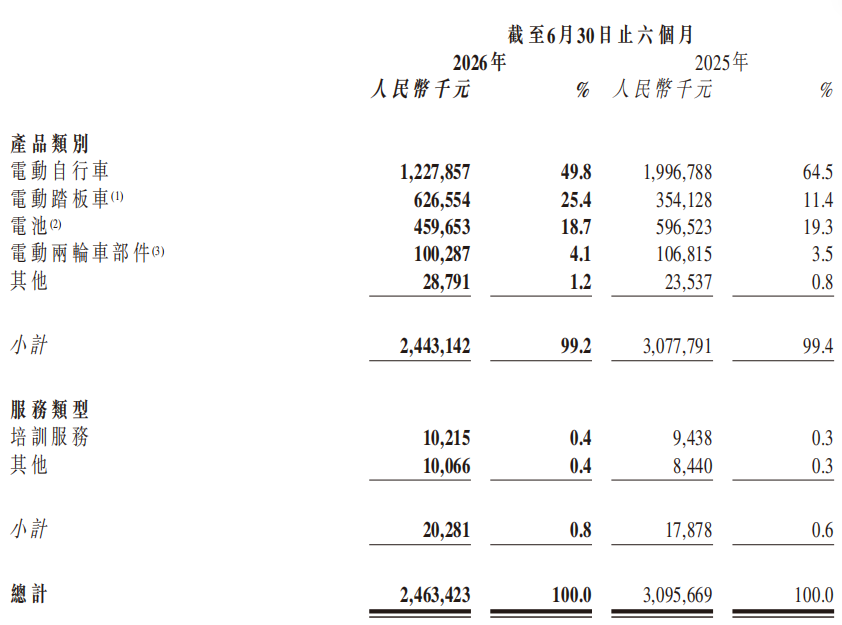
The future of the robotics business is certainly very imaginative, but in the “0 to 1” stage, the most scarce thing is never order announcements, but the pace of fulfillment. There is a sign worth paying attention to in Luyuan's interim report. The company said that due to continuous product upgrades, Allu has slowed down the order process and the delivery schedule has been extended. It is expected that only about 50% of deliveries will be completed during the year, and the rest will be extended until the first half of 2027. This means that even if the order framework is locked, revenue recognition still depends on the other party's acceptance and delivery progress, and the short-term performance contribution is limited.
Back on the market, the sharp turbulence on the 17th showed that when the market began to examine the distance between the company's future expectations and reality at a high level, financial hesitation was intuitively reflected in stock price trends. From a valuation perspective, Luyuan's current dynamic price-earnings ratio has exceeded 42 times, and the net price-earnings ratio is over 3.6 times. This is clearly no cheap pricing for a manufacturing company whose performance declined significantly in the first half of the year. In other words, the current valuation already includes the market's quite optimistic expectations for Luyuan's robotics business, and the pace and final scale of implementation of these expectations are still unknown.
Looking ahead to the future market, the subsequent trend of Green Source will probably depend mainly on three variables: whether the market style still favors subject-driven targets, whether the popularity of embodying intelligent concepts can be maintained until large-scale delivery of company orders, and the extent to which the new business can actually meet growth expectations. Until there are no clear answers to these three variables, I'm afraid the funding differences will only continue to grow as stock prices rise.