


Recently, in the otherwise calm Hong Kong stock market, STERLING GP (01825) suddenly showed a “sky floor” market.
The Zhitong Finance App learned that the stock opened as high as HK$12.65 on September 16. It hit HK$12.83 in the intraday period, then dived rapidly, falling as low as HK$7. In the end, it closed down 36.88%, with a turnover of about HK$61.355 million.
The decline in early trading on September 17 got further out of control. The intraday low fell to HK$1.33, and finally closed at HK$1.95, a sharp drop of 75.58% in a single day; based on the two-day intraday extreme value, the biggest cumulative decline in stock prices was close to 90%.
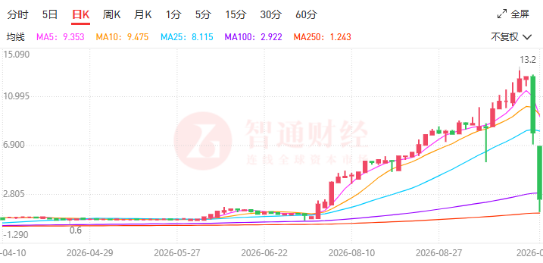
What is more noteworthy is that STERLING GP had already experienced a sharp rise before this sharp decline occurred. Among them, the company's stock price was still around HK$5 in mid-August, then continued to rise, reaching a high of HK$13.20 on September 14. In just over a month, the stock price completed a sharp transition from a low sideways trade to a sharp rise, to two consecutive days of flash collapse.
The question also came up: How can a garment manufacturing company with revenue falling 31.4% year on year in fiscal year 2026, increasing net loss to HK$62.28 million, and negative net assets, get out of such an extreme market without a simultaneous reversal in fundamentals? And what do the intensive transfers, storage, and placement actions mean?
After years of silence, it suddenly skyrocketed. Why did the stock price “change its face”?
Since June of this year, the STERLING GP market can be summed up by “accelerating upward, rising, and falling sharply.”
The Zhitong Finance App learned that STERLING GP landed on the main board of the Hong Kong Stock Exchange in October 2018, with an issue price of HK$0.4 per share, and was overpurchased by 18.43 times during the public sale phase. In the early days of listing, the company relied on stable customer orders from European and American clothing brands, and its performance remained stable.
However, along with the impact of external factors such as declining global apparel consumption and fluctuations in supply chain costs, the company's revenue was under pressure, and the stock price gradually entered a long-term slump channel. It was in a broken state for most of the time, and the average daily turnover was low for a long time, making it a typical unpopular small-cap stock in the Hong Kong stock market.
In January 2026, the company proposed implementing a share consolidation plan to adjust the share capital on the basis of merging 10 shares into 1 share. At the same time, the supporting share capital reduction and share breakdown was also adjusted. Each trading unit was also adjusted from 2,500 shares to 2,000 shares. After the merger, the shares were 41.472 million shares, and the face value of each share was reduced to HK$0.01.
Just in the first half of the year after the merger was completed, the stock price was still fluctuating at a low level. As of May 2026, the stock price was still hovering around HK$0.7, with an average daily turnover of less than HK$1 million, and liquidity was extremely scarce.
However, starting in June, the stock gradually broke away from the bottom range and entered an accelerated upward phase in early August. In just a few trading days, the stock price quickly rose from less than HK$2 to hit a 52-week high of HK$13.2 in mid-September. During this period, trading volume increased significantly at the same time, and the turnover rate continued to increase. This is in stark contrast to the previous situation where long-term trading was lackluster.
In the process of rapidly rising stock prices, brokerage warehouse receipts for the company's shares also experienced frequent large changes. In the month since August 14, the stock has continued to undergo multiple large-scale transfers, accounting for up to 16.54% of single transfers, involving various brokerage positions such as Zhuorui Securities, Yongfengjin Securities, and Yuanda Securities.
Large chips are quickly transferred between different brokerage firms, and the share of single transactions has exceeded 5% many times. In the historical case of the Hong Kong stock market, this kind of large-scale, high-frequency chip scheduling is often viewed by the market as a potential market signal for large capital allocation and preparation for subsequent chip distribution; combined with subsequent market conditions, this also provides an important observation clue for the market to examine the stock's high-ranking distribution and stock price collapse.
On September 4, STERLING GP, which is still in the high range, issued a placement announcement. It plans to place up to 8.294,400 shares at a price of HK$6.8 per share, a discount of about 19.53% from the closing price of HK$8.45 on the same day. The net capital raised is expected to be approximately HK$55.9 million. The proceeds will be used to expand the clothing business and supplement general working capital.
After the placement announcement was issued, the stock price was not immediately drastically adjusted. Instead, it remained volatile at a high level for the next few trading days, and market sentiment was still relatively optimistic. Until the end of trading on September 16, the stock suddenly collapsed and closed down 37% in a single day; the stock price fell further in early trading on September 17, hitting an intraday low of HK$1.33. The two-day cumulative decline was close to 90%. Almost all of the gains accumulated in previous months went back up, and investors chased at high levels suffered huge losses.
Stock prices diverge from fundamentals, and the characteristics of capital games are highlighted
From a fundamental perspective, STERLING GP's performance support makes it difficult to explain the recent increase. As of the year ended March 31, 2026, the company achieved revenue of about HK$328 million, a year-on-year decrease of 31.38%; gross profit of about HK$55.97 million, and gross margin fell from 18.3% to 17.1%; operating losses increased to HK$31.77 million, with a net loss of HK$62.28 million over the same period last year.
At the same time, the company's cash at the end of the period was about HK$26.5 million, and the net debt attributable to shareholders was about HK$25.8 million. Current liabilities were also higher than current assets. Net assets per share at the end of the period were -0.62 HKD, and net book assets had turned negative.
Against the backdrop of continued contraction of the main business and significant expansion of losses, the company's stock price showed an exaggerated increase of more than ten times, which clearly cannot be explained by improvements in fundamentals or an increase in industry sentiment. At least judging from the disclosed financial data, STERLING GP does not have a performance reversal logic sufficient to directly support a short-term increase of several times in stock prices; its essence is more biased towards capital-driven markets.
In fact, judging from the typical operating model of Hong Kong stocks, many STERLING GP markets are highly similar to the operating characteristics and risk characteristics of shares summarized by the market. First, the company's fundamentals are poor, business continues to decline and losses continue to expand, net assets are already negative, and there is no outstanding long-term investment logic from the perspective of financial reporting; such companies have relatively limited institutional coverage, small circulation market size, and stock prices are more likely to be affected by capital inflows and outflows, so they can easily become targets of speculative capital games.
Second, this stock is a typical micro-capitalization stock. On the eve of the collapse, the total market value was about HK$547 million, the total share capital was 41.472 million shares, and daily trading volume was sluggish for a long time before the market started. Judging from the market, smaller amounts of capital could easily have a big impact on the stock price.
Looking at the level of chip changes, stock prices fluctuated at the bottom for a long time before rising. There was a time window for capital to quietly absorb funds, and the upward process was accompanied by frequent large-scale transfers. It is worth emphasizing that the transfer of positions only represents a change in the share escrow seat, and it is impossible to confirm the purpose of the transaction. However, this series of chip changes can be used as a reference for the external performance of the “low level collection of chips - midway scheduling and division of positions - high level boosting shipments” as summarized by the market.
In fact, judging from the historical cases of some small market capitalization and low liquidity stocks in the Hong Kong stock market, there is indeed a situation in the market where capital operations such as “merger - increase - placement - collapse” are intertwined with changes in stock prices. Some Hong Kong stocks may also repeatedly affect stock prices through a cycle of “mergers, pull-ups, placements, and plummeting”. After the stock price plummets, shareholders' rights may continue to be diluted through stock splits, remergers, and multiple placements, forming a long-term model of so-called “downward speculation.” If ordinary investors step in with a bottom-up mentality, they may often fall into the dilemma of losing money more and more.
Judging from current public information, there is not enough evidence that the relevant accounts acted in concert, actually controlled, or artificially manipulated stock prices. Therefore, instead of rushing to label STERLING GP as a “stock,” it is better to define it as a high-risk small-cap stock with outstanding capital game characteristics, noteworthy chip changes, and a large divergence between stock prices and fundamentals.
However, from HK$13.20 to HK$2 intraday, STERLING GP completed the reversal from extreme rise to extreme decline in just a few trading days. This also shows once again that for small-cap Hong Kong stocks, simply observing the rise and fall of the K-line is far from enough. When fundamentals, financing, chips, and price trends are clearly misaligned, what really needs to be studied is not “how much more can it rise,” but what is the funding source, chip structure, and upward logic of this round of the market.