


The Zhitong Finance App learned that the latest “Retail Radar” research report from Wall Street financial giant J.P. Morgan Chase shows that with the Federal Reserve's interest rate hike finally being implemented, retail investors have not completely withdrawn from AI. Instead, the overall pace of market entry has slowed significantly under macroeconomic pressure, and individual stock choices are more focused on AI computing power leaders. As members of the Federal Reserve's FOMC monetary policy committee agreed to raise interest rates by 25 basis points to 3.75% — 4.00% on Wednesday EST, J.P. Morgan Chase's benchmark judgment is that if it only withdraws part of last year's “insured interest rate cut” cycle, while corporate profits remain strong and the situation in the Middle East does not get further out of control, the stock market can still absorb the rising trend of interest rates and long-term US bond yields.
As oil prices and long-term yields ease the pressure on valuations, AI-themed core assets that were previously supported by buying have the basis to participate in risk appetite restoration, and there are conditions for market focus to shift back from the impact of interest rate hikes to order, revenue, and profit fulfillment. This is why the latest data compiled by J.P. Morgan Chase shows that from September 10 to 16, the inflow of retail investors helped the Big Seven to receive a total net purchase of 1,601 billion US dollars, of which Nvidia had a monopoly of 1,196 billion US dollars, and leaders in the AI computing power industry chain such as SanDisk, Asmack, and Oracle also received strong inflows. This “total contraction and core acceptance” structure can better explain why the AI computing power theme still has a rebound basis even after the Federal Reserve's interest rate hike was implemented.
According to an analysis report based on historical data, J.P. Morgan Chase even believes that under the positive conditions of the current high-growth economic environment, the stock market can withstand the 10-year US Treasury yield gradually approaching 6%, but this is an affordability judgment based on strong profit expansion resilience driven by AI; it is not a 6% yield forecast.
Coincidentally, the other two major Wall Street giants Goldman Sachs and Jefferies have recently sent similar positive signals. A research report released by Goldman Sachs last weekend showed the “profit overriding everything” bullish logic that the long-term bull market in the US stock market will continue strongly since ChatGPT became popular around the world in 2022 — earnings per share of the S&P 500 are expected to reach 340 US dollars in 2026, which means that it is expected to increase sharply by 24% year over year on a high base; in 2027, it is expected to further reach 385 US dollars, an increase of 13% year on year.
Meanwhile, the forward price-earnings ratio fell from 22 times at the beginning of the year to 19 times, indicating that interest rate headwinds have been reflected through valuation compression. Its historical sample shows that three months after the start of the seven-rate hike cycle, the S&P 500 fell by an average of 2%, but increased by an average of 9% after 12 months. This data does not yet support “the end of the bull market trajectory after the Federal Reserve starts raising interest rates,” but it cannot be 100% used to prove that future investment returns will necessarily replicate history; Goldman Sachs emphasized in the research report that the real key is whether the profit cashing trend can offset the further decline in valuation factors.
Jefferies recently said that the S&P 500 index is expected to soar to 8,000 points by the end of 2026 and further hit 9,000 points in 2027, driven by the AI investment frenzy and rising profits of AI-related companies exceeding expectations. Jefferies's core logic is clear and powerful: in a cycle where AI-driven profit growth exceeds the historical average by more than two times the historical average, fighting against profit trends is dangerous. Jefferies's 2026 8,000-point S&P 500 benchmark forecast is based on earnings per share (EPS) reaching $373 (up 35% year over year, well above 29% of market consensus) and a price-earnings ratio of 21.5 times.
The Federal Reserve's interest rate hike has been implemented, and retail capital seems to be shrinking buying: capital is concentrated on AI computing power core assets
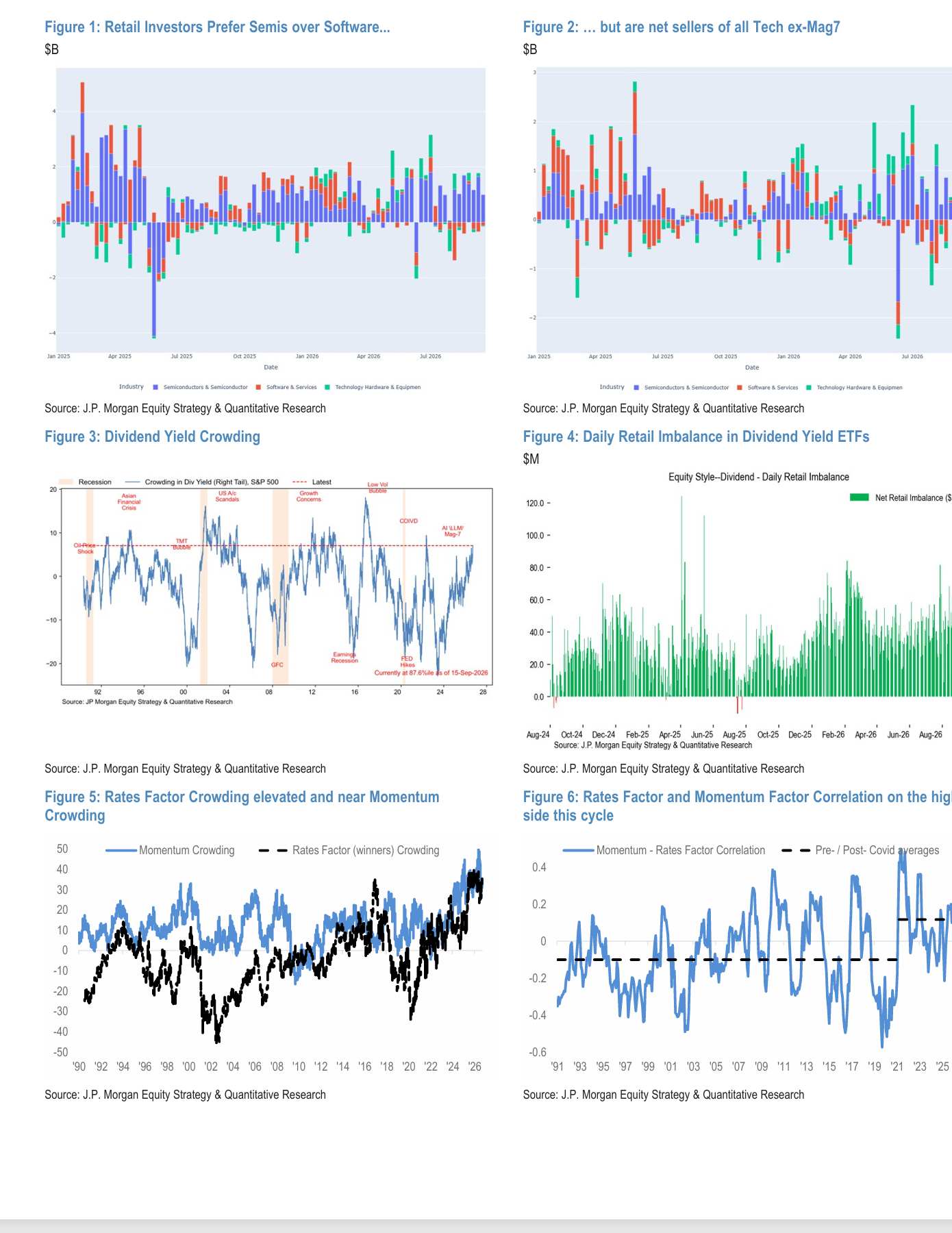
The latest retail capital flow data compiled by J.P. Morgan Chase shows that from September 10 to 16, the net inflow of retail capital was only 2.5 billion US dollars, which is about 63.2% lower than the average weekly average of 6.8 billion US dollars over the past 12 months; of these, ETFs had a net inflow of 3.1 billion US dollars and a net outflow of 600 million US dollars from individual stocks. The report placed the overall inflow intensity at the 2nd percentile in history, ETF inflows falling to a one-year low, and individual stock capital flows at the 12th percentile. Therefore, the most important market signal is “less incremental buying, more aggressive capital”: high oil prices, long-term interest rates, and AI security discussions suppress short-term risk appetite, yet core assets such as Nvidia can still attract net purchases.
On Thursday (September 17), the Philadelphia Semiconductor Index rose sharply by 3.1% after experiencing a short-term decline in oil prices and the fall in 10-year US Treasury yields to 4.93%, reflecting the resonance of marginal pressure relief on the interest/long-term US bond yield curve and strong recovery in investment confidence related to AI computing power after the Federal Reserve implemented interest rate hikes to fix the central bank's reputation against inflation.
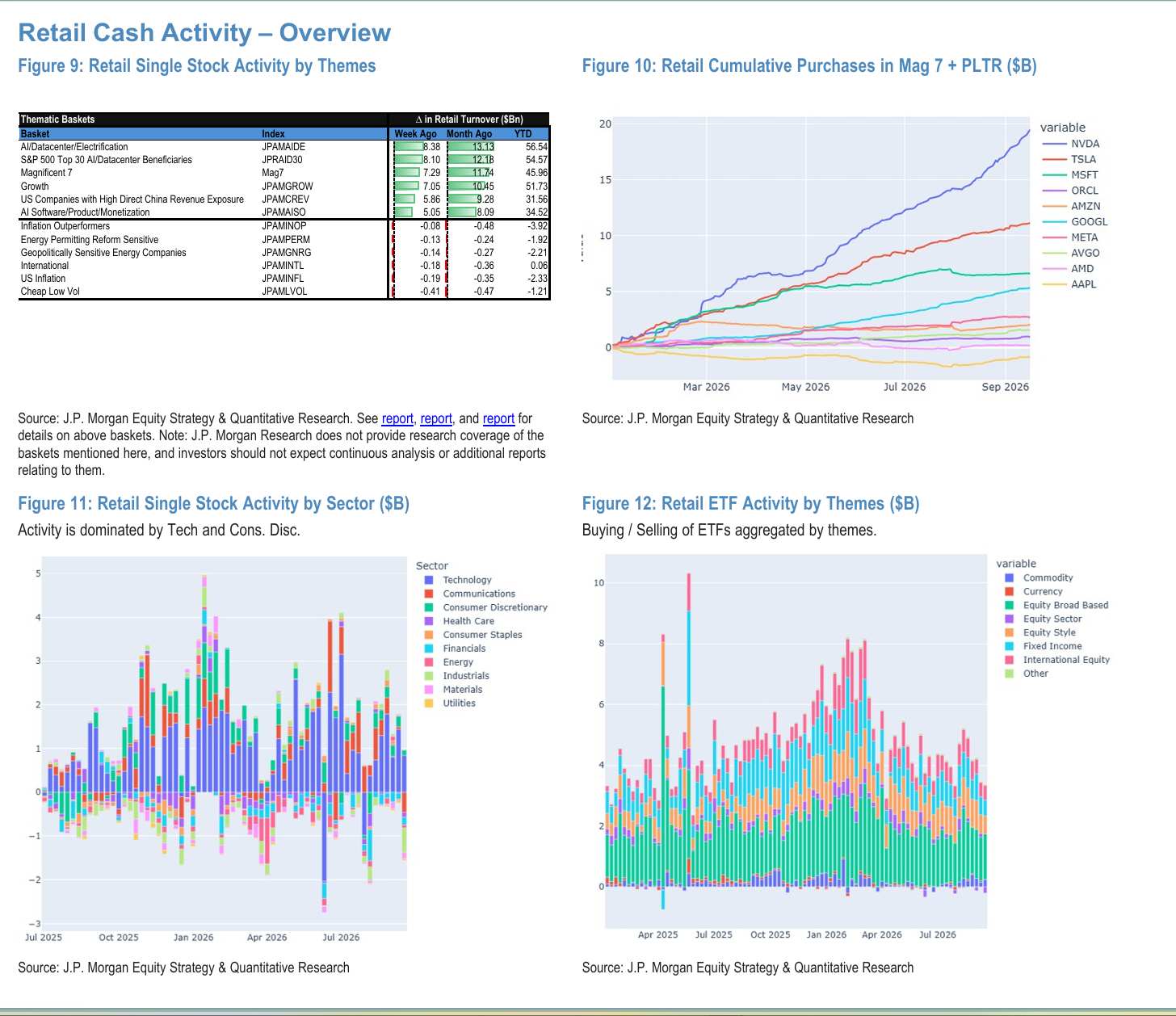
As far as the timeline is concerned, J.P. Morgan's “Retail Radar” was released on the eve of a major rebound in technology stocks in the global market, but it provided investors with a critical financial flow clue — that is, the overall market entry slowdown, but selective buying of AI core assets was not interrupted. In particular, the Big Seven in the US stock market (i.e. Magnificent Seven), including Nvidia and Google, still received a total net purchase of US$1,601 million, of which Nvidia had a monopoly of US$1,196 million, and AI computing industry chain leaders such as SanDisk, Asmack, and Oracle The forces also received net purchases of $202 million, $119 million, and $102 million, respectively.
This “total contraction and core undertaking” structure explains more than the general “retail withdrawal technology” why the AI theme still has a rebound basis: while reducing the overall exposure of non-Big Seven technology stocks, capital continues to select some companies that accelerate computing, storage, semiconductor equipment, and cloud infrastructure; the report also clearly records that topics such as the AI data center core infrastructure chain and electrification, major AI beneficiaries, and AI software commercialization are still being bought by retail investors.
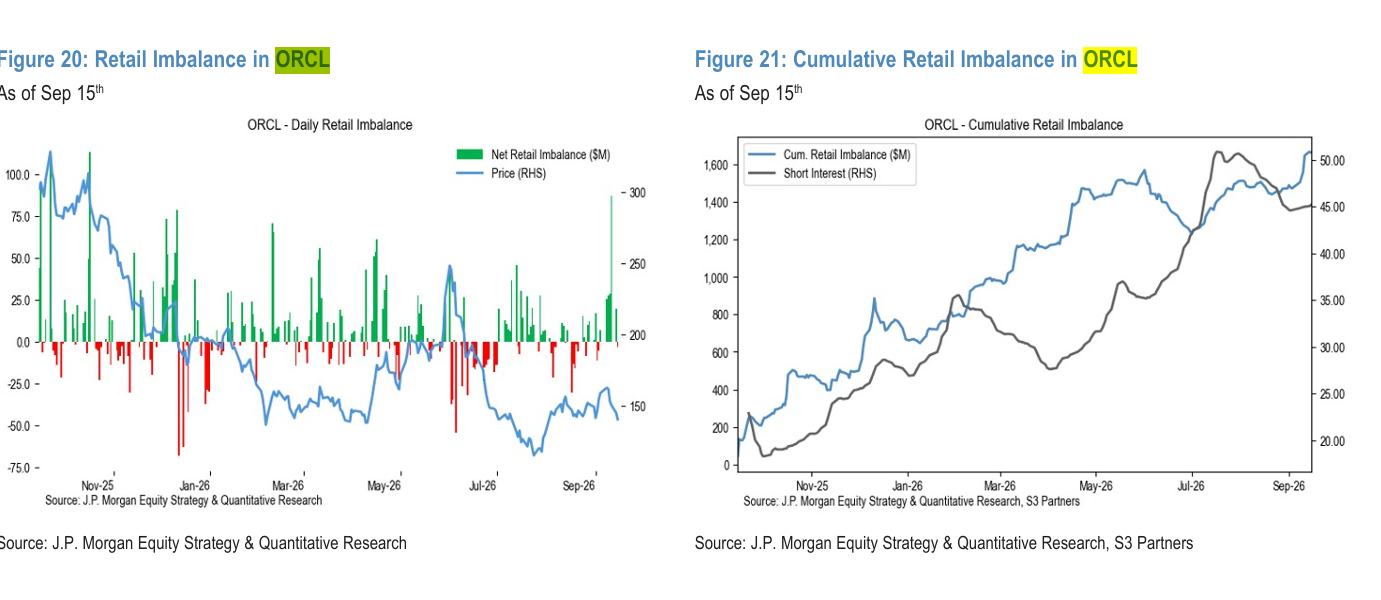
In particular, Oracle embodies the logic of “profit and order support underwriting”: its revenue increased 30% year over year, cloud computing-related infrastructure revenue increased by three digits, and remaining performance obligations increased by 26 billion US dollars month-on-month. Afterwards, it received a net purchase of 87 million US dollars in a single day from retail investors on September 11, highlighting that verifiable business growth can still attract capital into the market.
Combined with J.P. Morgan Chase's latest judgment that “when profits remain strong and geographical risk is under control, a light interest rate hike cycle and continued high long-term US bond yields can still be digested by the stock market”, one of the investment strategies that can be deduced is — when oil prices and long-term yields ease the pressure on valuations, AI computing power core assets that were previously supported by buying have a basis to participate in risk appetite correction. Providing a financial background for Thursday's rebound, market attention is also conditional to shift back from the impact of interest rate hikes to order, revenue, and profit fulfillment.
The pace of trading and sector flow together indicate that retail investors are simultaneously making defensive allocations and selective technology investments, rather than simply switching from technology as a whole to the defensive sector. In the last four trading days, retail investors were still net buyers of single stocks in the afternoon, but became net sellers in the afternoon. The main changes came from buying and reselling technology stocks other than the Big Seven, and the acceleration of sales of industrial stocks. In industry statistics excluding the Big Seven, essential consumption was the only sector with net purchases, with an amount of 11 million US dollars; the net outflow of industry, communications, and technology was 555 million, 493 million, and 405 million US dollars, respectively, while utilities and real estate were sectors with low net sales.
On the ETF side, industry ETFs had the third-largest weekly net outflow in history, mainly driven by technology products; however, broad-based large-cap ETFs still received net purchases of US$1.3 billion, precious metals ETFs received US$188 million, and demand for medium- to long-term bond ETFs also improved slightly. One phenomenon worth distinguishing is that the market is overcrowded with high-dividend strategies at close to a three-year high, yet retail inflows into dividend ETFs have declined.
At the same time, according to data compiled by J.P. Morgan Chase, the January rolling average of retail options transactions is still at the historical 96.8% level, indicating that participation in transactions is still very high, but there is a divergence between the intention to buy spot and the direction of the transaction.
From capital flow to profit realization: AI computing power infrastructure investment is shifting from general pursuit to selected superleader configurations
The specific purchase list shows that the capital not only continues to support the Big Seven, but also retains clear preferences in storage, semiconductor equipment, and cloud infrastructure. The retail capital flow data compiled by J.P. Morgan Chase shows the following (summary of the weekly retail fund flow from September 10 to 16):
The Big Seven all received net purchases: Nvidia $1,196 million, Tesla $201 million, Amazon $87 million, Apple $63 million, Google $25 million, Microsoft $19 million, and Meta $10 million, for a total of $1,601 million, of which Nvidia accounts for about 74.7%. In addition to the Big Seven, SanDisk (SNDK.US) received net purchases of US$202 million, ASML.US (ASML.US) of US$119 million, and Oracle (ORCL.US) of US$102 million. Together with Nvidia and Tesla, they formed the top five net purchases of the week; the top five net sales were SpaceX (SPCX.US) of US$249 million, Marvell (i.e. Maywell Technology, MRVL.US) of US$75 million, and NuScale Power ( SMR.US) $60 million and AMD (AMD.US) $52 million.
The report also clearly states that retail investors continue to buy the AI data center electrification industry chain, the core and main beneficiaries of AI and data center infrastructure, the Big Seven, growth stocks, and commercialization of AI software and AI applications, which can be described as fully highlighting that retail investors have not given up on AI, but have concentrated their purchases on the Big 7, as well as some of the most core and overall capital preferred companies in storage, equipment, and cloud platforms; there is an overall net outflow from the non-Big 7 technology sector, but that does not mean that every one of these companies has been sold.
The J.P. Morgan analyst team upgraded Meta to “Accumulation” (Accumulation), optimistic about its cutting-edge models, Muse agents, and model API services, and further expand AI commercialization from advertising to new products and revenue sources; in terms of cybersecurity, they are particularly optimistic about Okta, Palo Alto Networks, CrowdStrike, Varonis, and Zscaler. The core logic is that AI applications expand their attack surface, making security companies the infrastructure partners and security expenses of basic model companies More critical. Notably, retail investors are still net sellers of this security software portfolio as a whole, indicating that institutional fundamentals are not entirely consistent with short-term retail transactions.
Oracle, the leader in AI cloud computing power infrastructure, is an important example of a positive level of capital flow: the J.P. Morgan Chase report cites a 30% year-on-year increase in revenue, a three-digit increase in cloud infrastructure revenue, and a $26 billion month-on-month increase in remaining performance obligations (RPO), believing that these results will help respond to concerns about continued order growth, order conversion into revenue and subsequent financing; on September 11, retail investors made a net purchase of Oracle worth 87 million US dollars in a single day. Furthermore, on September 15, Skyworks and Qorvo received net purchases of 7.5 million US dollars and 400,000 US dollars respectively. The background is the news that the merger transaction between the two companies is expected to be completed within the year, and should not be directly classified as an AI computing power purchase.
The AI industry's financing, application, and delivery data provide a fundamental background for core assets to continue to receive attention, but they are additional evidence beyond observing capital flows. According to media reports, OpenAI is discussing new financing valued at over $1.2 trillion; Anthropic is preparing a potential IPO with a valuation of around $2 trillion and a maximum funding of $100 billion, which is expected to be the largest initial public offering in history — both are financing discussions or preparations.
On the specific AI application side, Astra enhances programming, browsing, computer operation, and complex workflow capabilities, broadening the range of tasks that AI can perform; OpenAI also confirmed that new registrations and upgrades to the $200 per month Pro 20X package will be suspended from September 10, and existing subscriptions will not be affected. On the procurement side, Anthropic has disclosed an agreement of up to 5 gigawatts with Amazon, a 5 gigawatt agreement with Google and Broadcom, 30 billion US dollars in Azure capacity, and 50 billion US AI infrastructure investments related to FluidStack.
On the delivery side of AI computing power infrastructure resources, Nvidia's data center revenue in the second quarter of fiscal year 2027 reached US$89 billion, up 117% year on year; South Korea's exports in August increased 68.7% year on year to US$98.26 billion, of which semiconductor exports reached US$46.65 billion. As of the beginning of September, cumulative exports for the full year had reached US$709.4 billion, exceeding the 2025 annual record. Judging from the investment logic, this data concretely implements “AI demand expansion” into application usage, capacity procurement, and hardware revenue to support the long-term growth of Nvidia, storage, and cloud infrastructure companies. This is why retail capital flows focus on reducing purchases in the short term and continue to select some of these core AI computing power investment targets.
The most notable increase at the technical level is that AI computing power resource requirements are expanding from centralized pre-training to post-training, continuous reasoning, and intelligent execution. This also helps to understand why funds are being re-screened within hardware and software.
Citing SemiAnalysis, J.P. Morgan Chase pointed out that the share of pre-training in the computing power allocation structure it discussed has fallen below 15%, and demand for terminal tokens has expanded, and post-training technology has also become an important direction for model capacity expansion; the decline in proportion describes structural changes and is not equivalent to a decrease in absolute computing power requirements. Based on the “Jevans paradox,” overall future AI demand will continue to expand due to declining computing power costs. Derived from the system architecture, user size, task frequency, call cycle, and context length together affect the total token processing capacity: prefill (prefill) requires processing input, decode (decode) continuously generates output, and key value cache (KV Cache) places requirements on video memory capacity and memory bandwidth; multi-tool intelligence also requires CPU execution programs, memory chip systems to provide data and cache bases, and high-performance Ethernet network devices to connect computing resources. AI data center optical interconnection/optical communication systems provide high-speed transmission modes between data, and the cloud The platform completed scheduling and on-site delivery of services.
This also basically forms a complete demand chain of “accelerated computing—memory and storage—infrastructure delivery—software commercialization,” and the Nvidia, SanDisk, Asmack, and Oracle purchases recorded in the J.P. Morgan Chase Money Flow Report each correspond to different aspects of it. Retail investors still selectively favor AI computing power and technology topics in their capital flows, but instead of chasing all AI labels indiscriminately, they continue to deploy bottleneck AI computing power industry chain companies that are critical to the core and part of the computing power theme when overall purchases cool down.