


The Zhitong Finance App learned that US stocks experienced a very happy rebound on Thursday — although just a day ago, the Federal Reserve had just completed its first rate hike since July 2023.
The three major stock indexes closed higher across the board. The S&P 500 index rose 1.1%, the Nasdaq Composite led by 1.7% increase, and the Dow Jones Industrial Average rose 316 points, or 0.6%. The Russell 2000 Index, which tracks small and medium capitalization stocks, closed up 0.5%. Of the 11 sectors of the S&P 500, 9 closed in an upward range, but the driving force was highly concentrated in technology stocks — Nvidia (NVDA.US), Amazon (AMZN.US), Microsoft (MSFT.US), Intel (INTC.US), and AMD (AMD.US) all recorded significant gains.
“Previously, the market predicted a rise in interest rates by the Federal Reserve, but now capital is starting to flow back,” said Robert Pavlik, senior portfolio manager at Dakota Wealth in Fairfield, Connecticut. “Now, many investors are taking advantage of the pullback to buy.”
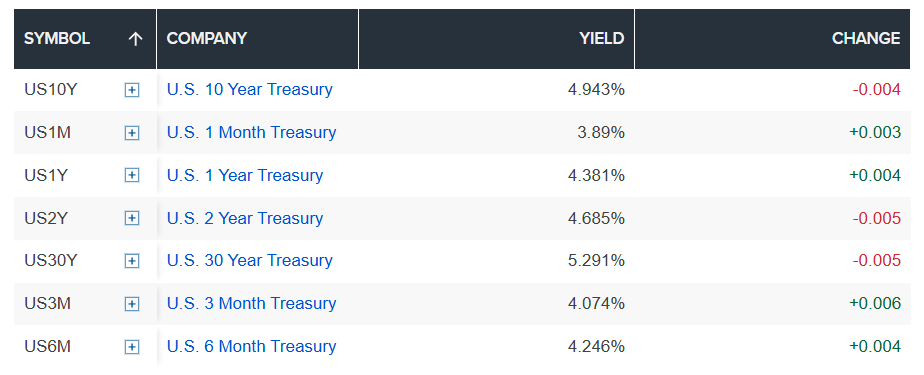
While stocks are rising, bonds are also rising — a rare situation after the Federal Reserve implemented a “hawkish” rate hike. The 10-year US Treasury yield fell to a minimum of 4.93% from 5.02% hit on Wednesday, and the 30-year yield fell from 5.36% to 5.27%. Meanwhile, U.S. crude oil once fell below $100 per barrel, for the first time since last Friday. This seemingly contradictory piece of good news appeared at the same time, constituting multiple narratives about “what is the market pricing after the interest rate hike is implemented”.
Oil prices are declining: geopolitical pricing is loosening
The most direct external impetus for this round of rebound came from the cooling of the crude oil market.
In Thursday's intraday session, US WTI crude oil fell below the $100 mark, and Brent crude hit a minimum of $101 — yet just two days ago, Brent was above $109. By the close, WTI's decline had narrowed, falling only 0.5% to $101.91, and Brent falling 0.9% to $104.82.
The two downward signs of oil prices resonated on the same day. First, there are reports that President Trump is expected to meet with the leaders of the six GCC countries during the UN General Assembly in New York next week to discuss the next steps in the Iran war. Trump himself told reporters, “I hope we are nearing the end of the war.” Second, Saudi Aramco is working to bypass the east-west oil pipeline section damaged by the attack, and plans to restore about half of its capacity within a few days, to transport 2 million to 2.5 million barrels of oil on the same day. The full restoration is expected to take about six weeks, but the news of “partial resumption of production” is enough to ease the market's most pressing anxiety about short-term supply cuts.
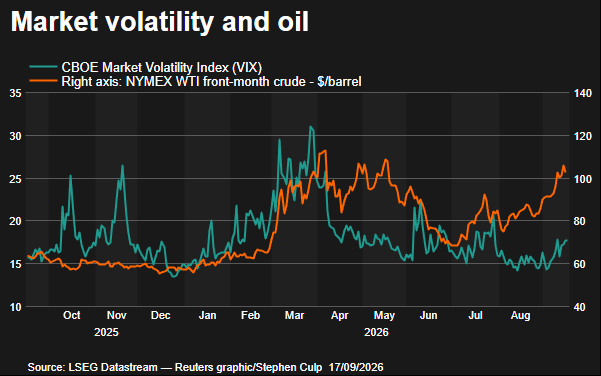
However, the absolute level of oil prices is still disturbing. Both WTI and Brent have accumulated gains of more than 70% since this year. The average retail price of gasoline in the US rose another 7 cents to $4.43 per gallon on Thursday, and the average price of diesel jumped 8 cents to $6.39, 93 cents higher than a month ago.
Baird investment strategy analyst Ross Mayfield described the oil price shock as “the only major headwind currently facing the global economy”. “When the oil price shock continues for so long, it will inevitably penetrate the price system of the entire economy. But any mitigation — good for consumers, good for business, can also make the Federal Reserve less hawkish”.
The “resurgence” of US Treasury yields
The bond market's reaction is also critical. In the context of the Federal Reserve's interest rate hike and the bitmap suggesting another rate hike during the year, the decline in US bond yields seemed to send a subtle signal: the cooling of uncertainty at the macro level made investors feel at ease, and at the same time, the hawkish tendencies of Walsh's press conference on Wednesday were gradually digested by the market.
Newly appointed US Federal Reserve Chairman Kevin Walsh showed a “restrained hawkish” attitude recognized by the market at his first press conference. Evercore ISI Vice Chairman Krishna Guha commented: “Walsh's press conference was clear, confident, and consistent on hawkish positions, but it didn't feel crazy.”
ABN-AMRO economist Rogier Quaedvlieg explained it from another perspective: Walsh “withstood pressure from the Trump administration and maintained the credibility of the Federal Reserve by fulfilling previous interest rate hikes.” Chris Zaccarelli, chief investment officer at Northlight Asset Management, put it more vividly — “Walsh got the needle through the lead and got it right.”
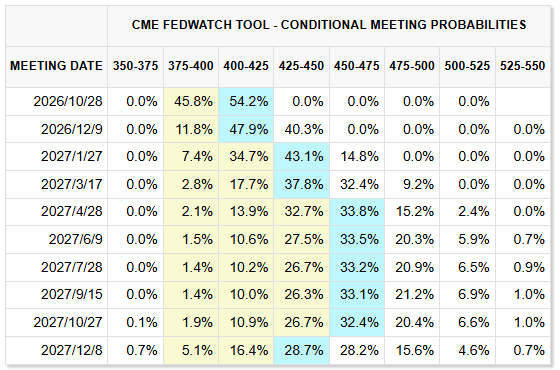
The market's pricing is also rapidly adjusting. According to CME's FedWatch tool, traders are currently pricing the probability of raising interest rates by another 25 basis points for the October meeting at about 54%, compared to only 27% a week ago. In other words, the market is indeed gradually accepting the reality that “the interest rate hike cycle is not over yet,” but in a gentle, orderly way — not panicking.
Overseas bond markets are also cooperating with this easing of sentiment. The Bank of England chose to keep interest rates unchanged at 3.75% on Thursday (passed by a 6-3 vote), while unexpectedly abandoning plans to sell long-term British treasury bonds, and instead said it would hold about £222 billion of treasury bonds due from 2026 to 2034 until maturity. This adjustment drove the yield on the UK 30-year Treasury note down 4 basis points to 5.82%, and the 10-year term to 5.262%.
Hwang In-hoon's “Doubling” Expectations: Emotional Healing in AI Narratives
In addition to macro-level benefits, there is also a more specific catalyst for leading the rise in technology stocks — Nvidia CEO Wong In-hoon said at an event convened by King Charles III of Scotland that he expects the company's chip sales next year to double that of this year.
“AI is making huge value contributions to different industries and different economies. You can see in almost every country where we do business, people want to invest in AI.” Hwang In-hoon said. At the same time, he pointed out that the current bottleneck is not demand, but Nvidia's ability to produce chips.
This statement did not come out of nowhere. Nvidia has previously predicted that the revenue growth rate for the fiscal year ending January 2028 will reach about 70%, with a revenue scale of about US$673 billion. Meanwhile, Hwang In-hoon revealed in the fall of last year that the company delivered 6 million Blackwell GPUs in four quarters. This statement of “doubling sales” has further strengthened the market's confidence in the sustainability of the AI infrastructure investment cycle.
A rebound or a reversal?
Thursday's market can easily give people the illusion that “the alarm has been lifted.” But a few factors are worth being wary of.
Jefferies's strategy research provides a less reassuring historical reference: one month after the first rate hike, the average return for the S&P 500 was negative 1.6%; after three months, the average return was negative 4.2%, the weakest performance of any period.
Jane Gibbons, the bank's stock strategist, said, “Looking back at the historical returns of the S&P 500 index during the interest rate hike cycle since 1983, interest rate hikes are unfavorable to stock market returns.”
The Huatai Securities Strategy Team analysis points out that there may be claims for a rebound in the market after the September rate hike is implemented, but the sustainability and flexibility of such a rebound is limited. The reason is that the nature of this round of interest rate hikes has changed: against the backdrop of employment data exceeding expectations and the Middle East conflict boosting energy prices, interest rate hikes can hardly be characterized as a “preventive” operation. It is more of a passive response to recent data. The risk of falling behind the curve is rising.
Morgan Stanley, J.P. Morgan Chase, and Goldman Sachs are relatively optimistic, believing that the current market has set prices for policy changes, corporate profits and economic growth are still the main factors supporting the stock market, and that a single rate hike will not necessarily change the mid-term direction of this round of market conditions.
Goldman Sachs pointed out in a research report that high interest rates are a headwind in the stock market, but they are not a force to end the bull market. As long as earnings growth remains strong and corporate balance sheets remain healthy, the US stock bull market will continue to have a solid foundation.
The tension between the two judgments essentially depends on a predetermined variable: how long oil prices remain high. If the US-Iran conflict makes substantial progress at the diplomatic level — Trump's meeting with Gulf leaders next week is an observation window — then inflation expectations may fall back, and the Federal Reserve's path to raising interest rates will be more moderate. Conversely, if oil prices continue to hover above $100 per barrel, the process of shifting high interest rates from a “risk situation” to a “benchmark situation” will continue to suppress valuations.
Three magic days superimposed: the market faced a liquidity test on Friday
But as far as tonight is concerned, Wall Street is preparing for possible fluctuations. On Friday, US stocks will usher in the quarterly “Three Witch Days”, that is, the three types of contracts for stock index futures, stock index options, and individual stock options expire at the same time.
According to Bluekurtic Market Insights, its historical performance can be described as notoriously poor. Data tracking performance since 2000 shows a fairly consistent trend: since 2012, the S&P 500 index has closed down 12 out of 14 “Three Witch Days.”
The only two exceptions during this period were in 2017 and 2025, respectively, when the index barely recorded marginal gains of 0.2% and 0.5%.
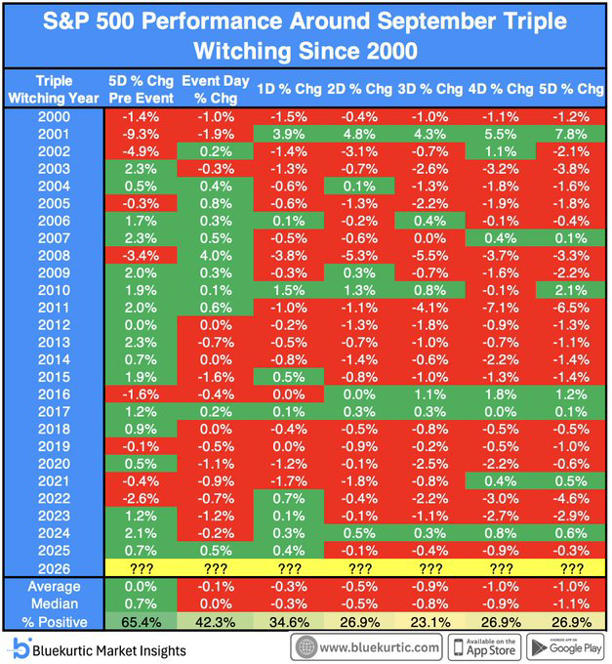
As more than $2 trillion of nominal delta options expire, market observers warned that this quarterly liquidity event could trigger downward fluctuations.
This upcoming expiration event comes at the time of the most challenging month for the stock market to perform in years. Although the S&P 500 has so far withstood these seasonal headwinds with an unusually calm 0.3% increase, Friday's large-scale expiration event could be the ultimate test to test this month's trend so far.